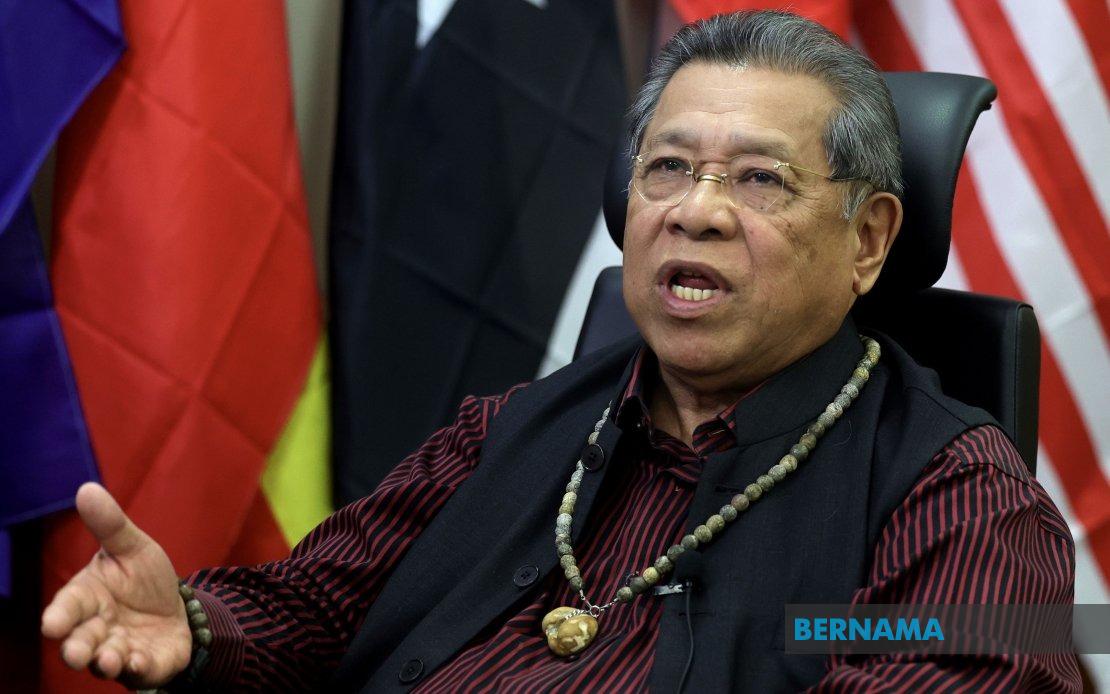
The prospect of accelerated development in Sabah has received backing from United Sabah National Organisation (USNO) president Tan Sri Pandikar Amin Mulia, who highlighted the strategic importance of elevated federal investment in the state. Speaking during the 2026 PKR National Congress in Melaka, Pandikar Amin underscored how the injection of additional resources would translate into tangible infrastructure and social initiatives benefiting Sabahans across multiple sectors.
Federal funding flowing to Sabah has experienced significant expansion under the current administration, with allocations climbing to RM17.6 billion in 2026 compared to RM13 billion in 2022—a 35 per cent jump over the four-year period. This escalation reflects a deliberate policy reorientation towards strengthening state-level development in Sabah, one of Malaysia's largest and most resource-rich territories. The magnitude of this increase positions Sabah to undertake projects previously constrained by budgetary limitations, potentially addressing longstanding infrastructure deficits in rural connectivity, healthcare delivery, and educational facilities.
Pandikar Amin's remarks carry particular weight given USNO's foundational role in Sabah politics and its alignment with the federal coalition. His public endorsement suggests consensus among key Sabahan stakeholders regarding the appropriateness of the funding trajectory. Beyond immediate state benefits, he framed the investment as contributing to broader national economic momentum, a framing that reflects how regional development increasingly intersects with Malaysia's international competitiveness and long-term growth prospects in an increasingly competitive Southeast Asian landscape.
Prime Minister Datuk Seri Anwar Ibrahim leveraged his PKR congress address to defend the government's fiscal allocation methodology against allegations of regional disparities. The Premier argued that budget distributions vary according to each state's specific priorities and developmental requirements rather than representing uniform cutbacks or preferential treatment. This rationale acknowledges that resource allocation in federal systems requires differentiated approaches reflecting demographic size, infrastructure maturity, and sectoral opportunities unique to each jurisdiction.
For Sabah specifically, the budgetary augmentation arrives at a critical juncture as the state seeks to modernise transport networks, expand digital connectivity to underserved communities, and enhance healthcare infrastructure following pandemic-related strains. The additional RM4.6 billion injection over the four-year cycle provides substantial headroom for executing multi-year capital projects that have accumulated in development pipelines. Whether directed towards port expansion, agricultural value-chain development, or human capital investments, the funds carry potential to reshape Sabah's economic trajectory beyond extraction-dependent models.
The timing of this financial boost coincides with heightened regional competition for foreign direct investment and talent retention across Southeast Asia. Malaysian states increasingly compete for comparable resources, making transparent allocation frameworks essential for maintaining political cohesion. Pandikar Amin's framing of the Sabah allocation within a national development narrative suggests efforts to position increased state funding not as wealth redistribution but as strategic investment in underutilised economic potential.
Critically, the efficacy of these enhanced allocations hinges upon implementation quality and project prioritisation. Historical Malaysian experience demonstrates that budgetary provision alone does not guarantee developmental outcomes; institutional capacity, project planning rigour, and accountability mechanisms determine whether allocations translate to concrete improvements in service delivery and living standards. The state government's ability to rapidly absorb these resources while maintaining quality standards will substantially influence whether the 35 per cent increase delivers promised benefits or results in delayed, inefficient expenditure.
Pandikar Amin's explicit confidence in Prime Minister Anwar Ibrahim's continued leadership carries implications extending beyond fiscal matters into coalition stability and federal-state dynamics. His public statement reflects political calculations regarding USNO's positioning within the broader federal alliance architecture and serves as an indicator of how Sabah-based coalition partners perceive government performance and future prospects. Such institutional endorsements matter considerably in Malaysian federal politics where state-level coalitions wield substantial leverage in elections and parliamentary arithmetic.
The broader context involves managing expectations across Malaysia's thirteen states regarding equitable resource distribution. Federal governments inevitably face pressure from all states seeking increased allocations, creating zero-sum political dynamics. The articulation of principled allocation criteria—developmental priorities, infrastructure gaps, population considerations—attempts to move budget discussions from raw political bargaining toward merit-based frameworks. Whether such approaches succeed or yield to factional pressures remains an open question shaping Malaysian federalism's trajectory.
Looking forward, the ultimate test of this budgetary commitment lies in observable developmental outcomes: infrastructure completion rates, service delivery improvements, and economic indicators measuring Sabah's competitive positioning. The 35 per cent allocation increase represents policy intention; translating intention into sustained, widely-distributed benefits requires sustained administrative focus and political will across multiple governmental levels and electoral cycles.

