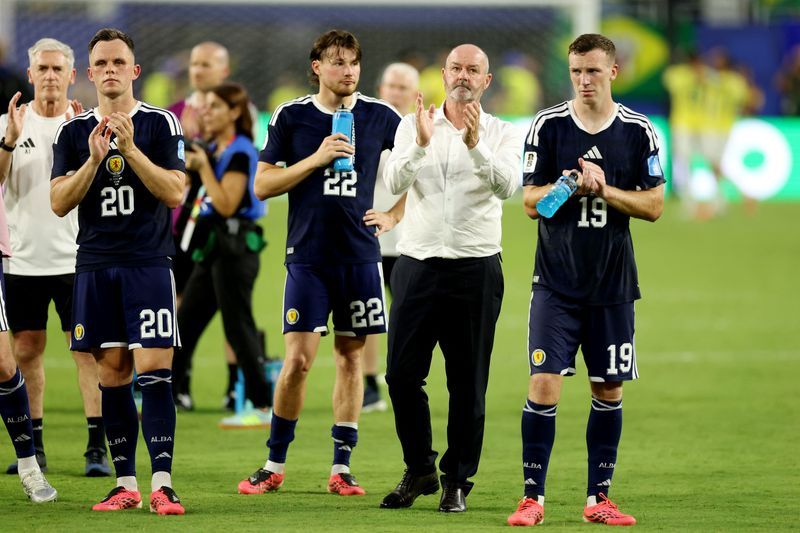
Scotland's participation in their first World Cup in 28 years is on the verge of ending in disappointment after succumbing to a 3-0 defeat against Brazil in their Group C finale on Wednesday. The heavy loss has left Steve Clarke, the national team coach, with little optimism about his squad's prospects of advancing through the tournament, despite technically retaining a mathematical chance of progressing as one of eight third-placed teams across the 12 groups.
While Scotland's three points from their opening matches theoretically keeps them in contention for the knockout stages, Clarke has already begun accepting the likely outcome of their departure. The coach's pessimism stems from an assessment that even the sixth-best record currently held by his side will be overtaken by multiple teams before the group stage concludes, with 20 further matches still to be played across competing pools. His resignation to the outcome reflects a pragmatic reading of the mathematics rather than any defeatist mentality, suggesting that Scotland's path to advancement remains extraordinarily narrow.
The defining narrative of Scotland's collapse against the five-time World Cup champions was not the quality of Brazil's attacking prowess but rather the fundamental defensive vulnerabilities that Clarke's team repeatedly exposed. In his post-match assessment, the Scottish manager drew a clear line between what his opponents accomplished through superior finishing and what his own players handed them through careless play. Clarke emphasised that Brazil capitalised ruthlessly on the openings Scotland created, suggesting that at this elite level of competition, such generosity in possession and positioning carries inevitable punishment.
Clark's analysis of the first two goals conceded—which he indicated Scotland essentially provided through poor defensive organisation—underscores a troubling pattern that has characterised the Scots' tournament campaign. The acknowledgment that Brazil may well have earned the third goal through straightforward superiority rather than Scottish error does little to soften the blow of a performance that fell measurably short of expectations. However, Clarke did offer some mitigation by noting that Brazil's goalkeeper faced several testing moments courtesy of Scotland's attacking contributions, and that goalkeeper Angus Gunn made important saves to prevent the margin from becoming even more lopsided.
Despite the manifest disappointment in his tone, Clarke resisted the temptation to direct anger toward the players who achieved the considerable feat of qualifying for the tournament in the first place. His frustration was directed instead at the gap between his team's demonstrated capability and their actual execution against elite opposition. The coach's perspective that the squad failed to operate at the levels they are genuinely capable of achieving speaks to a deeper concern than simple defeat—it suggests that Scotland possessed the potential to compete but did not perform to that standard.
Clark's comments following the Brazil match extended beyond the immediate tactical failings to address systemic weaknesses within Scottish football itself. The coach highlighted the physical intensity, power, and technical proficiency of both Morocco and Brazil as markers against which Scotland's development pathway must be measured. This acknowledgment that the nation's youth development system requires substantive improvement resonates particularly strongly in Southeast Asia, where emerging football nations continue to invest heavily in long-term player development infrastructure to compete with established football powers.
The coach's frustration with the structural underpinnings of Scottish football development reflects a broader challenge facing smaller football nations attempting to produce players capable of thriving on the world stage. Clarke's implicit suggestion that Scotland must enhance its player development mechanisms—creating pathways for young talent to acquire the physical and technical attributes demanded by elite football—points to strategic investment areas that many regional football associations similarly grapple with. The challenge of producing young players who can genuinely grace international competitions represents a constant preoccupation for nations outside the traditional football establishment.
Clark's comments regarding Scotland's travelling supporters revealed an interesting tension within his perspective. While clearly appreciating the Tartan Army's infectious enthusiasm and excellent representation of the country throughout the tournament, he appeared anxious that the positive atmosphere should not obscure a fundamental truth: the team's qualification itself deserved primary recognition. His intervention was notably diplomatic, ensuring that players received due credit for delivering what the fans ultimately came to experience rather than allowing the focus to shift entirely toward the supporters' celebrated conduct and enjoyment.
The coach's reminder that the very existence of Scottish support at the World Cup in America depended entirely on the current group of players' competitive achievements carries implicit weight in a nation that has endured a 28-year drought without World Cup participation. Clarke's invocation of the alternative scenario—supporters watching from their sofas as the World Cup proceeded without Scotland's involvement—effectively contextualised the players' achievement in qualifying while simultaneously underlining the magnitude of their tournament disappointment. The gap between the accomplishment of qualification and the reality of early elimination illustrates the ruthlessness of international football competition.

