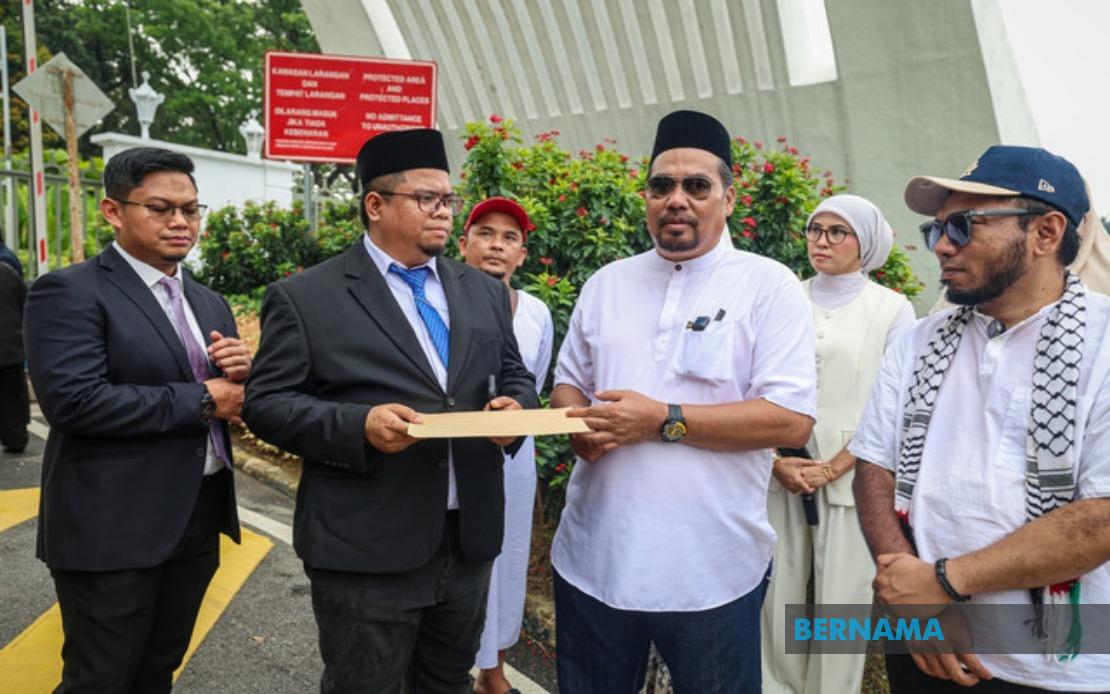
Malaysia's social media activist collective SEKPUR has escalated pressure on the government to prosecute those implicated in financial mismanagement at Tabung Haji, the nation's premier Islamic pilgrimage savings institution. The group staged a peaceful demonstration at Parliament's main gates on August 11, presenting a formal memorandum to political leadership that underscores growing public impatience with accountability mechanisms at the embattled institution. The submission came as lawmakers gathered for a special parliamentary sitting dedicated to examining findings from a comprehensive Royal Commission of Inquiry into TH's operational and governance failures.
SEKPUR's secretary, Mohd Yani Alias, conveyed the memorandum through Zairudin Hashim, press secretary to the Minister in the Prime Minister's Department (Religious Affairs), specifying that the document reach Minister Senator Dr Zulkifli Hasan. In doing so, SEKPUR positioned its grievance at the apex of the government apparatus, signalling that the group views TH's difficulties as demanding intervention at the highest administrative levels. The tactical timing of the protest—coordinated with Parliament's session on the matter—ensured maximum political visibility and forced elected representatives to confront constituent demands for justice.
The memorandum's central thesis reflects a non-partisan stance that has become characteristic of activist discourse in Malaysia's contemporary political landscape. SEKPUR's leadership declared that regardless of individual identity or party affiliation, anyone found culpable in TH's tribulations must face prosecution and proportionate penalties. This rhetorical commitment to impartiality proved significant, as it preempted accusations of political opportunism and framed accountability as a moral imperative transcending factional interests. The group emphasised that Tabung Haji functions as communal property stewarded on behalf of Malaysia's Muslim and Malay communities, placing mismanagement in the category of breach of public trust rather than mere administrative failure.
The immediate catalyst for SEKPUR's action was the publication on July 29 of a 211-page Royal Commission of Inquiry report documenting institutional weaknesses spanning the 2014 to 2020 period. This comprehensive examination identified systematic governance failures and operational deficiencies that contributed to TH's deteriorating financial position. The report's findings validated years of public concern about the institution's trajectory and provided empirical grounding for activist demands. Significantly, the RCI appended 25 specific recommendations for remedial action, and TH management reported that roughly 75 per cent of these recommendations had been implemented by July 30—a compliance rate that SEKPUR and other observers viewed as insufficient given the severity of revealed problems.
Beyond accountability for past transgressions, SEKPUR articulated concerns extending into TH's structural and operational future. The memorandum highlighted anxieties regarding the institution's long-term fiscal resilience and its capacity to provide competitive hibah distributions—the periodic dividend payments returned to depositors that constitute a crucial incentive for participation in the savings scheme. These distributions had been compressed during TH's financial distress, eroding the relative attractiveness of TH deposits compared to conventional banking alternatives. SEKPUR's inclusion of this concern signalled that the group understood the interconnection between governance failures, financial recovery, and the ability to restore depositor confidence.
The memorandum additionally pressed government to confront escalating haj expenses that have become an increasingly burdensome obstacle for ordinary Malaysians aspiring to perform the Islamic pilgrimage. TH functions as the primary institutional conduit through which Malaysian Muslims access haj arrangements, making cost inflation at the organisation a matter of acute public consequence. SEKPUR's critique on this dimension reflected broader frustration that TH's management crisis was compounding economic hardship for constituents already navigating inflationary pressures in their household budgets.
Transparency in haj quota administration emerged as another focal point within the memorandum. The allocation and management of quotas—which determine how many Malaysians can perform haj annually and in which order prospective pilgrims proceed—represents an area where clarity and procedural integrity prove essential for public legitimacy. SEKPUR's insistence on enhanced transparency acknowledges that quota systems carry significant patronage potential and that opacity invites suspicion of preferential treatment. By highlighting quota governance, the activist group signalled comprehension that institutional reform must extend beyond financial restitution to encompass procedural fairness in core functions.
The special Dewan Rakyat sitting that occasioned SEKPUR's protest provided parliament with an occasion to deliberate TH's trajectory and government's restorative strategy. The briefing delivered by Minister Senator Dr Zulkifli Hasan offered the cabinet's official assessment of institutional challenges and remedial measures undertaken. However, parliamentary debate on TH typically reveals tensions between government assertions of competent management and opposition demands for more aggressive intervention. SEKPUR's memorandum effectively inserted civil society into this deliberative space, insisting that the court of public opinion—represented through activist mobilisation—held the government accountable for tangible progress rather than procedural compliance.
The Yang di-Pertuan Agong's earlier directive that those culpable in TH's mismanagement face justice provided SEKPUR with authoritative justification for its demands. By invoking the constitutional monarch's decree, the activist group connected its campaign to the highest symbolic authority in the Malaysian state, thereby elevating the moral weight of its claims and making it politically costly for government to appear dismissive of accountability imperatives. This strategic invocation of royal authority represented sophisticated political communication within Malaysia's constitutional framework.
SEKPUR's intervention also reflected broader patterns of civil society mobilisation regarding governance failures in Malaysia. The group's emergence as a vocal stakeholder in the TH discourse demonstrated how social media platforms and organised activism outside traditional party structures have become consequential forces in domestic political contestation. Rather than confining grievances to ballot-box expressions, SEKPUR pursued direct engagement with political decision-makers through public demonstration and formal memorialisation of demands.
The response of Minister Senator Dr Zulkifli Hasan to the memorandum and the broader parliamentary discussion would determine whether government would pursue prosecutions aggressively or favour administrative remedies. The tension between these approaches—criminal accountability versus institutional reorganisation—looms large in Malaysia's reckoning with TH's crisis. SEKPUR's unambiguous demand for prosecution reflected activist conviction that administrative measures alone could not satisfy justice imperatives or restore public confidence in an institution whose failures had directly diminished Malaysians' savings and pilgrim aspirations.

