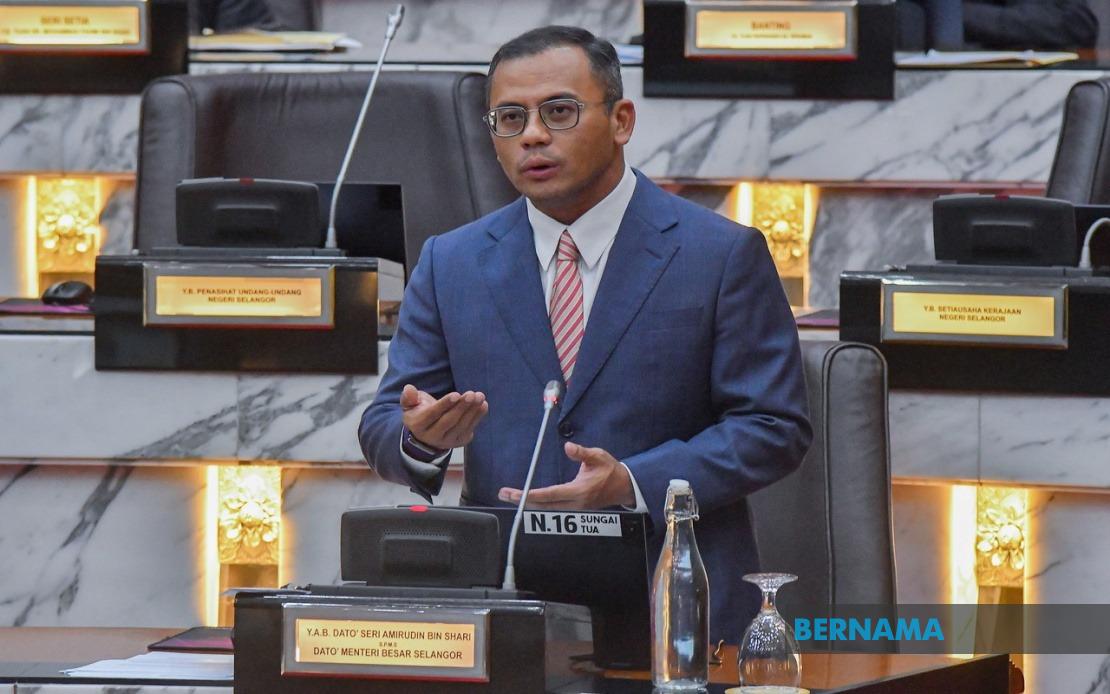
Selangor's Menteri Besar Datuk Seri Amirudin Shari has issued a directive to all local authorities across the state to thoroughly examine gaps in public transport accessibility, signalling a coordinated push to address longstanding concerns about first-mile and last-mile connectivity that have increasingly featured in public discourse. The announcement, made during the winding up of the Selangor Resilience Strengthening Package debate in the State Legislative Assembly, represents an acknowledgment that fragmented transit networks continue to impede the broader mobility objectives of the state government, which has prioritised increased public transport usage as a cornerstone of its development strategy.
The Menteri Besar underscored the state government's commitment to allocating supplementary budgetary resources to enhance the physical infrastructure surrounding public transport nodes, emphasising improvements to pedestrian walkways, safety features, and access routes that would make commuting less cumbersome for residents. His remarks were prompted by concerns raised by Danial Al-Rashid Haron Aminar Rashid, the assemblyman for Batu Tiga, who highlighted deteriorating connectivity between the LRT3 network and adjacent neighbourhoods—a complaint that had gained considerable traction on social media platforms including X and Threads. The virality of these grievances appeared to underscore the Menteri Besar's broader frustration with the reactive nature of local authority responses to infrastructure deficiencies.
Central to Amirudin's critique was his assertion that local authorities must adopt a proactive stance rather than remaining passive until community complaints escalate and spread across digital platforms. He advocated for closer engagement with council members and other stakeholders as a means of identifying and resolving connectivity problems before they reach crisis levels of public visibility. This emphasis on institutional culture and responsiveness reflects a recognition that public transport infrastructure extends beyond vehicles and railway lines—the gap between formal transit systems and the lived experience of commuters depends significantly on how well local administrators anticipate and address accessibility challenges.
The state government has tasked Ng Sze Han, the chairman of the Investment, Trade and Mobility Committee, with orchestrating a comprehensive dialogue with all public transport operators functioning within Selangor. This initiative aims to develop detailed service mapping that will pinpoint geographical and temporal gaps in coverage, creating a data-driven foundation for policy intervention. The mapping exercise represents a shift toward evidence-based planning, moving beyond anecdotal complaints to construct a systematic understanding of where and when the public transport network fails to serve commuters adequately.
A particularly nuanced dimension of the Menteri Besar's remarks concerns the relationship between state subsidies, operator behaviour, and consumer choice. Amirudin acknowledged that subsidies can reduce operational costs for transport providers, yet stressed that financial support alone cannot resolve connectivity deficiencies if operators continue to limit service hours or inadequately coordinate schedules. This observation touches on a persistent challenge in public transport governance: subsidies represent necessary but insufficient interventions if underlying structural and operational problems persist. Without concurrent improvements to service frequency, scheduling, and coverage patterns, even generous financial assistance may fail to shift commuter behaviour away from private vehicles.
The underlying tension identified by the Menteri Besar reflects a fundamental principle of transit economics: accessibility comprises both the availability of transport options and the practical feasibility of reaching those options. A resident living two kilometres from an LRT station faces a last-mile problem that financial incentives alone cannot overcome if pedestrian infrastructure is inadequate or unsafe. Similarly, a commuter might avoid public transport if service hours force inconvenient waiting periods or unreliable connections between transit modes. The state's recognition that subsidies must be paired with infrastructure investment and operational discipline suggests a more sophisticated understanding of the barriers that deter public transport adoption.
For Malaysian policymakers and urban planners beyond Selangor, the Menteri Besar's framework offers an instructive template. Public transport systems across the country often suffer from incomplete integration between modes and poor connectivity to residential areas, creating persistent inefficiencies that undermine ridership. The Selangor approach—combining service mapping, operator coordination, infrastructure investment, and local authority accountability—addresses these systemic issues through multiple complementary channels rather than relying on single interventions. This holistic methodology aligns with international best practices in transit planning, where successful systems invariably involve sustained coordination between government agencies, operators, and local authorities.
The emphasis on first-mile and last-mile connectivity is particularly pertinent for Southeast Asian cities, where rapid urban sprawl and mixed-use development patterns create complex accessibility challenges. Unlike mature transit systems in developed nations, many regional cities lack the comprehensive feeder networks required to make high-capacity transit corridors genuinely accessible to broad populations. Selangor's initiative to systematically map and address these gaps potentially offers lessons for other Malaysian states and neighbouring jurisdictions confronting similar problems.
The Menteri Besar's frustration with authorities responding only to social media complaints suggests deeper concerns about governance effectiveness and institutional proactivity. The observation that local authorities should listen to council members and stakeholders rather than waiting for viral posts underscores the importance of structured engagement mechanisms and feedback channels that allow problems to surface and be addressed before escalating into public crises. This governance imperative resonates throughout Southeast Asian administration, where responsiveness and institutional learning remain ongoing challenges in rapidly urbanising regions.
The directive's emphasis on cost-effectiveness—ensuring that improvements help advance mobility goals without unnecessary expense—reflects fiscal constraints that shape policy-making across the Malaysian public sector. The state government must balance ambitions for enhanced connectivity against budgetary limitations, making efficiency gains through better coordination and planning essential complements to direct infrastructure investment. This practical constraint underscores why the proposed service mapping and operator coordination exercises represent particularly valuable interventions: they can identify optimisation opportunities requiring minimal additional expenditure.
Implementation of these recommendations will require sustained political attention and institutional discipline over months and years rather than weeks. The success of the mapping exercise depends on the quality of data collection and analysis, the willingness of operators to engage honestly about operational constraints, and the commitment of local authorities to translate findings into concrete improvements. Measuring progress will be crucial—public statements about connectivity improvements require objective performance metrics to demonstrate whether initiatives genuinely expand accessibility or merely create an appearance of action.
Looking forward, the Selangor initiative represents an important acknowledgment that public transport systems function as integrated ecosystems where formal transit networks, local authority infrastructure, operator behaviour, and commuter experience remain deeply interconnected. Addressing connectivity deficiencies requires orchestrated action across multiple institutional actors and policy domains rather than siloed interventions. For residents across Selangor reliant on public transport, particularly lower-income households without access to private vehicles, the success of these coordination efforts carries direct implications for their mobility, economic access, and urban livability.

