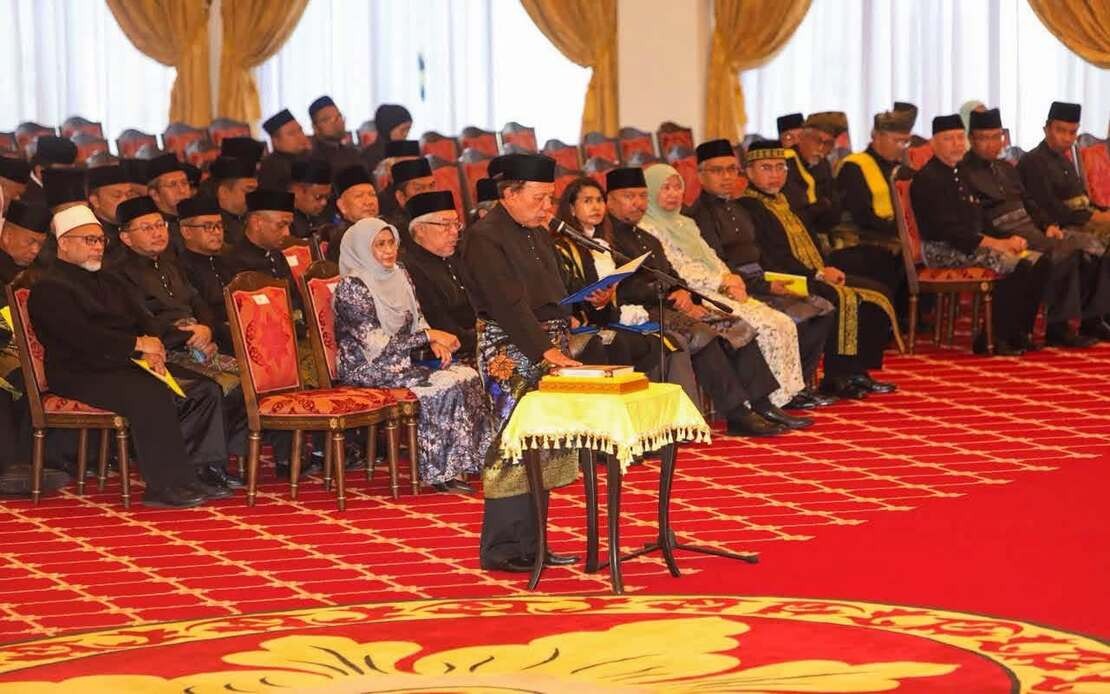
Malaysia's top government officials have rallied behind the newly appointed Menteri Besar of Negeri Sembilan, Datuk Ismail Lasim, signalling unified federal support for the central state's fresh leadership chapter. The 67-year-old Juasseh assemblyman was formally sworn in before the Yang Dipertuan Besar of Negeri Sembilan, Tuanku Muhriz Tuanku Munawir, at the Balairong Seri of Istana Besar Seri Menanti, cementing his ascension to one of Malaysia's most significant state executive positions.
Deputy Prime Minister Datuk Seri Dr Ahmad Zahid Hamidi, who additionally serves as Rural and Regional Development Minister, extended his public congratulations through social media, framing the appointment as both an honour and a substantial test of leadership capability. Zahid characterised the responsibility entrusted to Ismail as considerable, while simultaneously expressing confidence in the new Menteri Besar's capacity to discharge his duties effectively. His remarks emphasised the collective nature of governance, suggesting that federal-state cooperation would remain essential for advancing Negeri Sembilan's agenda under the new administration.
Defence Minister Datuk Seri Mohamed Khaled Nordin similarly offered his felicitations, focusing his remarks on the continuity of development momentum within the state. Mohamed Khaled's message stressed that the incoming leadership would need to sustain the progress already achieved while ensuring the state remains stable and prosperous. His reference to "shared prosperity" carried broader implications about inclusive growth and equitable distribution of development benefits across Negeri Sembilan's diverse communities. The Defence Minister invoked divine guidance in his formal blessing, a customary practice in Malaysian official communications that underscores the intersection of governance and faith.
Plantation and Commodities Minister Datuk Seri Dr Noraini Ahmad characterised Ismail's appointment as a watershed moment for the state, positioning his tenure as a gateway into a new developmental phase. Her statement reflected official optimism about institutional renewal and the potential for fresh policy directions under the incoming administration. By describing the appointment as significant, Noraini acknowledged both the symbolic weight of leadership transitions and the practical implications for state governance and resource allocation moving forward.
Ismail brings to the office nearly three decades of continuous political engagement within Negeri Sembilan's state assembly, a tenure that commenced when he first secured election as a state representative in 1999. This extended involvement has positioned him as a figure deeply embedded within the state's political architecture and community networks, a factor the federal ministers emphasised as assurance of his suitability. His longevity in electoral politics stands in contrast to several other state leaders, suggesting stability in institutional knowledge and existing relationships with local stakeholders.
The new Menteri Besar's prior executive experience adds substantive weight to his appointment. He previously served in the state's executive council across three consecutive terms concluding in 2018, beginning his Exco tenure in 2004. Throughout this fourteen-year period, he held responsibility for the education portfolio, a sector fundamental to human capital development and long-term competitiveness. His work encompassed policy formulation and implementation across educational development initiatives, suggesting a technical grasp of governance mechanics and bureaucratic processes.
The education portfolio assignments during his earlier tenure carry particular significance for understanding what Ismail may prioritise in his new role as chief executive. Educational policy intersects with employment readiness, economic competitiveness, and social mobility—domains that directly influence a state's development trajectory. His experience in shepherding education policies through implementation suggests familiarity with the complexities of translating political commitments into operational reality, a capability essential for any chief minister managing competing priorities and limited resources.
Negeri Sembilan occupies a strategically important position within Malaysia's economic and political geography, serving as a gateway between the Klang Valley and the southern regions while hosting significant industrial and agricultural operations. The state's fiscal health and developmental pace carry implications beyond its borders, affecting regional connectivity and economic integration. The federal government's visible support for Ismail's leadership, articulated through ministerial congratulations, signals continuity in federal-state collaboration and suggests alignment between the incoming state administration and national policy directions.
The ceremonial nature of the swearing-in before the Yang Dipertuan Besar underscores the constitutional foundations of Malaysian federalism, where state rulers retain ceremonial and custodial roles within their domains. This formal investiture, coupled with senior federal minister endorsements, establishes Ismail's administration within both the constitutional architecture and the political networks essential for effective governance. The involvement of traditional institutions alongside modern political structures reflects Malaysia's distinctive constitutional settlement combining monarchy, federalism, and representative democracy.
The timing of these ministerial congratulations, released contemporaneously with Ismail's swearing-in, reflects coordinated federal-level messaging designed to project governmental cohesion and institutional confidence. In Malaysia's political system, such ceremonial support from senior federal figures carries practical implications for resource allocation, priority setting in federal-state negotiations, and bureaucratic responsiveness. The emphasis by multiple ministers on stability, progress, and shared prosperity suggests a federal-level preference for evolutionary rather than revolutionary change in Negeri Sembilan's governance approach.
For Malaysian observers monitoring state-level politics and federal-state relations, Ismail's appointment and the accompanying ministerial endorsements indicate an attempt to maintain institutional continuity while introducing fresh leadership. His extensive background in Negeri Sembilan politics, combined with explicit federal support, positions him to navigate the complex interplay between state autonomy and federal coordination that characterises Malaysian federalism. The success of his administration will partly depend on translating the goodwill expressed by senior ministers into tangible benefits for Negeri Sembilan's residents across education, economic development, and infrastructure sectors.

