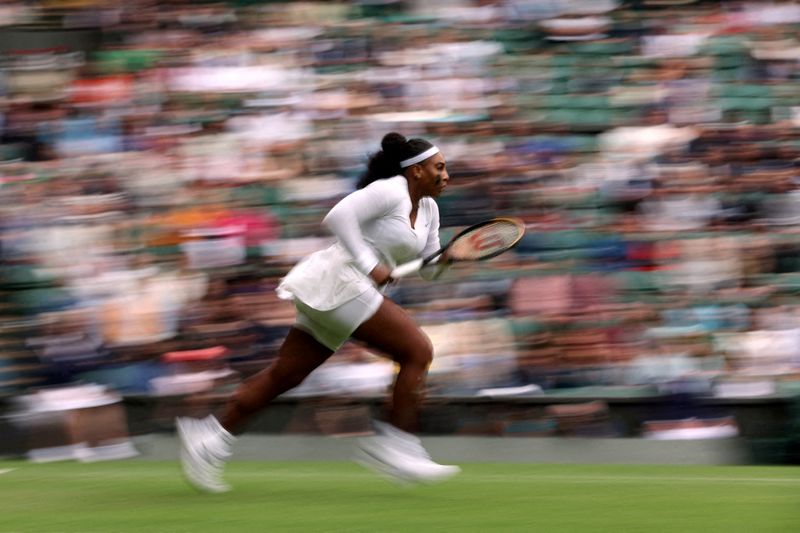
Serena Williams' return to professional tennis at Wimbledon next week has fundamentally altered the narrative surrounding this year's women's championship, overshadowing what was already shaping up as one of the most competitive and unpredictable tournaments in recent memory. The 44-year-old American icon, a seven-time Wimbledon singles champion, will make her first competitive appearance since the 2022 U.S. Open, and her presence alone has captured global sporting attention in a way that transcends the traditional tennis calendar. Her comeback arrives a full decade after her last Wimbledon title, yet the magnetism she commands remains undiminished, promising to drive television viewership to stratospheric levels and dominate social media discourse throughout the fortnight.
The women's draw heading into the championship was already fractured among multiple contenders, each carrying legitimate aspirations of lifting the trophy. World number one Aryna Sabalenka seeks redemption after a shocking collapse at Roland Garros, where she surrendered the last ten games consecutively in the quarter-finals from a position of strength. The Belarusian powerhouse, ranked first since October 2024, arrives as the tournament favourite, yet her emotional volatility and susceptibility to match implosions present significant vulnerabilities. Her recent Berlin preparation ended similarly dismally, with a 6-0 defeat in a deciding set against Jessica Pegula, suggesting the mental fortitude required for a grass-court Grand Slam title remains uncertain.
Beyond Sabalenka, the tournament features an unusually dispersed field of contenders. Poland's Iga Swiatek carries the specific narrative of chasing back-to-back Wimbledon championships, a feat unaccomplished since Williams herself achieved it in 2016. The 19-year-old Russian sensation Mirra Andreeva, fresh from becoming the youngest French Open champion in 34 years, arrives with the fearlessness that only youth and extraordinary recent success can provide. American Coco Gauff makes yet another attempt at solving what has become her grass-court puzzle, whilst 2022 champion Elena Rybakina brings an understated yet frequently devastating power game. The possibility that local favourite Emma Raducanu could capture Britain's first women's Wimbledon title since 1977 adds patriotic intrigue to an already compelling storyline.
Yet Williams' arrival instantly recalibrated tournament priorities. Having received the eighth and final wildcard from Wimbledon organisers, her presence transforms expectations and creates a gravitational pull toward Centre Court. The decision to make Wimbledon her comeback venue, rather than gradually reintroducing herself through smaller tournaments, reflects a confidence bordering on audacious. Williams spent four years away from competitive singles tennis, yet she approached this return with the same uncompromising mentality that defined her championship decades. Her preparation has been methodical—she rejoined the anti-doping pool last December and has reportedly lost approximately 20 pounds through targeted weight-loss interventions. Working alongside coach Rennae Stubbs, she has resumed intensive training regimens, and her recent doubles appearance alongside Victoria Mboko at Queen's Club demonstrated the retention of her most lethal weapon: a 120mph serve that remains among the most formidable in women's tennis history.
The psychological dimension of Williams' comeback cannot be overstated. Former world number one Andy Roddick articulated the peculiar confidence required to absent oneself from competitive tennis for years, then choose Wimbledon—historically one of the most demanding tournaments—as the stage for resurrection. Roddick's assessment highlighted the exceptional self-belief that underpins such a decision, suggesting that most athletes would construct a far more gradual reintroduction schedule. Fellow Grand Slam champion Lindsay Davenport echoed similar sentiments while acknowledging the legitimate physical challenges that grass presents. The surface punishes rustiness mercilessly—the ball travels low and at tremendous velocity, and the physical demands of lateral movement differ substantially from other court types. Yet both commentators agreed that if anyone possessed the technical mastery and mental fortitude to navigate these obstacles, it would be Williams.
Historically, Williams' return compares remarkably well to similar comebacks in professional tennis. At 44 years old, she would become the oldest woman to win a singles match at Wimbledon since Martina Navratilova accomplished the feat at 47 in 2004, a benchmark suggesting that chronological age need not automatically disqualify elite athletes from meaningful competition. The gap since her 2016 Wimbledon triumph starkly illustrates how the women's game has transformed and fragmented during her absence. In that eight-year span, eight different first-time Wimbledon champions have emerged, demonstrating the depth that now characterises the upper echelon of women's tennis. Players like Osaka, Sabalenka, Swiatek, Gauff, Rybakina and Barty have each accumulated multiple Grand Slam titles, yet none has dominated with the consistency that characterised Williams' playing dominance.
The most fascinating strategic subplot emerging from Williams' return concerns potential encounters with Sabalenka. As commentators have noted, should the world number one face the returning legend, the mathematics become starkly unfavourable for the favourites. If Williams, lacking recent singles competition, manages merely three or four service holds while generating the baseline power and court position that defined her career, Sabalenka faces an impossible scenario—any victory carries diminished prestige after four years of inactivity, whilst defeat introduces catastrophic psychological damage. This asymmetry of stakes amplifies the risk profile for tournament favourites should their paths cross.
The immediate regional implications for Southeast Asian tennis audiences merit consideration. Williams' return generates renewed global interest in tennis at a moment when the sport has been working to expand its footprint beyond traditional markets. In Malaysia and throughout Southeast Asia, tennis viewership and participation have experienced modest growth, and the Williams narrative—redemption, longevity, excellence transcending age—resonates powerfully across diverse demographics. Her comeback story provides aspirational narrative that extends beyond athletics into broader cultural conversations about reinvention and perseverance.
Sabalenka's vulnerability heading into Wimbledon represents perhaps the tournament's central tension. Her ranking provides no guarantee of consistency, and grass-court tennis has historically punished heavy hitters more severely than clay or hard courts where rhythm and power prove more transferable assets. The apparent collapse of her mental resilience during recent tournaments, particularly the catastrophic sequence at Roland Garros and Berlin, suggests psychological factors rather than technical deficiency. Under the intense pressure of being tournament favourite while competing on a surface where momentum swings occur rapidly, Sabalenka may struggle to maintain the emotional equilibrium required for sustained success.
For Malaysian and Southeast Asian tennis enthusiasts, Williams' return represents a watershed moment capturing the sport's capacity for unexpected narrative drama. The juxtaposition of an exceptionally talented but volatile world number one against an iconic returning champion creates compelling television regardless of specific match outcomes. Whether Williams progresses beyond early rounds remains secondary to the cultural phenomenon her presence generates. The tournament's openness—evidenced by the absence of a dominant recent champion and the dispersion of threats across multiple competitors—creates genuinely unpredictable tournament architecture that contrasts sharply with eras of dominance by individual players. Williams' comeback injects additional unpredictability into an already volatile competitive landscape.

