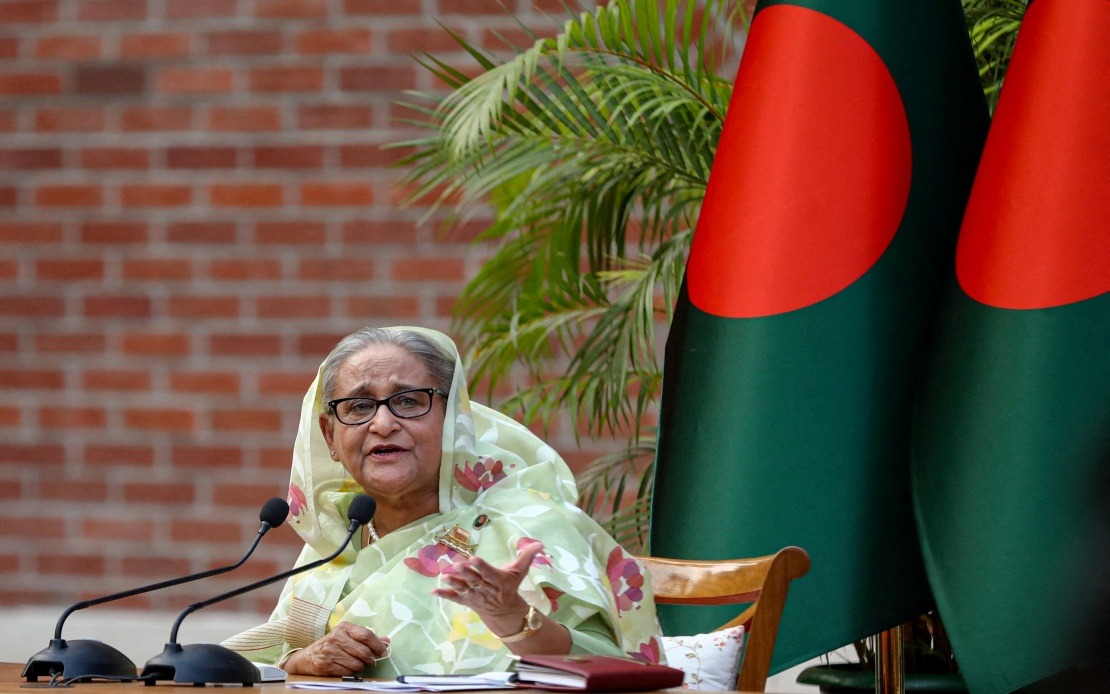
From her refuge in India, ousted Bangladesh Prime Minister Sheikh Hasina has defied the gravity of her circumstances by pledging to return and defend herself in court, even as she faces a death sentence handed down by the nation's war crimes tribunal. In a recent written interview, the 78-year-old former leader acknowledged the perils awaiting her—imprisonment or execution—yet maintained she would submit to Bangladesh's legal system, signalling an unwillingness to remain indefinitely exiled.
Hasina's forced departure in August 2024 followed widespread civil unrest triggered by a court decision to reinstate a quota system reserving 30 percent of civil service positions for descendants of those who fought in Bangladesh's 1971 independence war. What began as student protests over employment policy rapidly metamorphosed into a broader movement challenging her government, with security forces and supporters of her Awami League clashing with demonstrators across the country. The violence claimed an estimated 1,400 lives, according to United Nations assessments, though Hasina has consistently disputed responsibility for the deaths, instead characterizing the uprising as a politically orchestrated campaign engineered by her adversaries.
The war crimes tribunal's November 2025 conviction of Hasina in absentia for crimes against humanity related to the crackdown has intensified diplomatic complications. Bangladesh's new government, led by Prime Minister Tarique Rahman following the February 2026 election victory of the Bangladesh Nationalist Party, has formally requested India to extradite the former leader. India's Ministry of External Affairs acknowledged receiving the extradition request and indicated it was reviewing the matter within the framework of applicable legal and judicial protocols, suggesting New Delhi is proceeding cautiously given the political dimensions of the case and India's historical ties to Hasina.
What distinguishes Hasina's position is her rejection of the tribunal's legitimacy while simultaneously proposing an alternative mechanism for establishing truth. She has suggested that independent international forensic experts could objectively determine the circumstances of each death during the unrest, potentially exonerating her of direct culpability. This approach attempts to separate herself from systemic violence without appearing to deny that deaths occurred, a distinction that carries weight among observers concerned with accountability but also wary of victor's justice.
Human Rights Watch has voiced reservations about a trial conducted entirely in the accused's absence, while simultaneously reaffirming the principle that those responsible for governmental abuses warrant prosecution. This position reflects the organisation's broader concern that transitional justice mechanisms maintain procedural legitimacy alongside substantive accountability—a particularly delicate balance in Bangladesh given the charged political environment following the regime change.
Hasina's background as Bangladesh's founding father Sheikh Mujibur Rahman's daughter lends her claims historical and symbolic weight. Her five non-consecutive terms as prime minister, spanning from June 1996 to July 2001 and January 2009 to August 2024, encompassed periods of relative stability alongside controversial security operations. Most notably, during her third term in July 2016, militants attacked the Holey Artisan Bakery in Dhaka, massacring 20 hostages including nine Italian nationals, seven Japanese citizens, two Bangladeshis, one Indian and one American of Bangladeshi descent. The incident underscored the terrorism threats Bangladesh confronts and indirectly validated Hasina's claims that security forces faced genuine security challenges requiring robust responses.
The interim government that succeeded Hasina, initially led by Nobel Peace Prize laureate Muhammad Yunus as chief adviser, was succeeded by the elected government of Tarique Rahman. Since May 2025, all activities of Hasina's Awami League have been prohibited, effectively sidelining her political party from the democratic process. This comprehensive exclusion—encompassing the party itself alongside its former leader—suggests the new authorities view Hasina and her movement as beyond the pale of acceptable political competition.
For Malaysia and other Southeast Asian nations, Bangladesh's turmoil carries implications for regional stability and democratic resilience. The replacement of one government by another through popular unrest rather than constitutional mechanisms raises questions about institutional durability and the precedents being established. Moreover, the treatment of defeated political leaders influences perceptions of whether democratic transitions can accommodate peaceful power transfers or whether they inevitably culminate in persecution of predecessors.
Hasina's assertion that Bangladesh requires healing while maintaining that reconciliation cannot equate to impunity frames the challenge facing her successor government. This formulation acknowledges that societies fractured by violence require processes beyond pure punishment, yet insists that accountability remains essential. Whether Bangladesh's new leadership can navigate between these competing imperatives—pursuing justice without descending into endless recrimination—will shape not only the nation's trajectory but regional perceptions of how democracies manage political transitions.
The broader context includes Bangladesh's significance to Japanese development partnerships, particularly the railway infrastructure initiatives that the Holey Artisan Bakery victims were supporting through Japan International Cooperation Agency projects. This international dimension means that Bangladesh's governance and judicial processes command attention from strategic partners invested in the country's stability and prosperity.
Hasina's statement that "a stable Bangladesh matters for South Asia, the Bay of Bengal, development partners and countries like Japan" reflects recognition that her nation's internal politics carry external consequences. The decade ahead, she suggested, could represent either recovery and renewal or continued institutional decay, depending fundamentally on whether democratic processes are genuinely restored and whether citizens gain authentic agency in determining their country's direction. Whether she herself will be permitted to participate in that democratic renewal, or whether her promised return will result in prosecution rather than rehabilitation, remains contingent on decisions yet to be made by India and Bangladesh's authorities.

