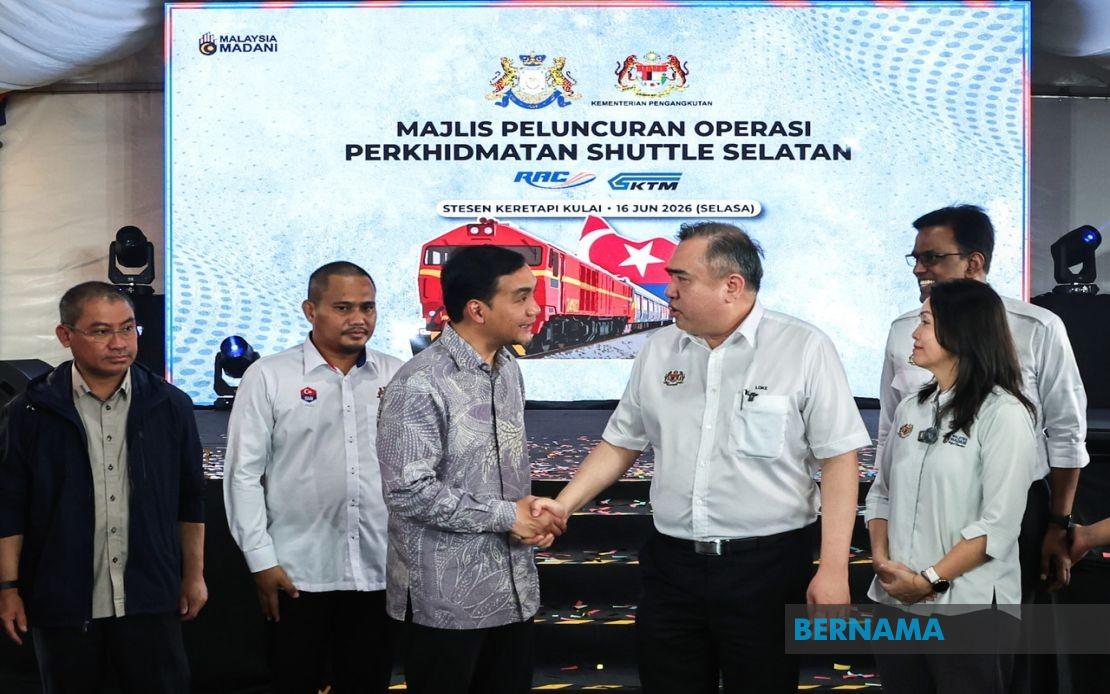
The Shuttle Selatan service has officially commenced operations, marking a significant step forward in Johor's public transportation infrastructure. Launched at Kulai KTM station, the service establishes a critical rail corridor connecting three major population and economic centres: Kulai, JB Sentral and Pasir Gudang. Transport Minister Anthony Loke oversaw the ceremony alongside Johor Menteri Besar Datuk Onn Hafiz Ghazi, signifying the project's importance to both federal and state governments.
Initially, the service operates across two main corridors designed to address commuter needs in these distinct regions. The Kulai-JB Sentral-Kulai route and the Kempas Baru-Pasir Gudang-Kempas Baru route form the backbone of the system. These routes have been engineered to deliver tangible time savings for daily users, with the Kulai to JB Sentral journey taking approximately 40 minutes, while the Kempas Baru to Pasir Gudang stretch requires around 40 to 45 minutes. Such journey times position the shuttle service as a competitive alternative to road-based commuting, particularly during peak traffic periods that regularly plague Johor's highways.
The government has positioned this launch within Johor's broader development trajectory. The state has emerged as one of Malaysia's fastest-growing regions, with expanding industrial parks, logistics hubs, port activities, educational institutions and trading operations requiring efficient worker and goods movement. The Shuttle Selatan addresses this infrastructure gap by establishing dedicated rail connectivity between residential precincts, commercial city centres and major employment zones. This strategic positioning responds to long-standing complaints about traffic congestion and insufficient public transport options in the southern Johor corridor.
Beyond the initial routes, Transport Minister Loke articulated an ambitious expansion roadmap that reflects long-term planning beyond the current launch phase. Future development will extend service from Paloh to Kulai, traversing intermediate stations at Kluang, Renggam and Layang-Layang. Additionally, three new stations—Taman Daya, Bandar Baru Sri Alam and Pasir Putih—are in the planning stages. These additions would substantially increase geographical coverage and accessibility for residents currently underserved by rail infrastructure.
To facilitate seamless journeys, the government has implemented a comprehensive first-and-last-mile strategy recognising that rail corridors alone cannot solve transportation challenges. Feeder bus services coordinate with shuttle schedules, while Bas.My routes have been realigned to complement the rail network. A dedicated shuttle service operates at Kempas Baru, and park-and-ride facilities at AEON Bandar Dato' Onn enable motorists to transition from private vehicles to public transport at key interchange points. This integrated approach mirrors best practices from mature transit systems and acknowledges that user convenience determines adoption rates.
Financial incentives form another pillar of the launch strategy. The government has introduced the Commuter MADANI Shuttle Selatan Card, with 3,000 complimentary cards distributed to Johor residents. Each RM50 card permits unlimited rides on the shuttle service for a specified duration, effectively subsidising early adopters. The Railway Assets Corporation has allocated more than RM150,000 as additional incentive funding, demonstrating substantive commitment to encouraging modal shift from private vehicles to rail-based public transport. Such financial backing typically requires sustained government support to remain viable over time.
The Shuttle Selatan represents the culmination of collaborative efforts between multiple agencies. The Ministry of Transport, Keretapi Tanah Melayu Berhad (KTMB) and the Railway Assets Corporation (RAC) jointly implemented the project, reflecting Malaysia's emerging capability to coordinate complex infrastructure initiatives across government entities. This institutional coordination capacity proves increasingly vital as urban centres demand sophisticated, multi-layered transportation solutions.
For Malaysian commuters and businesses, the service offers immediate practical benefits beyond simple journey-time reduction. By providing reliable, scheduled alternative transportation, Shuttle Selatan alleviates road congestion, reduces vehicle emissions and creates economic value through productive time gained on transit. Logistical operations gain from more predictable transportation of workers and goods. Residential property values in Taman Daya, Bandar Baru Sri Alam and Pasir Putih may appreciate following improved connectivity, potentially triggering secondary development.
Regionally, Shuttle Selatan contributes to Singapore-Johor-Kuala Lumpur economic integration by improving intra-Johor mobility. Workers in Pasir Gudang's petrochemical and manufacturing zones gain faster commuting options. Educational institutions in Kulai and surrounding areas benefit from improved student and staff movement. The service indirectly supports Malaysia's broader aim to reduce private vehicle dependency in urban regions, aligning with climate commitments and sustainable development objectives that increasingly influence international investment decisions.
The two million potential beneficiaries represent a substantial user base justifying infrastructure investment. Johor's population density, industrial concentration and urbanisation patterns suggest genuine demand for rail-based alternatives. However, long-term success depends on sustained service quality, competitive pricing relative to personal vehicles and continuous network expansion. Commuter adoption patterns will indicate whether the shuttle service achieves its transformative potential or remains a niche offering.