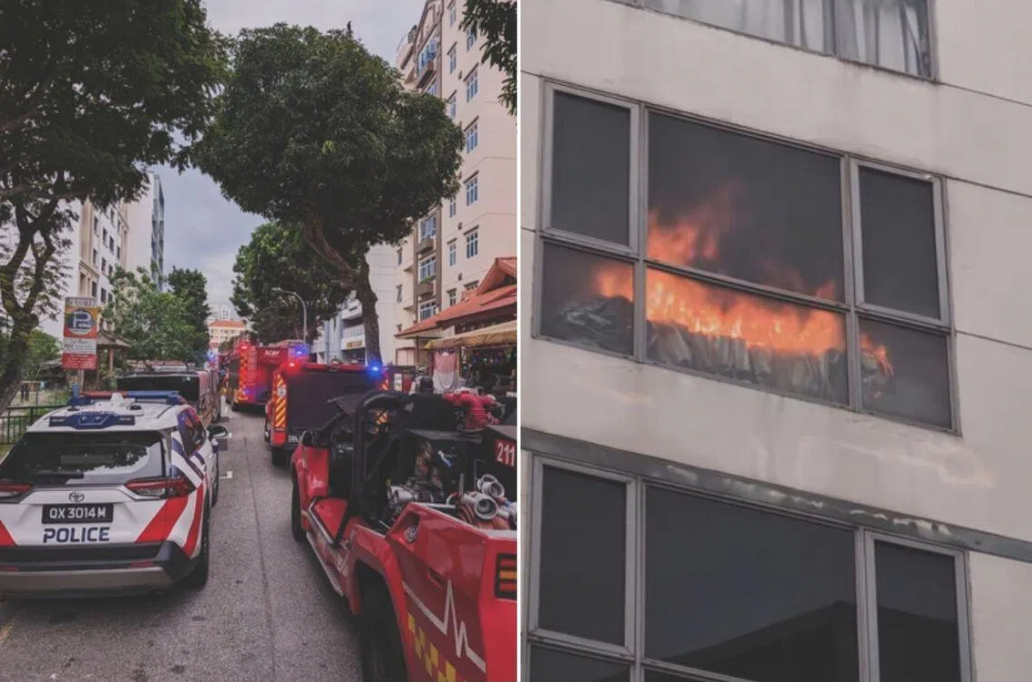
An unattended power-assisted bicycle battery ignited a fire in a Geylang condominium on Sunday afternoon, prompting the evacuation of five residents and reigniting concerns about the safety risks posed by the growing use of active mobility devices across Southeast Asia. The Singapore Civil Defence Force responded to the incident at 9 Lorong 26 Geylang, a residential complex known as Casa Aerata, after receiving an alert at 5.35pm on June 21. The blaze originated in a seventh-floor unit where the PAB battery had been left charging unattended in the living room, a common practice among users seeking convenience but one that authorities have repeatedly cautioned against.
The fire service successfully brought the incident under control using standard equipment including a hosereel and a compressed air foam backpack, ensuring that the flames did not spread to neighbouring units or cause structural damage to the building. Police officers and SCDF personnel evacuated five residents from adjacent units as a precautionary measure, though fortunately no injuries were recorded. Initial investigations determined the fire to be of electrical origin, tracing its source directly to the malfunctioning PAB battery, reinforcing the growing body of evidence linking these devices to residential fire hazards in densely populated urban environments.
Major incidents involving active mobility devices have become increasingly common across Singapore and the broader Southeast Asian region, prompting heightened surveillance and public education campaigns. The February figures released by the SCDF reveal a more complex picture than simple numbers might suggest. While the overall count of active mobility device fires dropped from 67 incidents in 2024 to 49 in 2025, the composition of these fires shifted dramatically, with personal mobility device fires climbing from 25 to 31 cases during the same period. This trend suggests that different device categories present distinct hazard profiles, requiring tailored safety approaches rather than a one-size-fits-all regulatory framework.
The broader context involves the rapid proliferation of personal mobility devices across Singapore's compact urban landscape, where residents and commuters have increasingly adopted e-scooters, e-bikes, and power-assisted bicycles as convenient alternatives to public transport and private vehicles. This shift reflects a regional trend visible throughout major Southeast Asian cities, where the convenience and affordability of these devices have made them popular among younger demographics and delivery workers. However, the infrastructure and safety protocols have not uniformly kept pace with adoption rates, creating vulnerabilities in how batteries are stored, charged, and maintained within residential settings.
The incident occurred in a residential condominium, highlighting how safety risks extend beyond individual users to affect entire buildings and neighbourhoods. The seventh-floor location meant that smoke could have spread through vertical ventilation shafts and communal areas, potentially affecting dozens of residents. Local Member of Parliament Cai Yinzhou, representing Bishan-Toa Payoh GRC, personally attended the scene after noticing smoke and hearing emergency sirens in the vicinity. His prompt action in clearing the area beneath the burning unit demonstrated awareness of a particular hazard associated with high-rise fires: the risk of debris and safety glass falling from broken windows as internal heat builds. The window did indeed shatter as temperatures rose, validating his precautionary measures.
Autorities have consistently emphasized that non-original or counterfeit batteries represent a significant safety concern, yet many users in the region continue purchasing aftermarket replacements due to lower costs and easier availability. The SCDF's repeated warnings specifically target this practice, as third-party batteries often lack the thermal management and safety circuits built into manufacturer-approved units. Additionally, extended charging periods and overnight charging substantially increase the risk of battery degradation, overheating, and thermal runaway—a cascade failure that can occur without obvious warning signs.
For Malaysian readers, this incident carries direct relevance given the rising popularity of PABs and other active mobility devices in cities like Kuala Lumpur, Penang, and Johor Bahru. The regulatory environment in Malaysia remains less stringent than Singapore's, meaning similar hazards may be developing with less systematic monitoring. The growth of e-commerce and last-mile delivery services has accelerated adoption among commercial users who charge devices frequently in residential or workshop settings, creating conditions where fires are likely to occur. The precedent set by Singapore's approach to documenting and addressing these incidents provides valuable lessons for Malaysian authorities considering their own safety frameworks.
The data pattern from Singapore also suggests that regulatory focus may need to shift toward personal mobility devices, where the increase in fire incidents is most pronounced. This could indicate either increasing device popularity among higher-risk user groups, declining battery quality in the PMD market, or both factors working in combination. For manufacturers, distributors, and regulators across Southeast Asia, these trends suggest that a proactive stance on battery standards, user education, and enforcement may prevent similar incidents from multiplying as device adoption continues accelerating throughout the region.
Looking forward, the incident underscores the necessity for apartment buildings and condominiums to establish clear charging protocols and designated areas where these devices can be safely charged under controlled conditions. Some progressive developments in Singapore and Malaysia have begun implementing dedicated charging stations with fire suppression systems, though widespread adoption remains limited. The cost of such infrastructure is modest compared to the potential consequences of fires spreading through residential complexes, yet uptake has been slow due to regulatory uncertainty and questions about liability.
The emergency response itself demonstrates the importance of maintaining well-trained civil defence forces with appropriate equipment and procedures for these emerging hazard types. The SCDF's effectiveness in containing the fire without casualties suggests that Singapore's approach to emergency preparedness provides a useful model for other cities grappling with similar risks. However, prevention remains preferable to even the most skillfully executed emergency response, making user education and device regulation the most efficient long-term solutions.
For individual users, the key takeaway remains straightforward but often ignored: always use original batteries, never charge devices unattended, avoid overnight charging, and select appropriate charging locations away from flammable materials and sleeping areas. In Malaysia and across the region, as these devices proliferate and become entrenched in daily mobility patterns, building a culture of responsible charging practices may prove as important as any regulatory mandate. The Geylang incident serves as a timely reminder that convenience should never override safety when dealing with lithium-ion batteries in densely populated residential environments.

