A Singapore court has charged a 29-year-old man with multiple offences stemming from a chaotic early-morning driving incident that endangered numerous road users and hospitalised two young passengers on a school bus. The sequence of events, which unfolded across several kilometres of inner-city roads, represents one of the more hazardous drink-driving episodes the city-state has prosecuted, involving reckless disregard for traffic rules and public safety standards that will resonate with Malaysian authorities and road safety advocates across Southeast Asia.
According to court documents filed on Thursday, 18 June, Aaron Tan Yao Cong faces five distinct charges related to the 6 March 2024 incident. These include drink driving, dangerous driving causing hurt, leaving a vehicle in a position creating hazard to others, failure to cooperate with breathalyser testing, and driving against the flow of traffic. The accumulated charges carry potentially severe penalties that reflect the severity and recklessness demonstrated throughout the incident, signalling how seriously Singapore's judiciary treats such infractions when multiple people are endangered simultaneously.
The morning began when Tan failed to obey directional signage along Cavenagh Road near Bukit Timah Road at 5.50am. Rather than proceeding straight as required, he executed a left turn and deliberately drove into oncoming traffic lanes. Court documents describe how he brought his vehicle to a complete stop on the left side of the two-lane Cavenagh Road, direction Buyong Road. At this point, Tan and three passengers in his vehicle remained trapped in a dangerous position as morning traffic intensified. That he and his occupants escaped without immediate injury during this initial phase proved merely fortunate rather than preventative of greater danger.
What followed represents an escalation in recklessness. When police officers approached the stationary vehicle around 6am, Tan accelerated away from the scene and embarked upon a high-speed journey along Bukit Timah Road towards Upper Bukit Timah Road. Between 6.16am and the collision, he maintained average speeds of approximately 114 kilometres per hour, continuously weaving through traffic lanes and disregarding standard road protocols. The pursuit traversed between Coronation Road and Anamalai Avenue, covering considerable ground through populated areas where such speeds posed significant danger to other motorists and pedestrians.
Alcohol impairment significantly influenced Tan's judgment throughout these events. When arrested, he refused to submit to a breathalyser test immediately, a refusal that itself constitutes a separate criminal charge and typically indicates consciousness of guilt. Subsequent testing established blood alcohol content of 148 milligrams per 100 millilitres of blood, substantially exceeding Singapore's legal limit of 80 milligrams per 100 millilitres. For Malaysian readers familiar with comparable drink-driving enforcement, this concentration represents nearly double the permissible threshold, indicating significant intoxication during the driving incident.
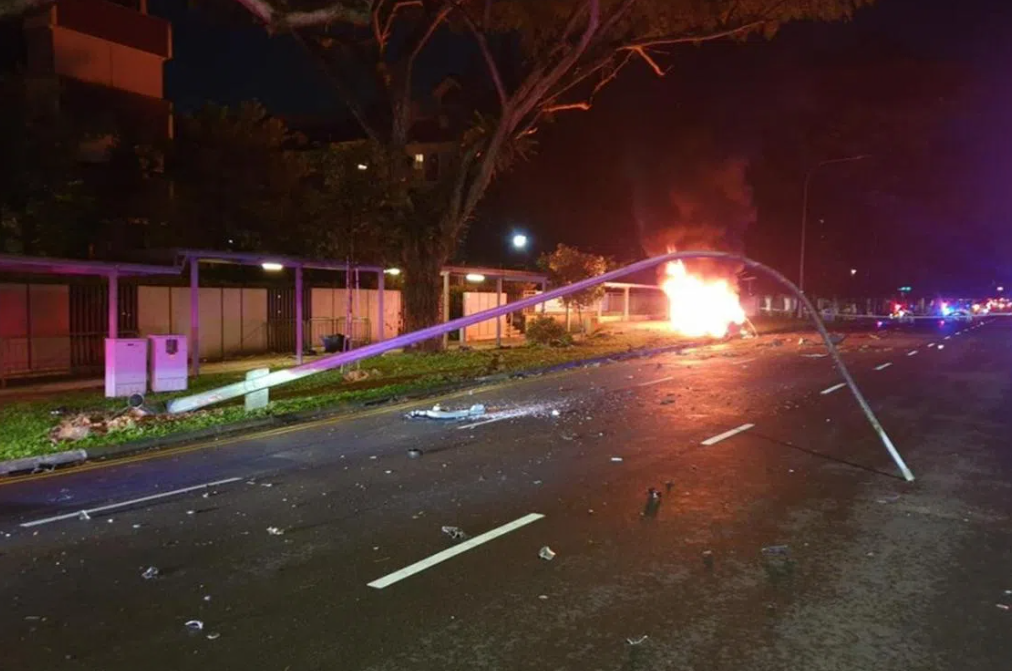
The collision occurred at the junction of Sixth Avenue when Tan allegedly proceeded through a red traffic signal and struck a private bus executing a lawful U-turn. The impact of this collision proved violent enough to force his vehicle into a lamp post immediately thereafter. The impact ignited his car, causing it to catch fire. Tan and his three passengers managed to evacuate the burning vehicle without fatal consequences, though the brush with such danger underscores how fortunate the outcome could have been. The bus driver and his two young passengers—both aged nine and ten—required hospital treatment following the collision, with both children necessitating medical attention for injuries sustained.
Tan's criminal history significantly aggravates his current legal position. Court records reveal that he was previously convicted in 2019 of drink driving and driving without due care and attention. This prior conviction transforms him from a first-time offender into a repeat transgressor, triggering substantially enhanced penalties under Singapore's traffic legislation. The recidivism suggests a failure of previous sentencing to deter similar behaviour, raising questions about rehabilitation and whether custodial sentences should have been lengthier or more stringent conditions imposed on licence reinstatement.
The statutory penalties Tan faces reflect judicial concern about repeat offenders and the escalated danger created by reckless driving. For drink driving as a repeat offender, he could receive imprisonment up to two years and fines reaching 20,000 Singapore dollars. For dangerous driving causing hurt, guilty verdicts permit imprisonment up to two years alongside fines up to S$10,000, with repeat-offender sentencing raising maximum fines to S$20,000. Additional charges—vehicle endangerment, breath test refusal, and wrong-way driving—each carry independent penalties ranging from brief jail terms and modest fines up to six months imprisonment and S$5,000 fines depending on the offence and prior record.
From a regional perspective, this incident illuminates persistent challenges facing Southeast Asian traffic enforcement. Singapore maintains among the world's most stringent drink-driving laws and active enforcement mechanisms, yet repeat offenders continue to operate vehicles while intoxicated. The incident demonstrates that legislative frameworks and penalties, however severe, require complementary interventions including rehabilitation programmes, licence suspension protocols, and court-ordered monitoring. Malaysian authorities and neighbouring jurisdictions can extract valuable lessons regarding the inadequacy of criminal prosecution alone in preventing recidivism among problematic drivers.
Tan's case also highlights the collateral risk borne by innocent parties. Two children travelling on a school bus—presumably heading to educational activities—suddenly faced traumatic injury through no fault whatsoever. Bus drivers performing their professional duties encounter hazards substantially beyond their control when confronted by intoxicated drivers disregarding traffic signals and weaving recklessly across lanes. Such incidents strengthen arguments for more aggressive alcohol interlock device mandates, extended licence suspension periods, and insurance-based penalties that discourage driving by proven offenders.
The judicial process remains ongoing, with Tan scheduled to return to court on 16 July for further proceedings. As of the charging date, he had not indicated his intention regarding any guilty pleas among the five charges. His legal strategy—whether contesting allegations or pursuing negotiated outcomes—may influence final sentencing ranges. The court's ultimate determination will establish precedent regarding how Singapore's judiciary weighs aggravating factors including repeat offences, multiple endangered parties, and high-speed dangerous driving when imposing custodial and financial consequences.
For Malaysian road safety advocates and policymakers, the Tan case underscores the necessity of comprehensive approaches addressing drink-driving prevention. Education campaigns targeting younger drivers, mandatory rehabilitation for first-time offenders, technological solutions such as alcohol interlocks, and sufficiently stringent sentencing to create genuine deterrence rather than mere administrative inconvenience all merit consideration. The intersection of alcohol impairment, excessive speed, traffic signal violation, and reckless lane-changing created an incident where serious injury or fatality represented merely chance rather than prevention—a sobering reminder that legislative and enforcement frameworks remain perpetually insufficient without sustained cultural emphasis on personal responsibility and community accountability.