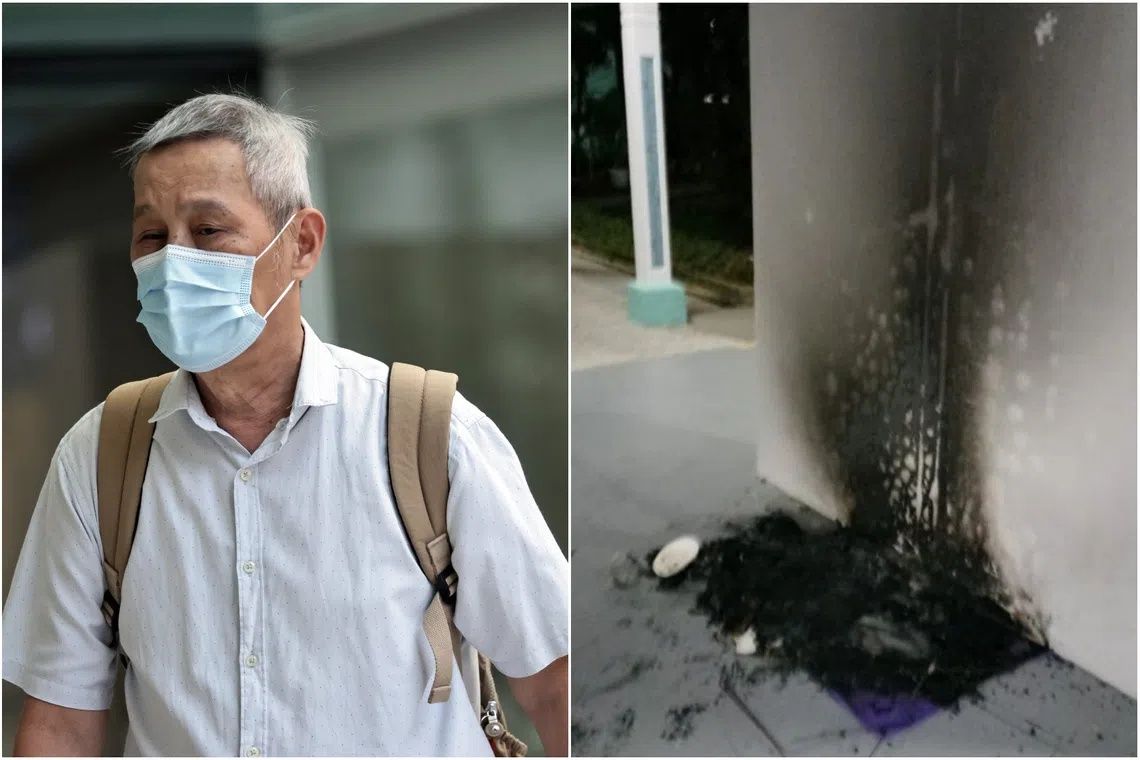
A Singapore court has handed down a three-month custodial sentence to Koh Teng Boo, 68, for deliberately igniting cardboard structures designed to house community cats near his home in Bukit Batok. The retired man's actions caused approximately S$913 in damage to the ground and walls of a void deck pavilion area, with the case raising questions about how residential disputes over animal welfare initiatives are handled in densely populated public housing estates.
Koh, who resides at Bukit Batok East Avenue 4, first encountered the cat houses in September 2025 when they appeared around a pavilion and void deck near his flat. The cardboard shelters, stocked with food and water to provide refuge for stray cats, became a source of escalating frustration for the resident. According to Deputy Public Prosecutor Stephen Yeo, Koh's grievance extended beyond simple annoyance—he believed the structures were creating a hygiene problem by attracting pests and birds to the area, a concern he articulated to his elected Member of Parliament.
The cat house initiative itself reflects a broader trend across Singapore's public housing estates, where grassroots community cat care efforts have grown substantially in recent years. These informal welfare programs, typically organized by residents or animal welfare advocates, aim to provide basic sustenance and shelter to the city's significant population of stray cats. However, such schemes can generate friction in multiunit housing blocks where not all residents welcome the presence of animal shelters on shared common property. Koh's case exemplifies this tension, illustrating how well-intentioned animal welfare efforts can collide with residents' perceptions of cleanliness and pest control in shared living spaces.
Frustrated that his initial complaint to his MP appeared to yield no visible results, Koh took matters into his own hands in October 2025. He removed three of the cardboard cat houses and placed them in an incense burner bin before setting them alight. The act of destruction seemed to satisfy his immediate frustration, yet the response from cat welfare supporters or organizers was swift—within two days, additional shelters had been constructed and repositioned around his residential block.
Undeterred by the reappearance of the structures, Koh escalated his campaign. He visited his MP again on November 17, reiterating his complaints and emphasizing his position that he held no animosity toward cats themselves but objected strongly to what he characterized as an unhygienic practice. He also noted that some residents were depositing litter directly into the cat houses, compounding his sanitation concerns. These repeated interventions through official channels seemed to provide no resolution, a fact that evidently hardened his resolve.
On the night of November 19, after consuming alcohol, Koh acted decisively once more. Around 1:30 am, while returning to his flat, he produced a lighter and deliberately ignited another cat house. This time, the act was far more serious in its potential consequences—he lit the fire and then simply walked away without extinguishing it or alerting anyone to the hazard. The incident posed a genuine risk to surrounding property and residents, as an unattended fire in a void deck environment presents dangers beyond the immediate structure burning.
The court record does not clarify whether Koh himself extinguished the November 19 blaze or whether it died out naturally, creating an investigative gap about the sequence of events. Undaunted even after this arson incident, Koh returned the following day—November 20—and set fire to yet another cat house. This time, two passersby witnessed the burning shelter and took action to suppress the flames before the situation escalated further. It was following this second deliberate fire-setting that Koh was arrested.
The cumulative damage assessment conducted by the Jurong-Clementi-Bukit Batok Town Council documented S$913 in repairs required to the flooring and walls proximate to the burnt cat houses. Koh has since made complete financial restitution to the town council, a factor that likely influenced the sentencing outcome. Under Singapore's penal provisions, individuals convicted of mischief by fire can face imprisonment of up to seven years and substantial fines, meaning Koh's three-month sentence represents a relatively lenient outcome within the statutory framework.
This case highlights the intersection of multiple social issues within Singapore's HDB ecosystem: the tension between animal welfare advocacy and neighborhood standards, the limits of parliamentary complaint mechanisms for resolving hyperlocal disputes, and the legal boundaries individuals must respect when taking unilateral action against practices they oppose. For Malaysian observers, the case offers insight into how neighboring Singapore addresses such disputes through the court system, particularly regarding the application of property damage statutes to destruction motivated by environmental and hygiene grievances.
The incident also underscores the potential escalation pathways when administrative or political channels fail to satisfy a resident's concerns. Koh's progression from complaint to minor destruction to repeated arson demonstrates how frustration with perceived inaction can drive individuals toward increasingly serious criminal conduct. The sentence imposed reflects Singapore's judicial approach to balancing proportional punishment with recognition of Koh's age, his subsequent restitution, and the nature of the underlying dispute.
For community organizations across Southeast Asia managing animal welfare initiatives in public housing estates, the Bukit Batok case serves as a cautionary narrative about the necessity of building consensus with neighboring residents before implementing cat or animal care programs on shared property. The availability and accessibility of mediation mechanisms or town council intervention in such disputes may prove critical in preventing escalation. Koh's resort to arson, while unjustifiable, originated in a genuine neighborhood grievance that might have been resolvable through more proactive engagement and dialogue.

