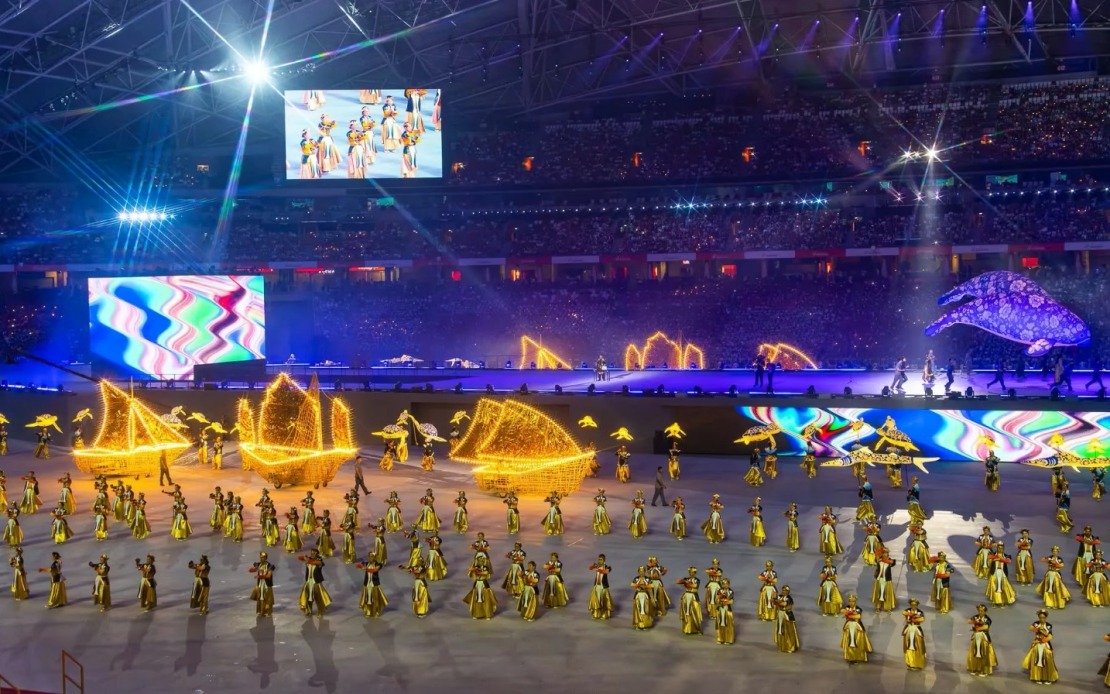
Singapore's 61st National Day celebrations on Sunday marked a significant milestone as the National Day Parade returned to the National Stadium following a ten-year absence, reinvigorating a tradition that remains central to the island republic's identity. Presided over by President Tharman Shanmugaratnam and Prime Minister Lawrence Wong, alongside Cabinet ministers and Members of Parliament, the ceremony drew approximately 42,000 members of the public who dressed in the national colours of red and white, transforming the stadium into a sea of patriotic symbolism. The proceedings unfolded under the overarching theme "Majulah Singapura, Go Beyond!", a message intended to inspire Singaporeans to transcend conventional boundaries and pursue greater aspirations in their collective endeavour.
The relocation of the parade to the National Stadium after a decade-long hiatus represents more than a logistical shift; it reflects Singapore's confidence in returning to large-scale public gatherings and its commitment to reinvigorating shared national experiences. The choice of venue carries symbolic weight in Singapore's urban landscape, reconnecting the celebration with a space that has historically hosted momentous occasions in the nation's public life. This return addresses a desire among Singaporeans for tangible, in-person national celebrations that foster communal bonds and collective pride during an era when virtual and dispersed gatherings have become increasingly common.
In a departure from precedent, the 2026 celebration introduced an innovative expansion of ceremonial elements by conducting the Presidential Gun Salute and State Flag Flypast at Kallang Basin, extending the parade experience well beyond the stadium's confines. This decision fundamentally altered the nature of the National Day experience, permitting thousands of additional spectators positioned throughout the wider Kallang precinct to witness these ceremonial components. Four 25-pounder Howitzer guns, mounted on Mobility 3rd Generation rafts, navigated the basin in a carefully choreographed maritime display, creating a unique visual spectacle that merged traditional military ceremony with contemporary urban geography. The initiative demonstrates how Singapore continues to reimagine its national celebrations by integrating natural and built environments in innovative ways.
The traditional 21-Gun salute, a ceremonial cornerstone of Singapore's National Day observances, involved 151 personnel drawn from the 23rd Battalion of the Singapore Artillery and the 35th Battalion of Singapore Combat Engineers. These uniformed service members executed their duties with the precision expected of Singapore's defence establishment, ensuring that the salute maintained its ceremonial gravitas despite its relocation and novel presentation format. The involvement of artillery and engineer battalions underscored the military's continued centrality to Singapore's national identity and security framework, embedding defence capabilities symbolically within civilian celebrations.
The main parade and ceremony segment commenced at approximately 6 pm and centred on the thematic framework of "Go Beyond Self", a concept designed to encourage individual transcendence and collective advancement. This segment incorporated 32 contingents representing more than 2,000 active participants, creating a substantial processional display that showcased the breadth of Singapore's institutional and organisational landscape. The composition of these contingents reflected Singapore's layered governance and social structure, encompassing the Singapore Armed Forces Colours Party, six Guard of Honour contingents drawn from multiple security and defence agencies, ten contingents from uniformed youth organisations, and sixteen supporting contingents. The 72-member Guard of Honour itself drew personnel from the Singapore Army, Republic of Singapore Navy, Republic of Singapore Air Force, Digital and Intelligence Service, Singapore Police Force, and Singapore Civil Defence Force, demonstrating the comprehensive mobilisation of state institutions for national celebration.
Beyond the formal ceremonial components, the National Day show segment presented a more expansive artistic and cultural dimension, engaging 36 artistes and over 2,600 performers in a carefully crafted production centred on the main thematic message. This performance element functioned as the affective heart of the celebration, translating abstract national concepts into narrative, movement, and sound that resonated with the assembled audience. The show segment deliberately showcased what organisers characterised as "authentic stories" from Singaporean life, suggesting an attempt to ground national symbolism in lived experience and contemporary realities rather than abstract ideals alone. The inclusion of innovative technology within the performance indicated Singapore's desire to position itself as a forward-looking society where tradition and modernity interweave.
A particularly noteworthy dimension of this year's celebrations was the explicit inclusion of performers representing Singapore's diversity and the nation's commitment to inclusive participation across all demographics. Seven dancers from varied backgrounds participated in the show segment, including an autistic dancer and a dancer with Down syndrome, a conscious programming decision intended to communicate that national contribution and belonging extend across ability spectrums and social categories. This performative choice articulated a specific vision of national identity in which inclusivity constitutes a foundational value rather than an afterthought, sending a deliberate message that every Singaporean, regardless of background or capacity, possesses agency in collectively shaping the nation's shared future. The visibility of performers with disabilities within the National Day ceremony reflects evolving understandings of what constitutes meaningful participation in national life and challenges conventional paradigms of who is positioned as a representative of national identity.
For Malaysian observers and Southeast Asian audiences more broadly, Singapore's celebration offers instructive lessons about how small, multicultural city-states approach the challenge of maintaining cohesive national identity in an era of globalisation and dispersed communities. Singapore's methodical approach to its National Day, encompassing ceremonial precision, artistic expression, and deliberate inclusivity, demonstrates one model for embedding national consciousness within populations that are geographically concentrated but increasingly diverse in background and experience. The return of the parade to a fixed stadium location, combined with the innovative expansion to Kallang Basin, suggests a strategy of blending traditional ceremonial forms with contemporary adaptations, permitting broader participation whilst maintaining ceremonial integrity. The explicit foregrounding of inclusivity and diversity within the performance dimensions of the celebration indicates Singapore's recognition that national cohesion in the twenty-first century cannot rest solely upon shared history but must actively embrace the heterogeneous composition of contemporary citizenry.
The practical logistics of assembling over 2,600 performers, coordinating military salutes across aquatic and terrestrial settings, and managing approximately 42,000 spectators within a single ceremonial framework underscore Singapore's considerable administrative capacity and resource commitment to national celebration. The coordination required to synchronise Guard of Honour contingents from six different agencies, integrate youth organisations with military units, and execute maritime artillery displays alongside terrestrial ceremonies reflects the level of state organisation and institutional integration that Singapore has achieved. For Southeast Asian countries contemplating how to strengthen national identity and civic engagement through public celebration, Singapore's example demonstrates both the logistical demands and the potential social returns of substantial investment in coordinated national ceremonies. The success of such celebrations depends critically upon institutional cooperation, careful thematic coherence, and an understanding that national identity in diverse societies requires continuous, deliberate reinforcement through shared public experiences rather than inherited or assumed consensus.

