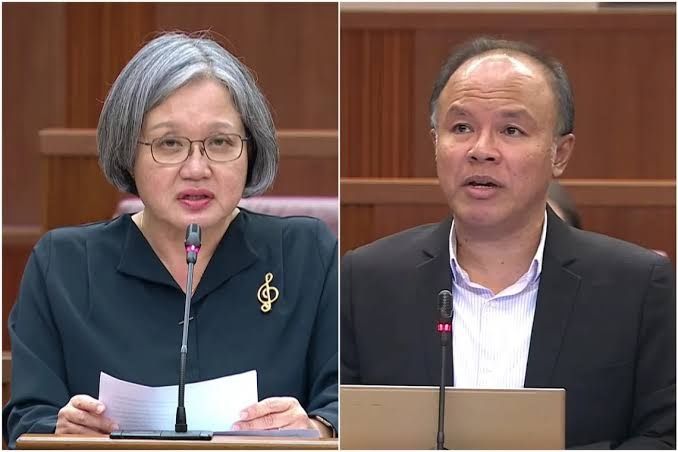
Singapore's Parliament has drawn a formal close to a lengthy political saga involving two senior opposition figures, with Leader of the House Indranee Rajah announcing on July 7 that no further disciplinary measures can be taken against Workers' Party leaders Sylvia Lim and Faisal Manap. The pair had been found to have misled Parliament's Committee of Privileges in their testimony regarding a statement made by then-MP Raeesah Khan, but the expiration of statutory time limits has now rendered Parliament unable to impose penalties under the Parliament (Privileges, Immunities and Powers) Act, even though their culpability has effectively been established through the court proceedings of party leader Pritam Singh.
The case originated from Khan's 2021 parliamentary speech in which she fabricated an anecdote about police conduct. When Parliament's Committee of Privileges investigated, it discovered that Singh had instructed Khan to "take her lie to the grave," and that both Lim and Faisal, who were present during the relevant meeting, subsequently provided false testimony denying that this conversation had occurred. While Singh's conduct was determined to be the most egregious and resulted in criminal prosecution, Lim and Faisal were characterised as playing a subsidiary role in the affair. Parliament had strategically delayed addressing their conduct pending the completion of Singh's court case, a decision taken to ensure procedural fairness to both individuals.
Singh's legal odyssey reinforced the Committee's original findings. Following his conviction by the District Court in February 2025, he mounted an appeal which was ultimately dismissed when the High Court upheld the conviction in December 2025. Indranee acknowledged that the High Court judgment effectively confirmed Parliament's earlier conclusions regarding the misconduct of Lim and Faisal, validating the Committee's investigative work. However, she explained that the court's vindication of these findings came too late within Parliament's procedural framework, rendering the legal mechanism for parliamentary discipline inoperable.
The technical obstacle stems from Section 22 of the Parliament (Privileges, Immunities and Powers) Act, which constrains Parliament's capacity to impose penalties for parliamentary contempt. Under this provision, the House may only punish offences committed during either the current parliamentary session or the immediately preceding session of the previous parliamentary term. The dissolution of the 14th Parliament following the 2025 general election and the establishment of the 15th Parliament in September 2025 triggered a critical threshold. Since Lim and Faisal's misleading statements occurred during the first session of the 14th Parliament, the new Parliament lacks statutory authority to prosecute them for these offences, regardless of the substantive merits of the case or confirmation through judicial proceedings.
Indranee articulated the principle underlying Parliament's constraint with candour, noting that while different timelines might have prompted alternative action, "the law, in this case the time bar provisions of PPIPA, must be observed." She observed that in most parliamentary systems, disciplinary matters are resolved swiftly within the same session or, occasionally, in the subsequent session. The exceptional delay in this instance—stretching across multiple years and encompassing criminal litigation—created an irreconcilable conflict between the demand for natural justice, which necessitated awaiting the outcome of Singh's prosecution to treat all parties equitably, and the statutory window for parliamentary action, which ultimately closed before administrative enforcement became feasible.
Parliament retains a narrower avenue for expressing institutional disapproval, though Indranee indicated this remedy has already been substantially deployed. The House may pass motions of censure or regret, and it had already signalled unambiguous disapproval of lying to Parliament or its committees in January when it resolved that Singh was unsuitable for the position of Leader of the Opposition. Indranee suggested that this prior motion adequately communicated Parliament's institutional stance regarding deliberate deception, making the passage of an additional motion redundant and risking the appearance of retrospective punishment after the fact.
For Malaysian observers, the resolution carries instructive dimensions concerning parliamentary procedure and the tension between accountability and procedural constraint. Singapore's experience underscores how rigid statutory time limits, while necessary for finality and closure in legislative business, can produce outcomes where factual culpability becomes established through independent judicial process yet remains formally unreachable by the disciplinary authority best positioned to address it. The decision to maintain strict adherence to legislative text rather than stretch interpretive boundaries reflects institutional preference for rule-bound governance even when it yields frustrating results.
The closure also reflects Singapore's escalating scrutiny of parliamentary conduct standards. The Workers' Party saga catalysed public discussion about transparency, truthfulness, and the consequences of deliberate misdirection within Parliament. Singh's criminal conviction for misleading Parliament represented a rare instance of criminal sanction for such conduct, elevating public expectations regarding parliamentary ethics. The inability to pursue Lim and Faisal through parliamentary discipline, despite judicial confirmation of their dishonesty, may paradoxically strengthen arguments for clearer statutory frameworks that prevent such temporal gaps from neutralising accountability mechanisms.
Within the opposition Workers' Party, the matter concluded earlier when party cadres reelected Singh as leader during internal elections on June 28, signalling that the rank-and-file endorsed his continued leadership despite conviction. Lim, in her parliamentary response, explicitly stated she was not contesting the ministerial statement and reiterated her earlier position that she lacked opportunity to defend herself in court proceedings since she had not been called as a witness. This assertion highlights a remaining grievance regarding procedural fairness: while her misleading testimony was confirmed through Singh's prosecution, Lim herself never faced direct criminal charges nor received the opportunity to contest the allegations within a judicial setting with full legal representation.
The ministerial statement's finality carries implications for Singapore's political trajectory. Concluding a protracted dispute involving senior opposition figures removes a recurring focal point for parliamentary procedure and institutional integrity debates. However, it also establishes a precedent that parliamentary discipline remains contingent upon temporal alignment—a gap between investigation and disposal can render statutory penalties inaccessible even after misconduct becomes independently verified. For regional observers and particularly those in Malaysia concerned with parliamentary standards and opposition accountability, Singapore's experience suggests that statutory frameworks governing parliamentary privilege require careful calibration to avoid scenarios where legal formalism trumps substantive accountability.
Indranee's concluding invitation for objections, met with silence from the chamber, marked the formal resolution of an episode that consumed parliamentary time and institutional energy over several years. Whether this outcome strengthens or weakens public confidence in parliamentary discipline remains contested; it simultaneously exemplifies procedural rigour and illustrates the constraints that formal legal structures can impose upon institutional accountability.

