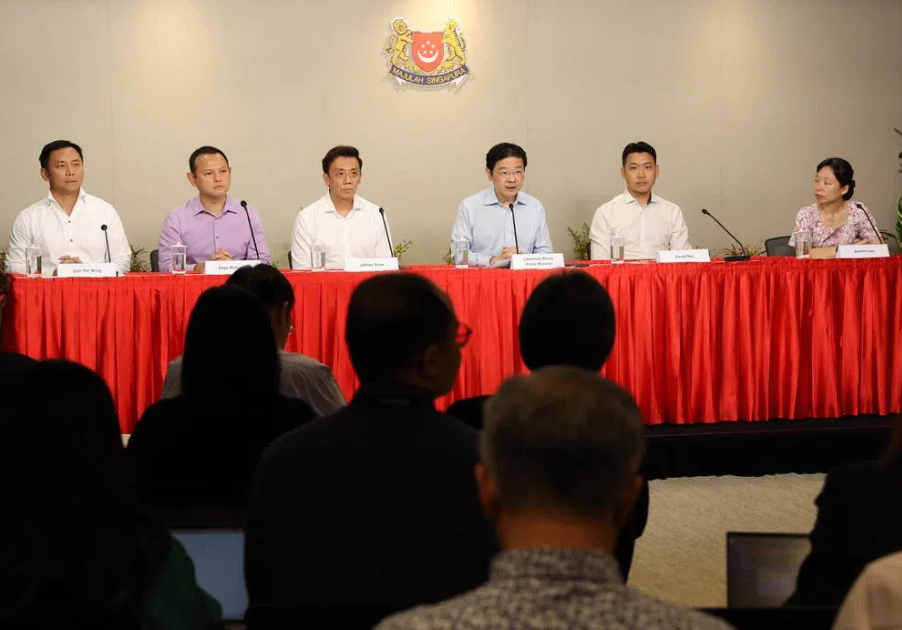
Prime Minister Lawrence Wong has announced a significant restructuring of Singapore's Cabinet that underscores the city-state's commitment to generational transition while maintaining institutional continuity through experienced leaders. The reshuffle, unveiled on July 22, sees a cohort of first-term politicians elevated to larger roles, marking a deliberate acceleration in the government's succession planning following two unexpected political resignations earlier this year.
The reshuffle represents more than routine administrative shuffling. It reflects the Singapore government's deliberate strategy of balancing youthful energy with institutional memory—a tension all Southeast Asian governments grapple with as they navigate demographic shifts and changing voter expectations. By promoting Jeffrey Siow and David Neo to full ministerial status, Wong is signalling that politicians who proved themselves in acting capacities during recent months are ready for permanent portfolios. Both men have been handling their ministries in interim roles since May 2025, with Siow managing Transport and Neo overseeing Culture, Community and Youth. Their elevation represents a calculated bet that performance in acting positions can translate into sustained ministerial effectiveness.
The changes also reflect pragmatic responses to departures that disrupted carefully laid succession plans. Faishal Ibrahim, who held sensitive positions as Acting Minister-in-charge of Muslim Affairs and Senior Minister of State for Home Affairs, resigned on July 20 following what he described as lapses in judgment regarding personal interactions. Before that, Koh Poh Koon stepped down in June citing family reasons. These departures forced Wong to recalibrate his timeline for leadership renewal, creating vacancies that demanded immediate filling and prompting the broader reshuffle announced this month.
Sim Ann's appointment as Second Minister for Foreign Affairs and Home Affairs represents another significant promotion for a first-term politician. Her expanded portfolio, covering two critical ministries simultaneously, indicates Wong's confidence in her capacity to handle complex, interconnected challenges. The Foreign Affairs and Home Affairs nexus is particularly sensitive in Singapore's context, requiring sophisticated navigation of both regional diplomacy and internal security concerns—matters of direct relevance to Malaysia and other immediate neighbours.
Jasmin Lau's appointment as Acting Minister for Manpower, replacing Tan See Leng, demonstrates how the reshuffle addresses emerging talent while repositioning experienced figures. See Leng's transition to Minister for Trade and Industry with expanded energy and industry oversight suggests Wong views him as valuable in portfolio areas requiring steady hands amid economic transition pressures. This kind of lateral movement allows governments to test competencies and match individual strengths to evolving national priorities.
The Cabinet changes incorporate two additional first-term backbench MPs—Foo Cexiang and Shawn Loh, both former senior civil servants—who will become ministers of state. Their recruitment from backbench positions into ministerial ranks reflects Singapore's historical practice of identifying capable parliamentarians early and accelerating their development. Their prior civil service experience provides technical grounding that can ease transitions into policy-making roles, a factor particularly important in ministries handling infrastructure, healthcare, and social policy where bureaucratic expertise intersects with political direction.
Wong's retention of labour chief Ng Chee Meng as Minister in the Prime Minister's Office and the elevation of K. Shanmugam to Senior Minister demonstrate how the reshuffle preserves hard-won expertise. Shanmugam, alongside Lee Hsien Loong, represents the deepest institutional memory in the Cabinet. By formalising Shanmugam's senior status, Wong creates explicit mentoring structures for younger politicians while maintaining continuity in critical areas. This approach addresses a recurrent challenge in Southeast Asian governance: how to facilitate generational change without losing the accumulated knowledge that enables effective policy execution.
Wong's decision not to appoint a second deputy prime minister alongside Gan Kim Yong deserves regional attention. The choice to maintain a single deputy while expanding coordinating minister positions reflects shifting governance architectures. Rather than pyramidal hierarchy, Wong is building a distributed leadership model where three coordinating ministers—including Shanmugam, Chan Chun Sing, and Ong Ye Kung—oversee different government sectors. This structure potentially increases responsiveness to specific policy domains while reducing bottlenecks at the deputy level, though it also fragments authority in ways that require careful coordination.
Wong's acknowledgment that he continues seeking a successor as finance minister reveals how leadership succession remains incomplete despite years of preparation. His observation that people develop at different paces provides cover for what may reflect genuine uncertainty about readiness among potential successors. For Malaysian observers, this transparency about succession challenges is noteworthy—few regional leaders publicly discuss the difficulties of identifying and developing credible finance minister alternatives, yet this remains a persistent governance challenge across Southeast Asia.
The reshuffle's timing reflects pragmatism about the Cabinet review calendar. While Wong noted that composition reviews typically occur annually, unexpected resignations necessitated bringing forward changes and restructuring around unanticipated vacancies. This flexibility allows governments to respond to scandals or personal circumstances while maintaining broader strategic direction—a balancing act requiring both political durability and institutional adaptability.
The promotions and repositioning announced on July 22 instantiate Wong's philosophy of continuous leadership renewal framed as distinctly Singaporean. This rhetoric carries implications for other Southeast Asian governments facing similar generational transitions. The emphasis on gradual, managed succession through acting appointments and lateral moves contrasts with more abrupt or faction-driven transitions visible elsewhere in the region. Whether this model of methodical renewal proves superior to alternative approaches remains an open question for regional political observers.
The reshuffle ultimately demonstrates how succession planning in city-state governments requires constant recalibration. Rather than executing a predetermined plan, Wong has adjusted course following unexpected departures while maintaining core principles: integrating new talent, preserving experienced judgment, and building institutional depth below ministerial level through backbench development. For Malaysian and Southeast Asian analysts, the Singapore case illustrates both the feasibility and the fragility of managed succession in contemporary Asian democracies.

