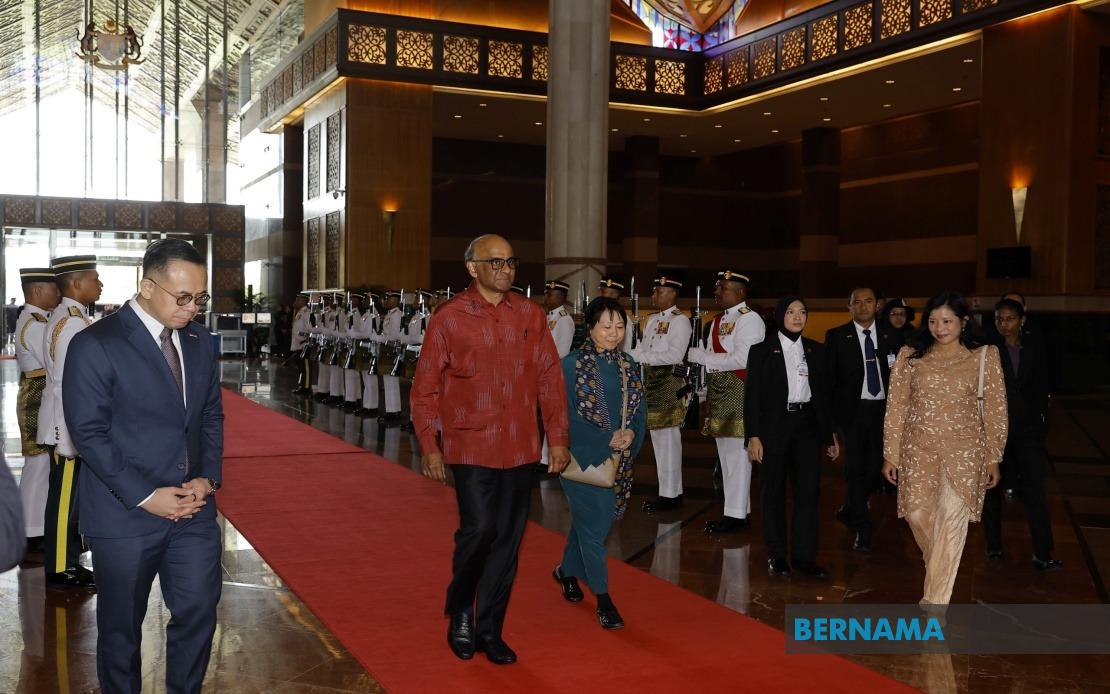
Singapore President Tharman Shanmugaratnam and his delegation departed Malaysia on July 15 after completing a three-day state visit that highlighted the enduring diplomatic warmth between the two closest regional neighbours. The President and his spouse Jane Ittogi boarded a commercial flight from Kuala Lumpur International Airport Terminal 1 at 2.20 pm, bringing to a close a visit that had encompassed formal ceremonies, high-level meetings, and engagements with Malaysia's royal establishment.
The departure saw Tharman accorded full ceremonial treatment befitting a visiting head of state. Upon arrival at the Bunga Raya Complex at 1.45 pm, he was formally honoured with a static Guard of Honour comprising two officers and 26 personnel from the First Battalion of the Royal Ranger Regiment, commanded by Capt Muhammad Hanafi Ja'afar. Minister of Entrepreneur and Cooperatives Development Steven Sim was present to extend official farewells on behalf of the Malaysian government, underscoring the significance attached to the bilateral relationship at ministerial level.
Tharman's visit, which commenced on Sunday at the personal invitation of His Majesty Sultan Ibrahim, King of Malaysia, served an important diplomatic function in the Malaysia-Singapore relationship. The three-day engagement represented his inaugural state visit to Malaysia since assuming the presidency on September 14, 2023, a milestone that carried particular symbolic weight given his recent ascension to the office. The timing and execution of the visit demonstrated the commitment both nations maintain toward maintaining regular high-level contact and reinforcing their foundational ties.
Crucially, the visit functioned as a reciprocal gesture to Sultan Ibrahim's state visit to Singapore on May 6 and 7, 2024. This pattern of mutual visits reflects the protocol-driven nature of Malaysia-Singapore relations, wherein each nation carefully calibrates diplomatic engagement to ensure balanced representation and acknowledgement of each other's significance. The reciprocal framework underscores how both countries, despite their historical complexities and contemporary challenges, remain committed to managing their bilateral relationship through formal channels and personal connections at the highest levels.
During his stay, Tharman engaged with Malaysia's key decision-makers and institutions. On Monday, he participated in a full state welcoming ceremony before being received in audience by Sultan Ibrahim at Istana Negara, the constitutional heart of Malaysian governance. This formal reception established the official tenor of the visit and positioned it within the framework of state-to-state relations rather than mere diplomatic courtesy.
Beyond the royal protocols, Tharman received a courtesy call from Prime Minister Datuk Seri Anwar Ibrahim, providing the visiting president with direct access to Malaysia's chief executive. The gathering brought together significant portfolio ministers including Foreign Minister Datuk Seri Mohamad Hasan, who oversees bilateral relations, Investment, Trade and Industry Minister Datuk Seri Johari Abdul Ghani, whose portfolio encompasses major economic dimensions of the relationship, and Minister Steven Sim. This concentration of ministerial attendance highlighted the breadth of bilateral engagement extending beyond ceremonial diplomacy into substantive policy domains.
The visit extended beyond federal-level engagement to encompass Malaysia's state-level structure. On the final full day of the visit, the Sultan of Selangor, Sultan Sharafuddin Idris Shah, granted Tharman an audience at Istana Alam Shah. This acknowledgement at the state level reflects how Malaysia's federal system ensures that visiting dignitaries engage with both national and regional leaderships, a practice that distributes diplomatic recognition across the constitutional hierarchy and acknowledges the importance of state-level actors in Malaysian governance.
For Malaysian observers and policymakers, Tharman's visit carries particular significance given Singapore's role as the region's financial centre and a critical economic partner. The presence of the Investment, Trade and Industry Minister at multiple engagements suggests ongoing discussions regarding bilateral economic cooperation, potentially addressing trade flows, investment frameworks, and sectoral collaboration that remain central to both nations' prosperity. Similarly, the involvement of the Foreign Minister indicates ongoing diplomatic consultations on regional issues, security matters, and multilateral coordination within ASEAN and beyond.
The visit also symbolises the continuity of Malaysia-Singapore relations across political transitions. Tharman represents a new generation of Singapore's political leadership, while Malaysia has experienced its own leadership changes in recent years. The careful orchestration of this state visit demonstrates both nations' understanding that maintaining stability and warmth in their bilateral relationship requires consistent investment in high-level dialogue, regardless of which individuals occupy top positions.
Looking forward, such visits establish the diplomatic infrastructure through which the two nations address their numerous shared concerns, from water agreements and land transportation to regional security and economic integration. While much attention in Malaysia-Singapore relations focuses on occasionally contentious issues, the formal, ceremonial nature of state visits serves the crucial function of affirming that beneath surface disagreements lies a fundamental commitment to coexistence and cooperation.
Tharman's departure marks the conclusion of an important diplomatic engagement, yet the visit's significance extends beyond its three-day duration. It sets the tone for continued engagement throughout his presidency and reinforces patterns of bilateral interaction that have evolved over decades. For the Malaysian government, the successful hosting of a Singapore presidential visit, conducted according to proper protocol and attended by senior ministers, demonstrates its capacity to manage one of Southeast Asia's most important and complex bilateral relationships with professionalism and strategic awareness.

