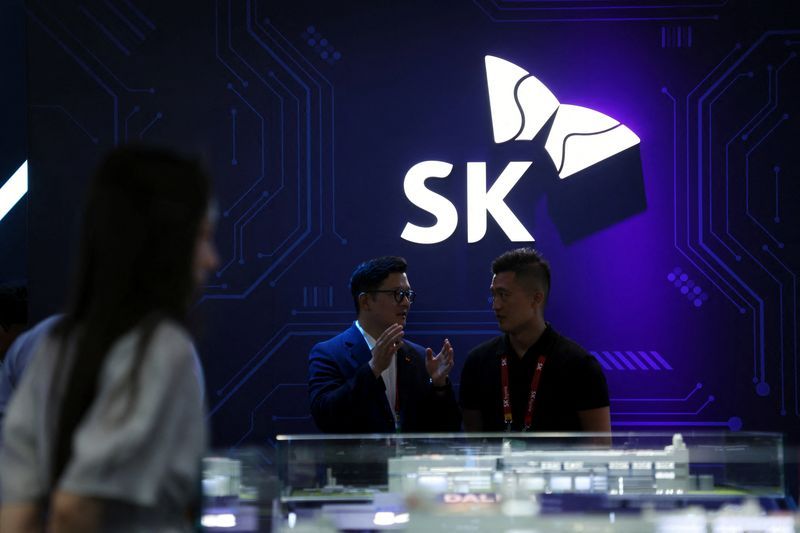
SK Hynix, South Korea's dominant memory chip manufacturer, announced plans on Wednesday to raise up to 45.45 trillion won, equivalent to $29.43 billion, through the listing of American Depositary Receipts on the Nasdaq exchange. The financing represents a landmark capital raise aimed at bolstering the company's position in the rapidly expanding artificial intelligence sector, where demand for specialized memory chips has surged dramatically. The exact proceeds may fluctuate following the bookbuilding process, where institutional investors will indicate their interest in the offering.
The Nasdaq listing, scheduled for July 10, will involve the issuance of 17.79 million new shares backing the ADR offering. The exchange rate structure will see ten ADRs representing one common share, a conversion ratio that reflects the company's strategy to broaden its shareholder base among international institutional investors while maintaining pricing accessibility. A consortium of major investment banks—BofA Securities, Citigroup Global Markets, Goldman Sachs, and JP Morgan Securities—will jointly manage the offering, underscoring the financial sector's confidence in the transaction's scale and success.
If the offering reaches the upper end of its indicated price range, SK Hynix would eclipse the previous record for ADR listings set by Chinese e-commerce giant Alibaba in 2014, when the firm raised $21.8 billion during its New York stock market debut. This milestone would cement the chip manufacturer's status as a generational capital raiser in Asian markets and reflect the extraordinary valuation commanded by companies positioned at the nexus of artificial intelligence infrastructure and supply chain dominance.
The capital raised through this offering will support SK Hynix's expansion of manufacturing capacity across multiple strategic locations and product lines. The company intends to construct a new chip fabrication facility in Yongin, South Korea, representing a significant expansion of its domestic production footprint. Simultaneously, SK Hynix plans to develop an advanced packaging facility in Cheongju, critical for the complex assembly and testing processes required for high-performance memory chips destined for data centres and AI applications.
Beyond facility construction, SK Hynix will deploy substantial funds toward acquiring cutting-edge chipmaking equipment, most notably an Extreme Ultraviolet Scanner, a specialized machine essential for fabricating chips at the most advanced technological nodes. The EUV technology represents the frontier of semiconductor manufacturing, enabling the production of increasingly dense and power-efficient chips that power contemporary artificial intelligence systems. Such capital-intensive equipment purchases reflect the capital demands inherent in maintaining technological leadership within the global semiconductor industry.
SK Hynix's capital raising ambitions arise from its commanding position as a critical supplier of high-bandwidth memory chips that power artificial intelligence computing infrastructure worldwide. The company serves marquee customers including chip designer Nvidia and Alphabet's Google, positioning it at the forefront of the AI revolution that has transformed global technology investment patterns. This customer concentration among leading technology giants underscores both the strategic value of SK Hynix's products and the company's exposure to the concentrated demand patterns of AI system developers and deployers.
The company's trajectory has been meteoric throughout 2024, culminating in its achievement of South Korea's most valuable company designation on Monday, surpassing the longstanding dominance of Samsung Electronics. This transition symbolizes a fundamental reordering of South Korea's technology landscape, where specialized chip manufacturers focused on artificial intelligence memory products have captured exceptional market premiums relative to broader diversified electronics manufacturers. The valuation shift reflects investor recognition that companies positioned in artificial intelligence supply chains command structural growth advantages unavailable to traditional technology businesses.
The timing of SK Hynix's ADR listing arrives during an extended bull market for artificial intelligence infrastructure and computing chips, driven by accelerating deployment of large language models and other advanced AI systems by technology enterprises and cloud service providers. The company's decision to access capital markets at this juncture reflects management confidence that near-term demand growth for AI memory chips will justify substantial capital expenditures for manufacturing expansion. This confidence extends to the company's ability to monetize expanded production capacity and justify the return on investment embedded within capital-intensive semiconductor facility construction.
For Malaysian and Southeast Asian investors and businesses, SK Hynix's capital expansion carries significant implications across multiple dimensions. The supply of advanced chips originating from South Korean manufacturers will influence regional technology infrastructure development and the cost structure facing companies building artificial intelligence systems and data centres throughout Southeast Asia. Moreover, SK Hynix's success in capital markets demonstrates the receptiveness of global institutional investors to pure-play semiconductor companies with credible positions in artificial intelligence supply chains, potentially influencing investment patterns directed toward technology enterprises throughout the region.
The offering also underscores South Korea's continued dominance within critical semiconductor segments, particularly memory chip manufacturing where Korean companies maintain near-monopolistic positions globally. This strategic positioning has enabled extraordinary capital accumulation and reinvestment cycles that further entrench Korean technological leadership. For Southeast Asian nations pursuing technology sector development and semiconductor manufacturing ambitions, SK Hynix's expansion trajectory illustrates the scale of capital and technical sophistication required to compete meaningfully within the global chip industry's most advanced segments.

