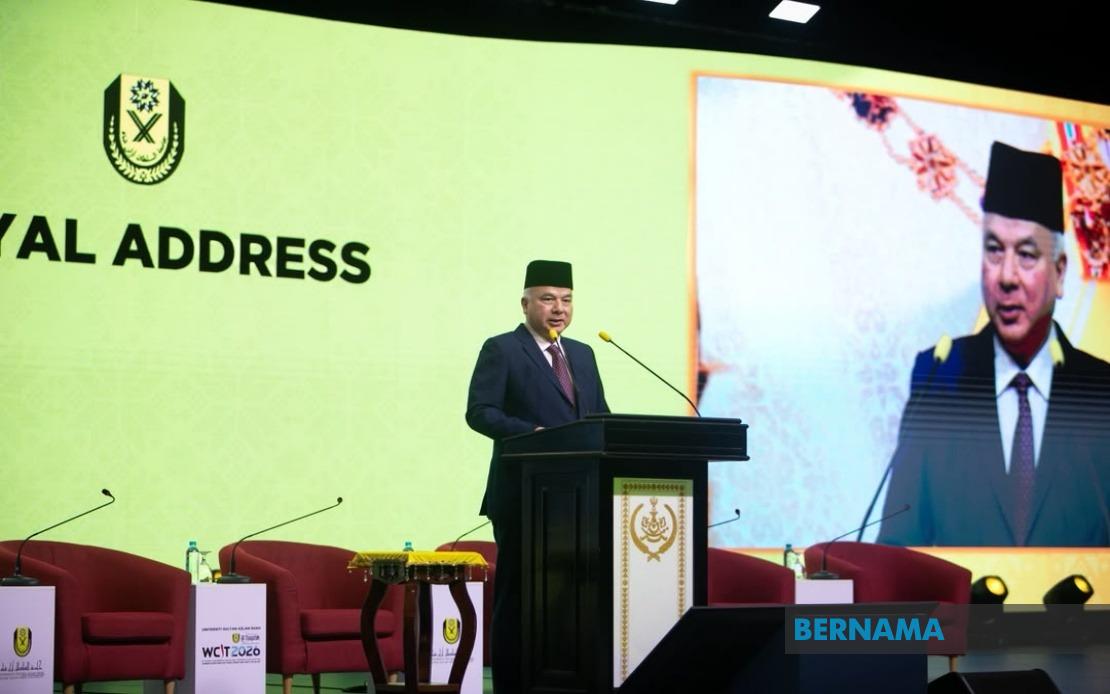
At the 8th World Conference on Islamic Thought and Civilisation in Ipoh, Sultan Nazrin Shah, the Sultan of Perak, articulated a vision of national security that extends far beyond traditional military and cybersecurity defences. While acknowledging the continued importance of border protection and countering digital threats and extremism, His Royal Highness positioned social harmony and inclusive national identity as the genuine foundation upon which a resilient state is built. This pronouncement carries particular weight in the Malaysian context, where demographic diversity and occasional communal tensions have long demanded careful navigation by political and religious leaders.
The Sultan's address, delivered in the presence of Deputy Prime Minister Datuk Seri Fadillah Yusof, Perak Menteri Besar Datuk Seri Saarani Mohamad, and Higher Education Minister Datuk Seri Dr Zambry Abd Kadir, directly confronted what he described as the exploitation of faith for factional political purposes. Sultan Nazrin emphasised that the manipulation of religious conviction to engineer division—rather than foster unity—and to promote exclusion contrary to the spirit of genuine community, represents a fundamental threat to national integrity. This warning reflects growing concerns across the Muslim-majority Southeast Asian region about the weaponization of religious identity in political campaigns and public discourse.
Central to Sultan Nazrin's argument is the proposition that citizens' psychological commitment to the nation—their sense of genuine belonging and stake in its prosperity—cannot be manufactured through security apparatus or state coercion. A polity secured from external enemies while internally fractured by corruption, injustice, and systemic exclusion has not achieved authentic security but merely deferred societal collapse. This perspective suggests that Malaysia's long-term stability depends less on surveillance systems or military expenditure than on ensuring that all communities perceive themselves as equitable participants in national success and governance.
The Sultan stressed that authentic national unity cannot be imposed through enforced homogeneity or the suppression of dissenting voices. Rather, resilient cohesion emerges when every community observes itself proportionally represented and fairly treated across legislative frameworks, economic opportunity, educational institutions, and leadership structures. This conception challenges authoritarian models of stability and aligns instead with emerging research in conflict studies suggesting that inclusive institutional design generates more durable political consensus than does top-down control.
For Malaysia, where constitutional provisions enshrine Bumiputera privileges and Islam's special position, Sultan Nazrin's framing invites reflection on whether current institutional arrangements foster or hinder the equitable sense of belonging he describes. His emphasis on communities seeing themselves "fairly" in the law and economy potentially signals the need for periodic reassessment of whether protections intended as transitional safeguards continue to serve cohesion, or whether they have become sources of resentment among non-beneficiary groups.
Pivoting to human capital development, Sultan Nazrin argued that Malaysia and other nations must simultaneously strengthen scientific and mathematical instruction whilst preserving humanities and artistic education. This integrated approach responds to the knowledge economy's demand for technical competence without sacrificing the ethical and philosophical grounding that enables societies to navigate complex moral questions arising from technological change. The Sultan rejected a false binary between vocational and academic pathways, insisting both merit equal societal investment and cultural prestige—a position with direct implications for Malaysia's education policy, which has historically privileged university-bound trajectories over technical training.
As artificial intelligence increasingly automates information retrieval and routine cognitive tasks, Sultan Nazrin identified critical thinking, ethical reasoning, creative problem-solving, and adaptability as distinctively human capacities that warrant educational priority. Rote memorisation and standardised testing, he noted, served industrial-era economies adequately but ill-equip young people for an age when information is instantaneously accessible. This diagnosis aligns with international educational reform movements but represents a notable departure from conventional Malaysian pedagogical emphasis on examination performance.
The Sultan further contended that Islamic education, properly conceived and drawing upon both revealed knowledge and rational intellectual inquiry, naturally cultivates precisely these higher-order capacities. This assertion reclaims Islamic learning from utilitarian or dogmatic framings, positioning it instead as a sophisticated tradition capable of developing the cognitive flexibility demanded by contemporary challenges. For Malaysia, where Islamic education exists in various institutional contexts—from national religious schools to private Islamic academies—the Sultan's articulation provides a philosophical template for distinguishing between education that genuinely develops human potential and systems oriented merely toward doctrinal transmission or examination success.
The conference's theme, "Everyone Matters: Pride and Unity in Islam," reflects an emerging discourse among Islamic scholars and leaders regarding Islam's capacity to accommodate pluralism and individual dignity. Sultan Nazrin's contribution situates national security and educational excellence within this broader theological conversation, suggesting that Islamic principles properly understood demand both inclusive governance and investment in human flourishing across sectarian and ethnic lines. This positioning is significant regionally, as it offers a counternarrative to accounts that characterise Islam and inclusive democracy as inherently incompatible.
For Malaysian policymakers, Sultan Nazrin's remarks implicitly challenge assumptions underlying some recent governance approaches. The emphasis on belonging rather than enforcement suggests that security strategies centred on surveillance, preventive detention, or restrictions on expression may prove counterproductive if they deepen perceptions of injustice or exclusion. Conversely, policies addressing economic inequality, ensuring fair judicial outcomes, and credibly incorporating all communities in institutional power-sharing could yield measurable improvements in social stability and resilience against extremist recruitment.
The Sultan's address also resonates with ongoing scholarly debate about the relationship between development, grievance, and conflict. Research increasingly indicates that poverty alone does not generate extremism or communal violence; rather, the combination of material deprivation with perceived systematic injustice and exclusion produces destabilising resentment. By foregrounding cohesion and belonging, Sultan Nazrin's framework redirects attention from addressing symptoms—tighter security, more surveillance—toward root causes residing in institutional fairness and inclusive economic participation.
Moving forward, the articulation of social cohesion as supreme security imperatives provides rhetorical and conceptual resources for civil society actors, educators, and moderate political voices advocating for inclusive policymaking. Whether Malaysia's institutions can operationalize the Sultan's vision—translating the ideal of equitable belonging into concrete legislative, economic, and educational reforms—remains an open question, but his intervention at WCIT signals that among the nation's most respected institutional figures, security understood as broad-based social solidarity commands serious intellectual and moral authority.

