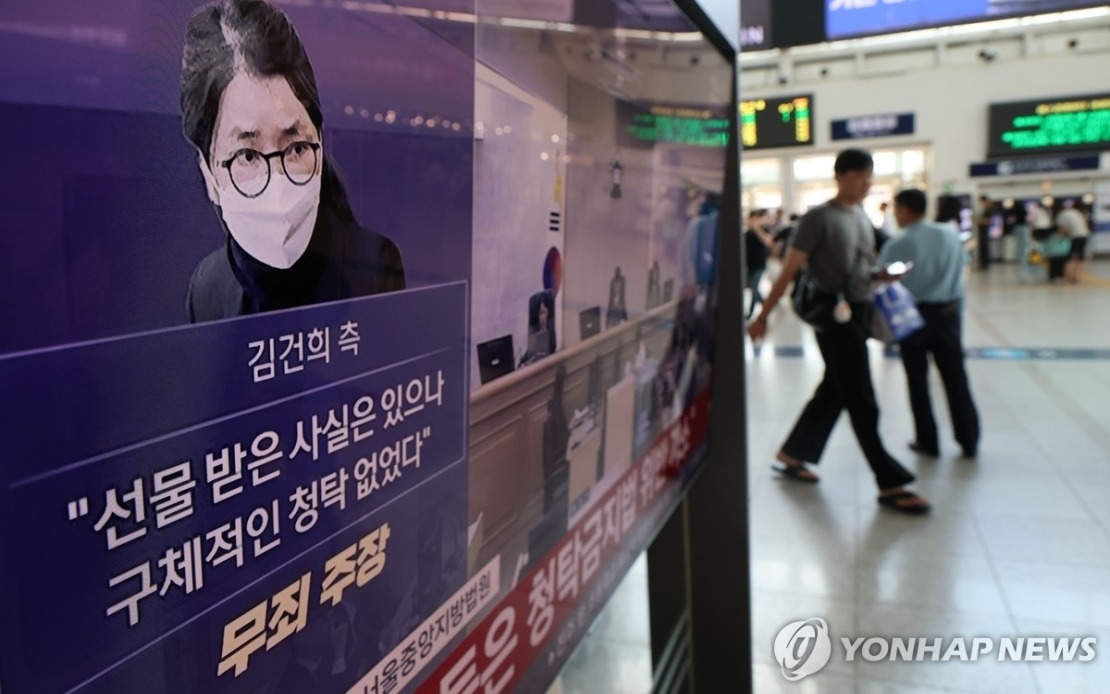
A Seoul court has delivered a significant blow to South Korea's political establishment by sentencing former first lady Kim Keon Hee to seven years imprisonment on charges of accepting bribes disguised as gifts. The Seoul Central District Court's decision on Friday represents a rare instance of legal accountability reaching the highest echelons of power in the country, marking a watershed moment in South Korean efforts to combat elite corruption.
Kim, who is married to ousted former President Yoon Suk Yeol, was convicted of accepting approximately 300 million won in gifts and jewellery between March 2022 and September 2022, primarily in exchange for leveraging her influence to secure government positions and business advantages for wealthy individuals and their associates. The court determined that she had weaponised her status as first lady to accumulate personal benefit rather than to serve public interests, establishing a pattern of transactional relationships with powerful businesspeople and former officials.
The specific charges reveal the granular nature of the alleged corruption scheme. Prosecutors documented that Kim received a Van Cleef & Arpels necklace and additional jewellery from a construction company chairman between March and May 2022, exchanging this favour for assistance in securing a government position for the executive's son-in-law. In April 2022, she accepted a golden turtle ornament from Lee Bae-yong, then head of the National Education Commission, as reciprocation for his own appointment. A Dior bag valued at 5.4 million won from a pastor and a Vacheron Constantin watch from another businessperson in September 2022 rounded out her collection of high-end gifts obtained through similar arrangements.
Presiding judge Cho Sun-pyo delivered a particularly cutting assessment during the televised proceedings, stating that Kim had fundamentally betrayed the public trust associated with her position. "The defendant disregarded the social responsibilities associated with the position of first lady and used it merely as a means to pursue her private interests," he declared, highlighting the court's view that her actions represented not merely personal malfeasance but a systemic abuse of institutional privilege.
The court's analysis of Kim's subsequent behaviour proved equally damaging to her defence. When investigators began their inquiries, she attempted to return certain gifts or claimed she had purchased them with her own funds—arguments that the judge found unconvincing and even incriminating. This defensive strategy, rather than establishing her innocence, demonstrated to the court that she possessed full awareness of the illegality of her conduct and actively sought concealment. The timeline matters considerably here: these transactions occurred predominantly during her husband's presidency from May 2022 until his removal from office in April 2025, meaning she wielded genuine institutional power during the period in question.
Beyond the immediate sentencing, the judgment carries broader implications for South Korean governance and institutional integrity. The special counsel's office, led by Min Joong-ki, had pursued a notably aggressive prosecution, requesting a sentence of seven-and-a-half years. That the court imposed precisely seven years suggests judicial confidence in the evidence and perhaps a measured but firm stance on presidential-adjacent corruption. Meanwhile, Kim's legal team has indicated plans to appeal, signalling that litigation on this matter will likely extend considerably longer.
The court also held accountable several other participants in the corruption network, though with more lenient sentences reflecting their secondary roles. The construction company chairman received a one-year prison term suspended for two years, the businessman who provided the watch faced a ten-month suspended sentence, and the pastor was fined 8 million won. These graduated penalties suggest a judicial hierarchy that distinguishes between the primary beneficiary of the scheme and those who facilitated it.
For Malaysian and Southeast Asian observers, the case underscores persistent governance challenges that extend across the region. South Korea, typically regarded as more institutionally advanced than many neighbouring economies, still struggles with corruption entrenched at the highest levels of the political system. The fact that a former first lady could orchestrate such an extensive influence-peddling operation highlights the structural vulnerabilities that exist when formal institutional checks remain insufficient to constrain family members of powerful executives.
Kim's legal troubles extend well beyond this sentence. An appeals court previously condemned her to four years imprisonment in a separate corruption investigation, meaning her total exposure exceeds a decade of potential incarceration should both convictions withstand appellate review. Additionally, she faces forthcoming trial proceedings related to her alleged involvement in coercing Unification Church members to join the People Power Party before the 2022 presidential election, an allegation that carries troubling implications for electoral integrity and religious freedom.
This constellation of cases targeting Kim reflects South Korea's determined, albeit imperfect, commitment to pursuing accountability regardless of political station. The transparency of the proceedings—with the judge's ruling broadcast live to the public—contrasts markedly with opaque processes in some regional peer nations, though critics might note that such accountability often arrives tardily and selectively.
The broader context matters for understanding how such corruption becomes embedded in governance structures. Presidential systems across East Asia frequently concentrate power within executive households, creating environments where family members exploit access and proximity to decision-makers. South Korea's institutional responses, including special counsel investigations and dedicated corruption courts, represent attempts to counterbalance these structural incentives, yet the continued prosecution of high-profile figures suggests these mechanisms remain perpetually inadequate to prevention.
For South Korean society itself, the sentencing provides a measure of institutional legitimacy—evidence that even the most connected individuals may eventually face legal consequences. However, the years elapsed between the alleged conduct and punishment, combined with the certainty that appellate processes will extend this timeline further, raise questions about the practical deterrent value of such justice, however dramatically delivered.

