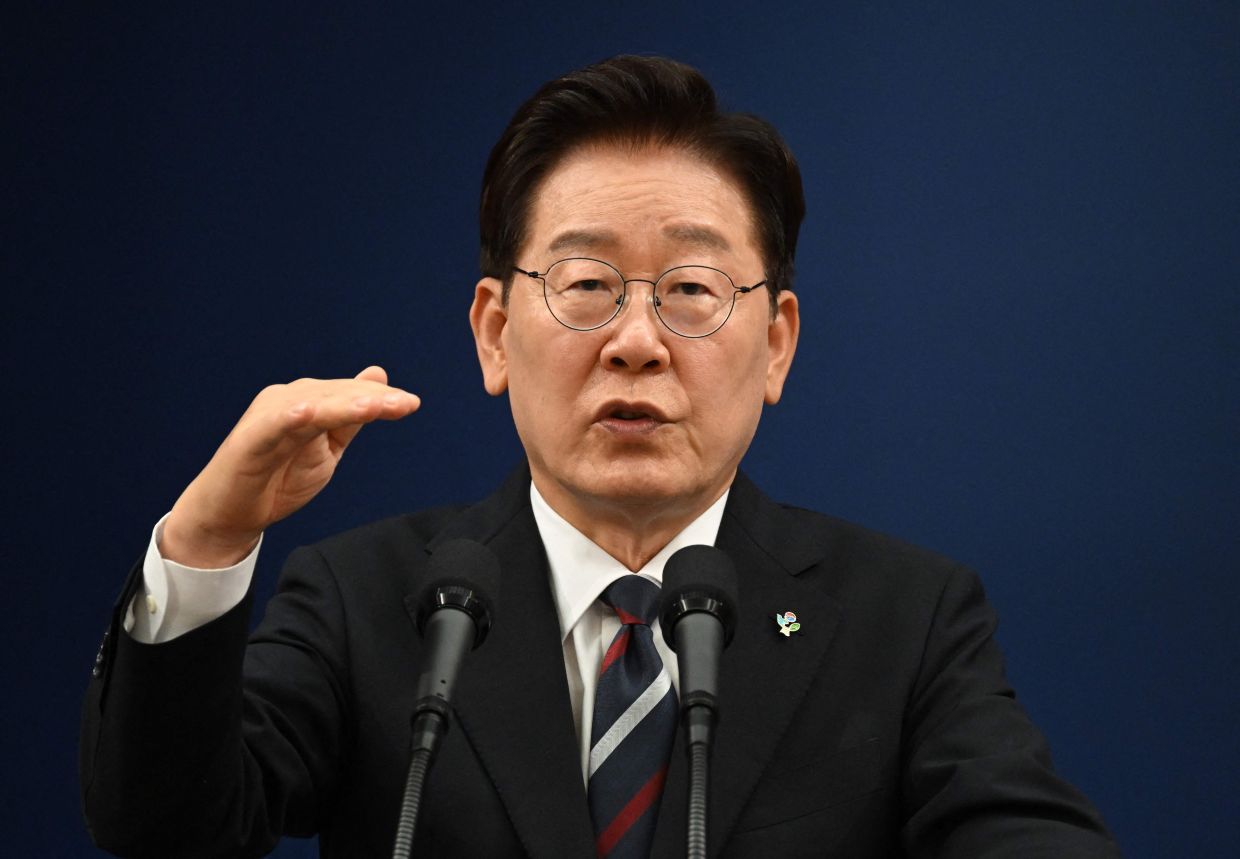
South Korean President Lee Jae Myung has experienced a significant erosion of public support, with his approval rating dropping into negative territory for the first time since assuming office in June 2025. According to polling data released in late June, only 46.7 percent of respondents approved of his job performance, marking the fifth consecutive week of decline and the first occasion his support has fallen below the 50 percent threshold. This milestone represents a watershed moment for the new administration, signalling substantial challenges ahead as Lee navigates his presidency during a critical phase.
The deterioration in public confidence has been steep and consistent. Lee's approval rating stood at a robust 60.5 percent in mid-May but has descended through 59.3 percent, 59.1 percent, and 55.2 percent in subsequent weeks before reaching the current 46.7 percent. Meanwhile, disapproval ratings have climbed to 49.7 percent, creating the crossover that political observers view as a turning point for any new administration. The remaining respondents, comprising 3.6 percent, expressed uncertainty about their assessment. While the gap between approval and disapproval remains technically within the survey's margin of error, the trajectory itself underscores genuine public discontent rather than statistical noise.
Comparative analysis reveals that Lee's slide into negative approval territory has proceeded more rapidly than his recent predecessors. Former President Yoon Suk Yeol experienced a similar crossover just six weeks into his term in June 2022, while Park Geun-hye took roughly sixteen months to reach the same point in mid-2014. Moon Jae-in required nineteen months before disapproval outpaced approval in December 2018. Lee's progression to this milestone within roughly three weeks of the crossover occurring suggests particularly acute challenges or a more pronounced public reaction to recent events than previous administrations encountered during comparable periods.
The immediate catalyst for the approval decline centres on two interconnected political crises. The June 3 local elections were marred by significant ballot shortages that undermined the electoral process and raised questions about administrative competence and preparedness. Simultaneously, the ruling Democratic Party of Korea faces intensifying internal divisions as factions manoeuvre for advantage ahead of August 17 convention to elect a new party chair. According to analysts, these overlapping controversies have crystallised public frustration and eroded the honeymoon period that newly inaugurated presidents typically enjoy. The combination of electoral mismanagement and visible party infighting creates an impression of governmental dysfunction precisely when Lee should be consolidating support.
Geographic variations in the approval decline reveal important fault lines in Lee's political coalition. The steepest drops occurred in traditionally conservative strongholds—Daegu and North Gyeongsang Province registered a 9.9 percentage point decline, falling to just 34.6 percent approval. This erosion of support in conservative heartlands is particularly troubling given that Lee draws his core backing from the Democratic Party, which traditionally dominates these regions. Greater Seoul, encompassing Seoul, Incheon, and Gyeonggi Province, also experienced significant deterioration, with approval sliding to 39.8 percent in Seoul proper and 44.8 percent across Incheon and Gyeonggi. The weakness in the capital region and surrounding areas represents a particular vulnerability, as Seoul metropolitan voters exercise outsized influence in national politics.
Demographic fractures have emerged along ideological lines, exposing vulnerabilities in Lee's coalition construction. Among moderate voters, approval dropped 4.9 percentage points to 47.5 percent, suggesting that centrist elements who might otherwise provide a stabilising force are increasingly dissatisfied. Support among liberal voters, who form Lee's primary constituency, declined by 3.2 percentage points to 80.4 percent—still robust but notably softer than earlier weeks. Even conservatives, typically hostile to Lee given his Democratic Party affiliation, saw minimal change at 19.8 percent approval, indicating little room for meaningful expansion in that direction. The pattern suggests Lee is losing support most rapidly among the moderate and independent voters essential for sustaining broader political viability.
While Lee's personal approval has deteriorated sharply, his Democratic Party has experienced a more mixed trajectory in parallel polling. The party gained 2.1 percentage points to reach 40.1 percent support in party preference surveys, slightly narrowing but still trailing the opposition People Power Party at 42.3 percent. This relative resilience in party support despite presidential approval collapse suggests voters may be distinguishing between Lee as an individual leader and the Democratic Party as an institutional force. The narrowing gap between the two major parties indicates that the bipartisan agreement to investigate the election administration failures may be helping both parties demonstrate commitment to accountability, thereby restraining the magnitude of partisan backlash that might otherwise occur.
The opposition People Power Party has encountered its own difficulties stemming from the same ballot shortage controversy. The party's approval rating declined 2 percentage points to 42.3 percent as internal conflicts intensified, particularly disputes over leadership resignation and competing approaches to addressing the electoral failures. Notably, the party hemorrhaged younger supporters at alarming rates, with approval among voters in their twenties plummeting 10.5 percentage points to 48.6 percent and dropping 5.1 percentage points among those in their thirties to 47.4 percent. This generational erosion within conservative ranks suggests deeper structural challenges in maintaining coalition cohesion, with young voters particularly alienated across the political spectrum.
Analysts have identified several cross-cutting factors influencing the approval landscape beyond the immediate political crises. Lee's European trip generated some positive international perception, and stock market performance, with the Kospi breaking through the 9,000-point barrier, provided modest economic optimism. However, these positive elements have been substantially outweighed by concerns over widening asset market disparities, which have particularly resonated among moderate voters and Seoul metropolitan area residents. The perception that economic gains are unevenly distributed, accruing disproportionately to wealthy asset holders rather than wage earners and ordinary families, appears to have eroded support particularly among those who might otherwise remain politically flexible.
In response to the polling data, Lee's presidential office issued a carefully calibrated statement acknowledging the results with expressed humility. Cheong Wa Dae indicated that the administration would take the public's concerns seriously and pay closer attention to citizen expectations regarding both economic conditions and state affairs generally. The cautious tone suggests recognition that the administration faces a credibility challenge requiring demonstrable policy responsiveness rather than defensive posturing. However, the statement notably avoided specific commitments or policy shifts, leaving open the question of whether mere acknowledgement will suffice to arrest the decline in public confidence or whether substantive measures will prove necessary.
For Malaysian observers and policymakers, the South Korean developments offer instructive precedents regarding the fragility of new administrations and the rapid erosion of political capital when governance challenges compound. The ballot shortage crisis and subsequent internecine party conflicts demonstrate how technical administrative failures can crystallise broader public dissatisfaction, particularly when coupled with perceptions of elite divisions and inattentiveness to ordinary citizens' economic concerns. The speed at which Lee's approval collapsed—from 60 percent to below 50 percent within weeks—underscores that initial electoral mandates provide limited protection against accumulating governance and political setbacks.

