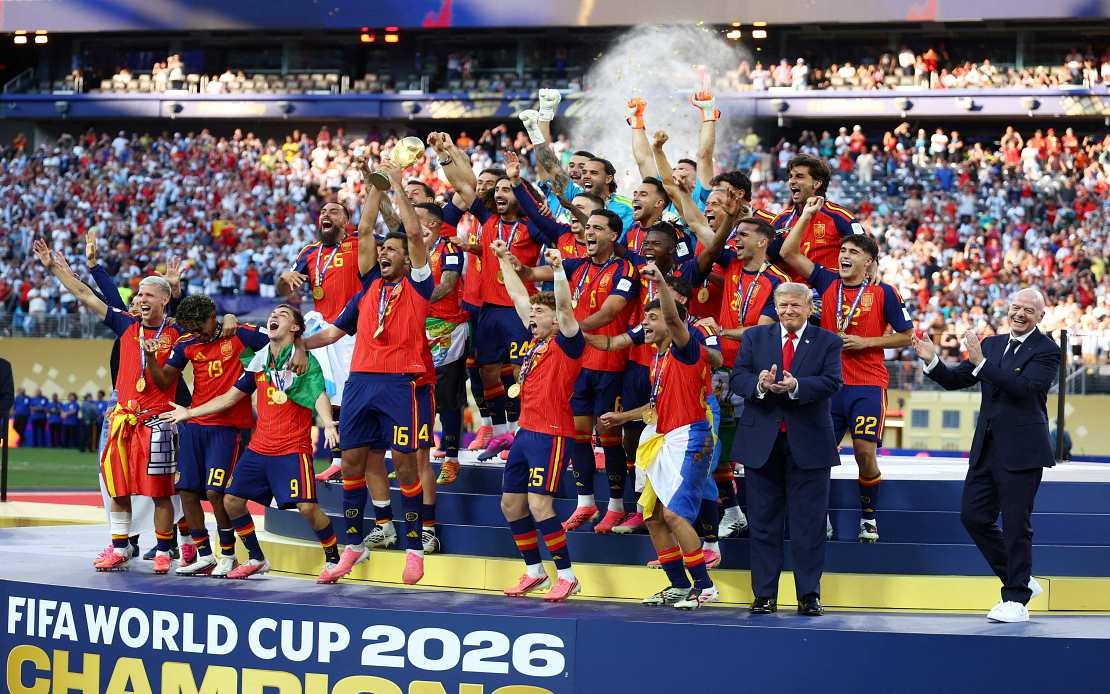
Spain's football team touched down in Madrid on Monday afternoon to an extraordinary outpouring of national celebration following their second men's World Cup title, claimed in a thrilling extra-time victory against Argentina in the United States on Sunday. The arrival at Madrid airport at 12:50 pm local time marked the beginning of a day-long festival of recognition for a squad that has brought the sport's greatest honour home to the Iberian nation once more. The scope of the festivities underscored the magnitude of the achievement and reflected the deep emotional investment Spanish football fans place in their national team's performance on the world stage.
Captain Rodri led his teammates back across the Atlantic following a commanding tournament run that culminated in Ferran Torres' dramatic extra-time strike against Argentina at the New Jersey stadium. The presence of the Spanish royal family at that decisive match, along with Prime Minister Pedro Sánchez, demonstrated the national importance of the competition and the highest levels of political and ceremonial support for the team's achievements. Sánchez subsequently posted on X: "We Are World Champions. Our national team is tremendous. Thanks, Team," capturing the mood of celebration sweeping across Spain in the hours following the victory.
The afternoon itinerary reflected Spain's formal state protocols for such momentous occasions. King Felipe VI would host an official reception at the Royal Palace, providing an opportunity for the monarch to personally congratulate the players and coaching staff on their triumph. Such ceremonies carry significant symbolic weight in Spanish culture and governance, representing the nation's recognition of sporting excellence and the athletes who have brought international prestige to the country. The royal audience would serve as a formal acknowledgement before the team transitioned to more populist celebrations connecting them with ordinary supporters across Madrid.
Following the palace reception, the team would embark on an open-top bus journey through Madrid's streets, a tradition that transforms major sporting victories into citywide festivals of public participation. Organisers anticipated that hundreds of thousands of supporters would line the route, creating scenes of jubilation and national pride that would extend far beyond the immediate vicinity of the city centre. Such parades serve multiple functions in Spanish civic life—they provide cathartic release for passionate football supporters, create shared memories across generations, and visually demonstrate the breadth of public enthusiasm for the national team's success.
The celebrations would reach their crescendo at Cibales Square, where a major public show was scheduled to commence at 6 pm, with the team expected to arrive at 9 pm. This carefully orchestrated timing allowed the event to transition into evening hours, when the square's lighting and visual displays would create maximum dramatic impact. The choice of venue and timing reflected Madrid's experience in hosting large-scale public gatherings and the desire to showcase the team's achievement to the widest possible audience while maintaining crowd management and public safety.
Defender Marc Cucurella articulated the players' desire to include the broader Spanish public in their moment of triumph. "We are really looking forward to returning to Spain. Many people couldn't be here and we want to celebrate with everyone. I think we deserve a good celebration," he remarked, emphasising that the squad viewed the victory as belonging not merely to those present in New Jersey but to the entire Spanish nation who had followed their progress. This sentiment reflects the contemporary understanding among professional athletes that their achievements gain meaning partly through collective national participation and shared emotional investment.
Spain's second World Cup title represents a significant milestone in the nation's football history, building on decades of development in player education, tactical innovation, and sustained competitive excellence. The pathway to this victory involved numerous qualifying matches, strategic tournament preparation, and the culmination of years spent cultivating talent through domestic leagues and youth development systems. The achievement stands as testament to the quality of Spanish football administration, coaching structures, and the deep cultural enthusiasm for the sport that permeates Spanish society across all demographic groups.
For Southeast Asian readers following global football, Spain's success illustrates the continuing dominance of European football at the highest competitive levels. The region's own football development efforts must contend with the established institutional advantages and resource availability that European football associations can deploy. Spanish football's success rests partly on sophisticated training academies, established pathways for youth development, and the financial resources that flow from commercial broadcasting agreements and sponsorship deals far exceeding those available to most Asian football federations.
The Madrid celebrations also reflected broader patterns in contemporary sports culture, where national sporting achievements serve as vehicles for public expression of patriotism and collective identity. In an era of social fragmentation and political polarisation within many democracies, major sporting triumphs provide rare moments of genuine national unity and shared purpose. The spontaneous gathering of hundreds of thousands of supporters at Cibales Square would represent an affirmation of Spanish national identity and a cathartic release of emotions that sporting competition uniquely enables.
The team's return and the orchestrated sequence of celebrations from royal palace to public squares demonstrated Spain's capacity to organise large-scale civic events that honour achievement while maintaining public order and safety. The coordination between government agencies, municipal authorities, security services, and event organisers required to execute such celebrations at this scale reflects sophisticated urban management capabilities. For other nations contemplating similar festivities following sporting successes, Spain's approach offers a model balancing formal ceremonial acknowledgement with inclusive public participation.

