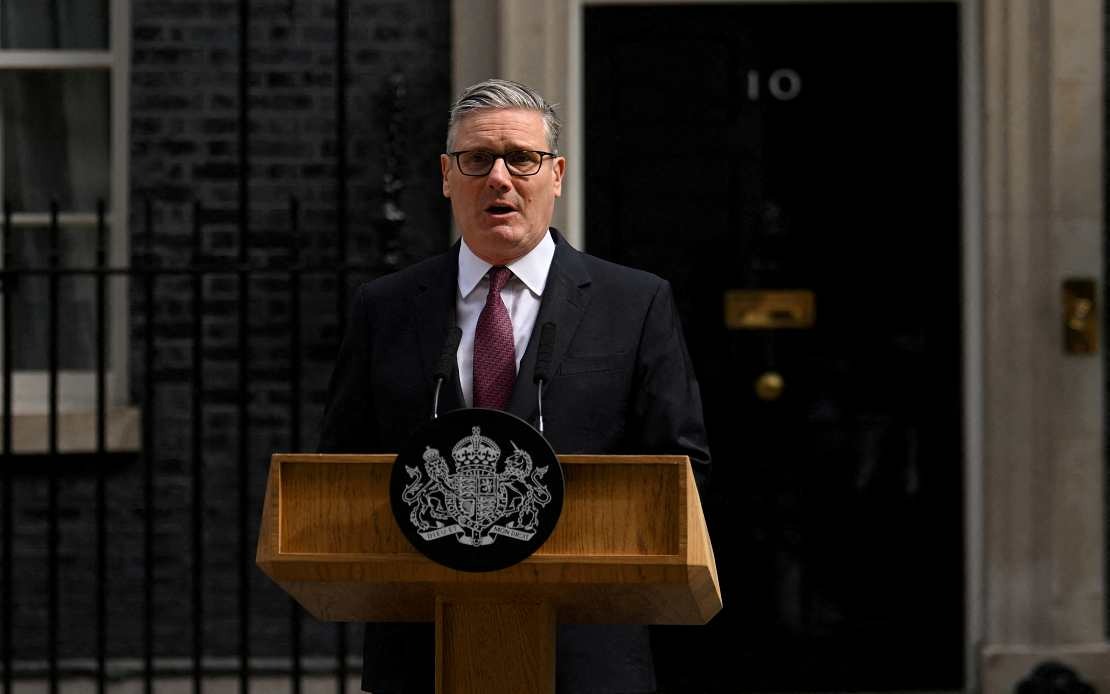
Keir Starmer has formally stepped down as Prime Minister of the United Kingdom, bringing an end to his tenure at Number 10 Downing Street. Speaking to gathered supporters, colleagues, and family members in Downing Street on Monday before proceeding to Buckingham Palace to tender his resignation to King Charles, Starmer reflected on his time leading the nation with characteristic composure, stating that his "work is done" and that he departs "with a smile."
The Labour leader's decision to hand over to Andy Burnham marks a significant transition within British politics, though the circumstances surrounding the change remain notable. Starmer had led the Labour Party to a commanding general election victory in 2024, securing a landslide mandate after years spent rehabilitating the party's standing following its devastating 2019 defeat under Jeremy Corbyn's leadership. His journey from party restoration to electoral triumph had taken six and a half years of determined effort to reshape Labour's appeal to British voters.
During his final remarks as premier, Starmer projected a tone of accomplishment and measured optimism about the nation's trajectory. He emphasized that Britain had emerged from his stewardship in a fundamentally improved condition, arguing that the country was "stronger and fairer" than when Labour assumed office two years prior. This assertion underpins his broader narrative of institutional and social progress, though such claims remain subject to debate among political observers and the broader electorate regarding tangible policy outcomes.
The departure of a sitting prime minister who enjoyed such a recent electoral mandate is unusual in contemporary British politics, raising questions about the pressures and challenges that necessitated his decision to step aside rather than complete a full parliamentary term. The transition occurs within the context of ongoing governance demands and the need for fresh leadership to navigate Britain's complex domestic and international challenges. Burnham's ascension represents a continuation of Labour governance while simultaneously offering an opportunity for renewed strategic direction.
Andy Burnham, who assumes the prime ministerial office following Starmer's resignation, brings his own political profile to the role. His elevation to the nation's top position concludes a period of internal Labour dynamics that shaped party strategy and public perception over the preceding years. The handover process itself reflects the mechanisms through which power transfers within the Westminster system, with formal resignation submitted to the monarch and subsequent appointment of a successor.
For Malaysian readers, this development carries significance in understanding the broader stability and continuity of Britain as a major trading partner and geopolitical actor. The United Kingdom remains an important economic and diplomatic partner for Malaysia, and transitions in British leadership can influence bilateral relations, trade negotiations, and regional security cooperation. The smooth transfer of power within Labour's ranks demonstrates institutional resilience in established democracies, contrasting with political turbulence in other regions.
Starmer's tenure, though relatively brief at two years following his 2024 election victory, represented an attempt to recalibrate British governance after the preceding Conservative government's extended period in office. His emphasis on making Britain "stronger and fairer" reflected the electoral promises upon which Labour had campaigned, focusing on economic recovery, public service improvements, and social cohesion. Whether such objectives were substantially achieved remains a matter for historical assessment and contemporary political evaluation.
The symbolism of Starmer's departure, framed positively around the completion of necessary work rather than forced removal, shapes the narrative surrounding leadership transition. By casting his resignation as timely rather than reluctant, and by explicitly passing authority to a designated successor, Starmer attempts to preserve his legacy while facilitating orderly governmental continuity. The involvement of his wife Victoria Starmer at Downing Street during his final moments as premier added a personal dimension to an otherwise formal constitutional process.
Burnham's assumption of the premiership carries expectations for renewed dynamism and policy direction within the Labour administration. His background and political positioning within the party will influence the government's strategic priorities and approach to governance challenges. The transition occurs at a moment when British politics faces persistent pressures regarding economic management, public service delivery, and international engagement.
The resignation represents a calculated decision within Labour's political calculus, suggesting internal assessment that new leadership would better serve the party's electoral prospects and governmental effectiveness. Such transitions, while sometimes reflecting deeper party tensions, can also represent proactive efforts to shape political narrative and maintain momentum. Burnham's position as incoming prime minister reflects confidence within Labour structures regarding his capacity to lead the government forward.
For Southeast Asian observers and Malaysian stakeholders, the stability demonstrated through this power transfer underscores institutional frameworks that enable orderly governance change. Britain's constitutional arrangements, while different from Malaysia's federal system, illustrate mechanisms through which democracies manage leadership transitions. Understanding such processes provides insight into how established Westminster-derived systems navigate political change while maintaining governmental continuity and public administration functionality.

