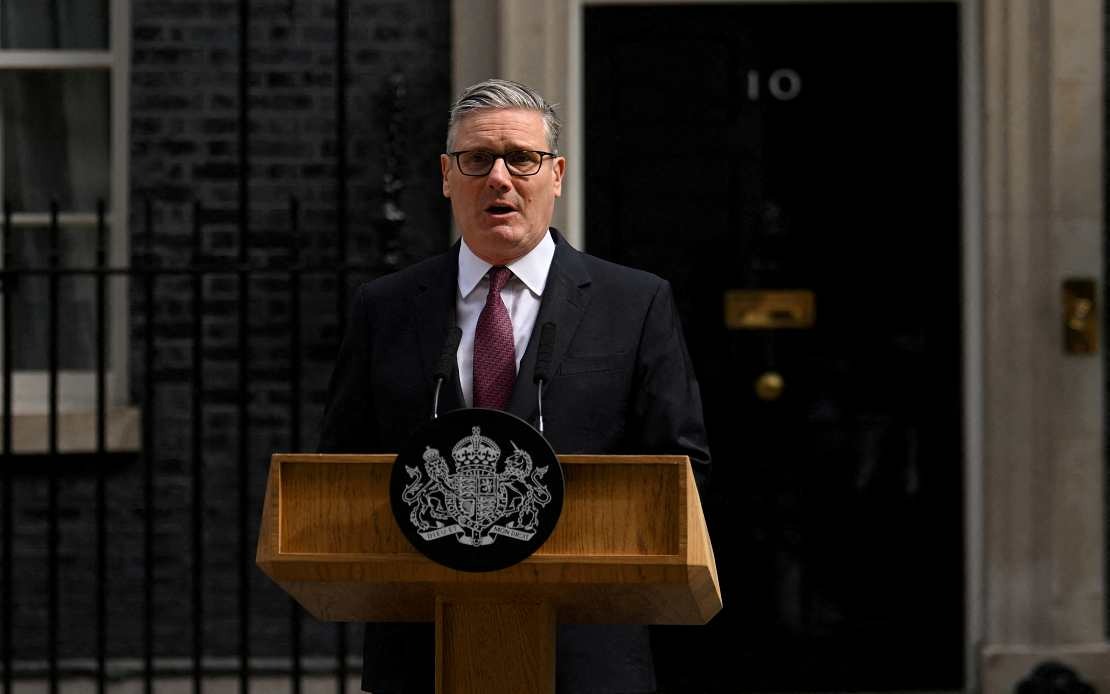
British Prime Minister Keir Starmer announced on Monday that he intends to resign as Labour Party leader, with a replacement to be selected and installed by September when parliament reconvenes. The announcement marks a dramatic reversal for a politician who secured one of Britain's most commanding electoral victories less than two years ago, a landslide Starmer had positioned as an antidote to years of political turbulence. Despite his initial triumph, which promised to restore stability to British governance, the Prime Minister has watched his political capital evaporate with astonishing speed, leaving his party fractured and his personal approval ratings at depths not recorded for any contemporary British leader.
Starmer's exit was precipitated by mounting discontent among Labour Members of Parliament, a groundswell that accelerated dramatically following the Greater Manchester mayoral election on Friday. Andy Burnham, the incumbent Greater Manchester mayor and a seasoned political operator recognised for his communication acumen, won that contest decisively. His victory carried particular symbolic weight because his opponent represented Nigel Farage's Reform UK party, which has dominated national polling averages for over a year. That triumph immediately catalysed speculation within Westminster that Burnham could reverse Labour's withering electoral prospects and restore the party to its former standing.
Burnham's performance offered Labour backbenchers a glimmer of hope that contrasted starkly with their party's current trajectory under Starmer's stewardship. The Manchester politician, with decades of experience navigating complex political challenges, appeared to represent a different kind of leader—one capable of reconnecting with an increasingly alienated electorate. His mayoral track record demonstrated an ability to manage substantial portfolios and communicate effectively with diverse constituencies, attributes that Starmer's administration has struggled to project. Within days of Burnham's election victory, momentum behind his potential candidacy for the top job had become irresistible, effectively sealing Starmer's fate within his own party.
The scale of Britain's political instability becomes apparent when examining the succession of prime ministers since the 2016 European Union referendum. Starmer's impending departure will make him the seventh prime minister to occupy Downing Street in a decade, a turnover rate unseen in nearly two centuries of British political history. This extraordinary churning of leadership reflects a deeper malaise afflicting British governance—the electorate's profound frustration with successive administrations' inability to improve living standards, reinvigorate struggling public services, or effectively address illegal immigration. Each new prime minister arrives promising transformation, yet each departs having failed to deliver on those undertakings, deepening public cynicism.
Yet any successor, including the widely anticipated Burnham, will inherit governance challenges of formidable complexity. Britain currently faces the highest borrowing costs among the Group of Seven industrialised nations, a consequence of elevated national debt, substantial interest payment obligations, persistently sluggish economic expansion, and chronic difficulties in controlling expenditure. Simultaneously, the country requires substantial new investment in defence capabilities to meet contemporary security challenges. These structural constraints leave minimal room for government manoeuvre, regardless of who occupies the Prime Minister's office.
Burnham's own positioning on these fiscal realities remains ambiguous. Though he declared last September that Britain must move beyond what he termed being "in hock to the bond markets," he has offered limited clarity regarding how he would navigate the competing demands of financial markets and public expectations for meaningful policy change. His broader vision for foreign affairs, economic management, and defence spending remains largely unspecified. Such ambiguity may reflect strategic circumspection, but it also highlights the considerable uncertainty surrounding his intended approach to governance.
Financial markets have begun scrutinising Burnham's prospective leadership with evident scepticism. Economists at Citibank assessed a Burnham premiership would inherit "a precarious fiscal situation with few tools to deliver meaningful change," suggesting that whatever rhetorical commitments he made about challenging bond market constraints, the practical realities of British public finance would likely constrain his capacity for transformative action. This analysis underscores a fundamental paradox confronting contemporary British politics: voters demand radical change addressing decades of accumulated policy failures, yet the structural conditions of public finance severely limit any government's ability to execute such transformation.
Starmer's decision to step down while remaining in post until a successor is chosen reflects what appears to be a negotiated arrangement aimed at managing the transition. The political advisory firm Eurasia had previously suggested that the optimal scenario involved Starmer announcing his departure while remaining in office through September, enabling him to represent Britain at a UK-European Union reset summit scheduled for July. This approach would provide Burnham—or whichever candidate ultimately prevails in any formal Labour leadership contest—with time to prepare for assuming executive responsibility.
The broader implications for Malaysia and Southeast Asia merit consideration. Britain's serial leadership instability demonstrates how electoral success alone cannot insulate leaders from subsequent political erosion, particularly when promised improvements in governance fail to materialise within sufficient timescales. The United Kingdom's experience illustrates that transformative change in complex modern economies proves extraordinarily difficult to achieve, even with substantial electoral mandates and parliamentary majorities. For regional observers, this pattern underscores the significance of managing expectations and delivering tangible improvements in living standards and public service provision before political capital dissolves, lessons equally relevant across Southeast Asia's developing democracies as they navigate governance challenges and public demands for improved outcomes.

