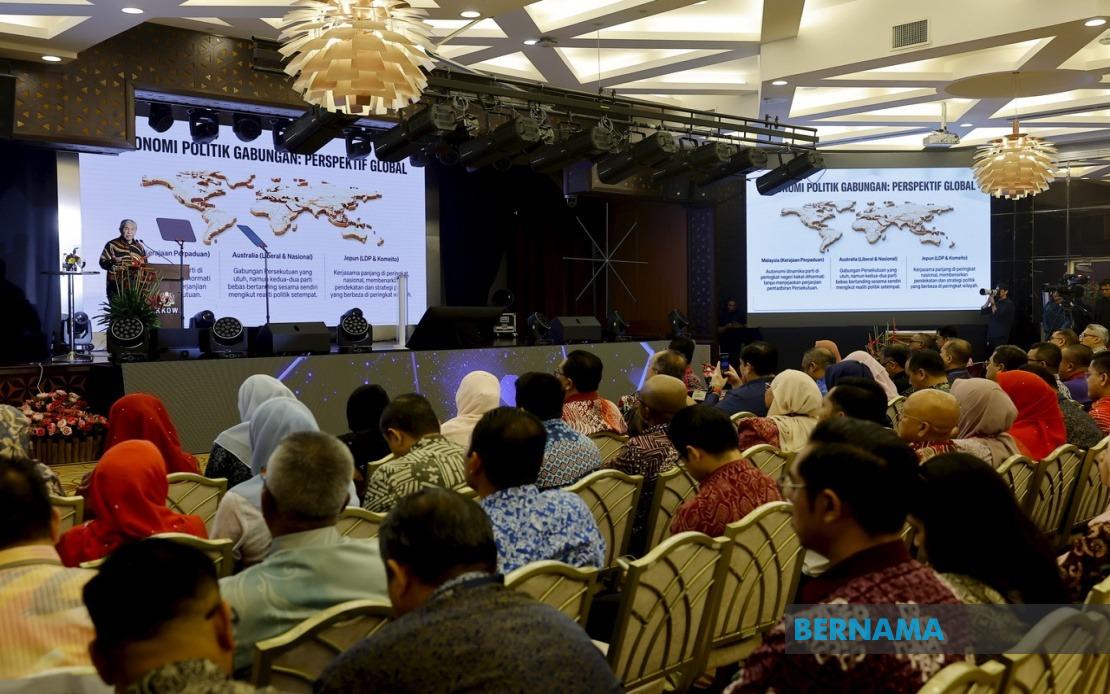
Deputy Prime Minister Datuk Seri Dr Ahmad Zahid Hamidi moved to reassure the nation on Wednesday that internal political competition at the state level would not compromise the stability or functioning of Malaysia's federal government, speaking against the backdrop of recent electoral contests in key states including Johor and Negeri Sembilan.
Addressing the Rural and Regional Development Ministry's monthly assembly in Putrajaya, Ahmad Zahid, who also chairs Barisan Nasional, emphasized that the Unity Government framework rests upon a binding mutual understanding and agreement that remains fully operative until Parliament is dissolved. This foundational accord, he suggested, provides sufficient structural safeguards to insulate federal governance from the volatile dynamics of state-level politics.
The statement carries particular significance in Malaysia's federal context, where states retain considerable autonomy in local governance whilst remaining subject to federal authority on matters of national importance. The existence of competing political interests across different states—and the occasional friction these generate—represents a normal feature of Malaysia's multi-tiered political system. However, Ahmad Zahid's remarks suggest the federal coalition governing structure is sufficiently resilient to accommodate such regional variations without fracturing.
Central to Ahmad Zahid's position is the assertion that the MADANI Government's administrative direction, policy implementation, and development programmes will proceed uninterrupted, irrespective of which party controls individual state administrations. This framing implies a deliberate separation between federal-level governance responsibilities and state-level electoral competition, allowing parties within the coalition to pursue distinct political strategies at the grassroots level whilst maintaining commitment to the federal arrangement.
The concept Ahmad Zahid introduced—that of political autonomy within a coalition government—addresses a tension inherent in multi-party governing arrangements. Under this model, component parties retain the liberty to advance their own political identities and strategic interests, provided they honour the foundational compact that binds the coalition together. This approach theoretically permits Barisan Nasional, Pakatan Harapan, and their coalition partners to compete vigorously in state elections without jeopardizing federal cohesion.
For Malaysian political observers, particularly those monitoring the stability of the Unity Government since its formation, Ahmad Zahid's statements provide reassurance that coalition partners have negotiated arrangements permitting political differentiation. The fact that parties need not surrender their political principles or electoral independence—even whilst governing jointly at the federal level—may actually strengthen the coalition's durability by reducing pressure on component parties to homogenize entirely or suppress their distinct voter bases.
The deputy prime minister's emphasis that government functions will continue as normal, with all public responsibilities fulfilled, also addresses practical governance concerns. Citizens and investors require assurance that policy continuity and administrative effectiveness will not deteriorate amid political maneuvering. By publicly anchoring federal stability to the continued validity of the coalition agreement rather than to any single party's dominance, Ahmad Zahid signals that the institutional machinery of government operates independently of electoral outcomes at the state level.
However, Ahmad Zahid's framing warrants careful scrutiny in light of Malaysia's recent political history. Previous federal coalitions have fractured when state-level defeats generated momentum for realignment or when the distribution of power within federal arrangements became contested. The stability Ahmad Zahid describes depends crucially on coalition partners maintaining confidence in the agreement's fairness and their respective roles within it. State election results that significantly alter the balance of power—by strengthening some parties whilst weakening others—could ultimately create pressure on the federal arrangement, even if the immediate institutional impact remains contained.
The specific mention of Johor and Negeri Sembilan appears strategic, as these states hold particular significance within Malaysia's political geography. Johor, as the largest state by electoral representation in Parliament and traditionally a BN stronghold, carries disproportionate weight in coalition calculations. Negeri Sembilan's political trajectory similarly influences broader perceptions of momentum. By asserting in advance that outcomes in these states will not alter federal government stability, Ahmad Zahid attempts to establish a preemptive narrative frame within which election results are interpreted as regional phenomena rather than harbingers of federal realignment.
The remarks also reflect sophisticated understanding of coalition management in Malaysia's plural political environment. Rather than demanding absolute party loyalty across all electoral contests, the Unity Government appears constructed to accommodate legitimate competition amongst coalition partners in state-level contests. This flexibility may represent a learned lesson from previous attempts at political cooperation that foundered when parties felt constrained by coalition obligations to subordinate their interests entirely.
Looking forward, the durability of Ahmad Zahid's stability assertions depends on whether the coalition's foundational agreement truly possesses the structural elasticity he describes. Should state-level competitions produce results that fundamentally alter perceptions of which parties are ascending or descending within the coalition hierarchy, or if electoral patterns suggest that some component parties are becoming electorally irrelevant, pressure for federal-level renegotiation could emerge regardless of formal commitments. For now, Ahmad Zahid's message seeks to establish that Malaysia's federal government operates according to constitutional principles and coalition agreements that transcend the volatility of state politics.

