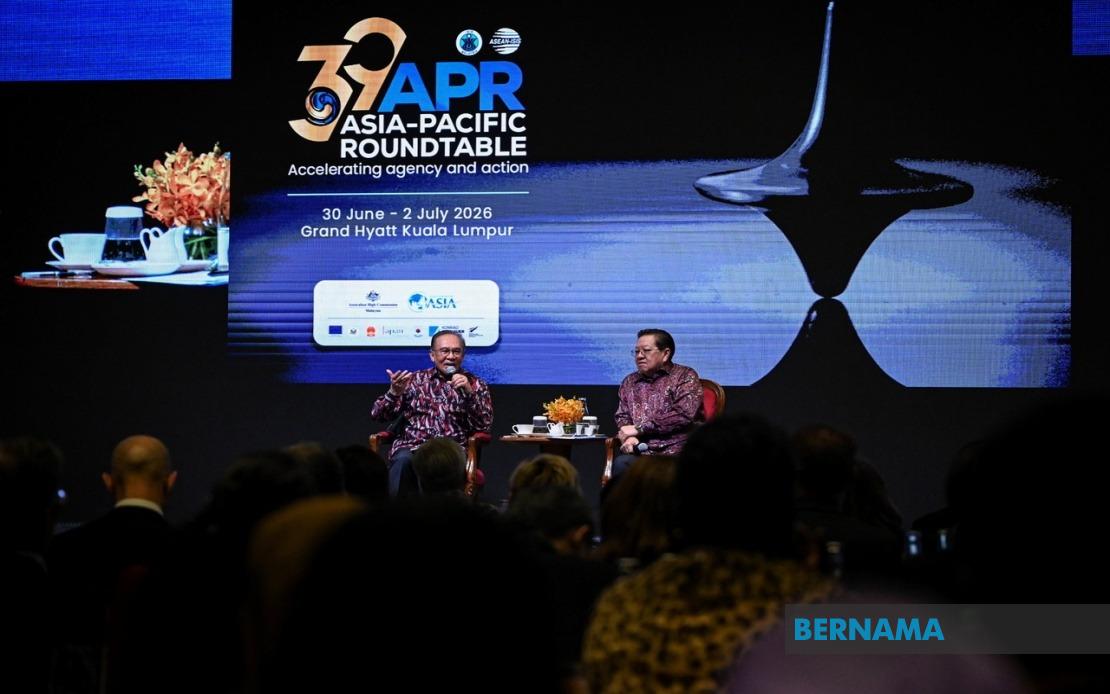
Prime Minister Datuk Seri Anwar Ibrahim has stressed that Malaysia's most pressing responsibility lies in reinforcing its governance structures and institutional frameworks at home, arguing that any credible role the nation wishes to play on the global stage must be underpinned by successful domestic reform. Speaking during a question-and-answer session at the 39th Asia-Pacific Roundtable in Kuala Lumpur on July 2, Anwar outlined a vision where Malaysia consolidates its strengths internally before assuming broader responsibilities internationally.
The Prime Minister identified four cornerstone objectives that form the backbone of his administration's domestic agenda. These encompass enhancing governance standards across public institutions, dismantling systemic corruption that has long plagued Malaysia's bureaucracy, narrowing the wealth gap that continues to disadvantage marginalised communities, and ensuring that quality education and healthcare remain accessible to every Malaysian regardless of socioeconomic background. This comprehensive approach reflects an understanding that governance reform encompasses far more than administrative efficiency; it involves building equitable systems that serve all citizens fairly.
While acknowledging Malaysia's commitment to engaging with international affairs and articulating principled positions on global issues, Anwar emphasised that his government's immediate energies must concentrate on nation-building and institutional transformation. He highlighted the particular significance of demonstrating that a Muslim-majority democracy can simultaneously uphold rigorous democratic principles, embrace moderation as a governing philosophy, and foster genuine inclusivity across religious and cultural lines. This positioning carries considerable weight in contemporary geopolitics, where the relationship between Islam and liberal democracy remains contested in many quarters.
In characteristically direct language, the Prime Minister articulated his determination to catalyse meaningful change within Malaysia's governance ecosystem. He called for leveraging governmental authority to represent the interests of ordinary citizens and to guarantee fundamental rights to education and healthcare for every Malaysian. This rhetorical emphasis on the common person reflects a populist dimension to his administration's messaging, suggesting that governance improvements should ultimately benefit ordinary Malaysians rather than elite networks.
Anwar also cautioned against a simplistic interpretative framework that reduces global tensions to a binary "clash of civilisations" narrative. Instead, he proposed that many international conflicts originate from incomplete understanding and deep-rooted prejudice between communities. Drawing on the intellectual legacy of the late Palestinian-American scholar Edward Said, Anwar recharacterised contemporary global divisions as a "clash of ignorance," suggesting that people frequently form sweeping judgements about distant societies and cultures without meaningful engagement or genuine comprehension.
This conceptual reframing carries particular resonance for Malaysia, a nation whose prosperity and social stability depend substantially on interfaith and intercultural dialogue. The Prime Minister's invocation of Said's critical framework signals an intellectual approach to diplomacy that privileges nuance and cultural literacy over confrontational positioning. For Southeast Asian policymakers navigating an increasingly multipolar international order, this analytical perspective offers an alternative to zero-sum geopolitical calculations.
Anwar made explicit reference to Malaysia's MADANI framework, which he described as maintaining equilibrium between technological progress and the preservation of core human values. Rather than pursuing modernisation at the expense of cultural identity or ethical considerations, this framework aspires to achieve development that enriches both material circumstances and spiritual wellbeing. The approach acknowledges that sustainable development in diverse societies requires simultaneous attention to innovation and human-centred governance.
Drawing on the Islamic concept of "li ta'arafu," which translates roughly to mutual knowing or acquaintance, the Prime Minister advanced the proposition that multiracial and multireligious societies should aspire beyond mere tolerance of difference toward genuine comprehension and appreciation of other communities' perspectives and values. This theological and philosophical foundation provides what Anwar evidently views as a more robust basis for social cohesion than passive acceptance of diversity. For Malaysia, a nation with significant Malay-Muslim, Chinese, Indian, and indigenous communities, this principle carries practical implications for how citizens navigate shared public spaces and democratic processes.
The emphasis on moving beyond tolerance to understanding reflects a sophisticated understanding of Malaysia's particular vulnerabilities and strengths. The country has experienced periodic episodes of communal tension, most notably in 1969, making the cultivation of deeper intercommunal understanding a matter of genuine national concern. By articulating a vision where citizens actively seek to comprehend and value differences rather than merely coexisting, Anwar positions governance improvement as inseparable from social harmony and national cohesion.
These statements at the Asia-Pacific Roundtable suggest that Anwar's administration views domestic institutional reform and social harmony as prerequisites rather than obstacles to Malaysia's international engagement. By prioritising governance strengthening, the Prime Minister indicates that Malaysia intends to approach regional and global affairs from a position of internal stability and moral clarity. This sequencing—consolidating domestic foundations before expanding international commitments—represents a deliberate strategic choice that acknowledges the connection between internal legitimacy and external influence.
For Malaysian observers and Southeast Asian analysts, Anwar's remarks underscore an administration that appears conscious of the limits of Malaysia's international leverage and the fundamental importance of domestic credibility. The emphasis on democratic values, anti-corruption efforts, and inclusive governance speaks to an understanding that Malaysia's competitive advantages in regional diplomacy ultimately derive from the legitimacy and effectiveness of its institutions at home. In an era when many developing democracies face erosion of public trust, this prioritisation of foundational governance reform may prove consequential for Malaysia's trajectory over the coming decade.

