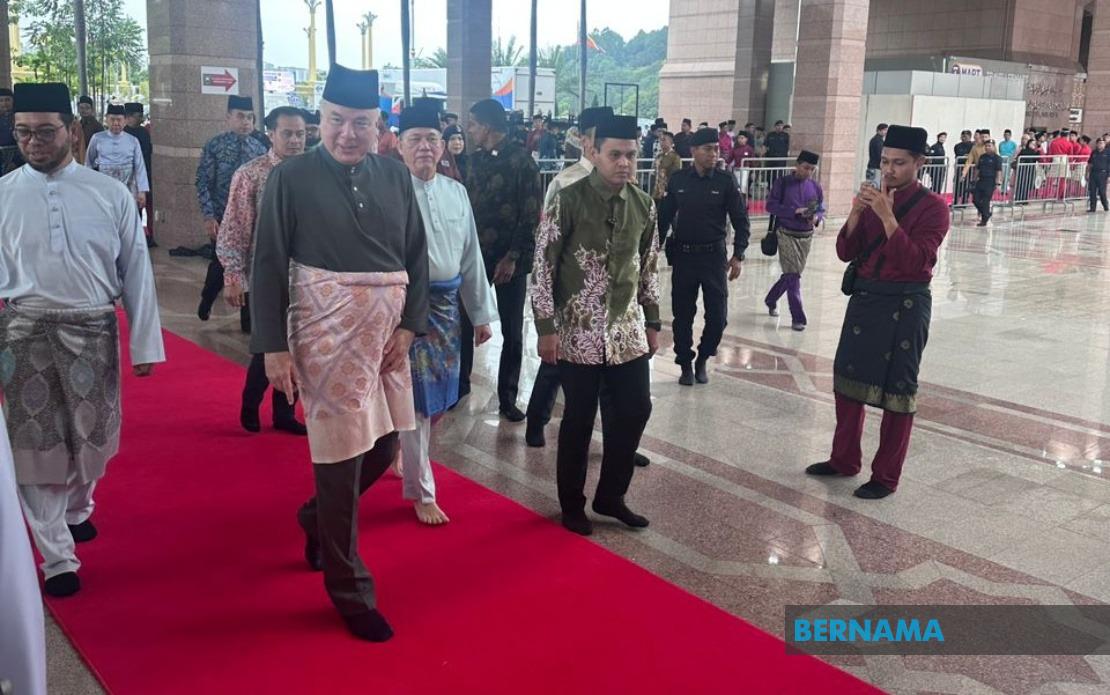
Deputy Yang di-Pertuan Agong Sultan Nazrin Shah delivered a pointed address to Malaysia's leadership at the National Level Maal Hijrah 1448 Celebration in Putrajaya, warning against the perils of impulsive governance and the human cost of reckless decision-making. Speaking before approximately 5,000 attendees at the Putra Mosque, the Sultan of Perak articulated a vision of leadership grounded in careful deliberation, moral clarity, and long-term strategic thinking—a message that carries particular resonance in the Malaysian political context where rapid shifts in policy and sudden reversals have occasionally generated public uncertainty.
The Sultan's critique of emotionally driven governance strikes at the heart of contemporary political challenges across the region. When leaders prioritise immediate reactions over reasoned analysis, he cautioned, the consequences ultimately cascade down to ordinary citizens who bear the financial, social, and institutional costs. This observation reflects broader concerns about decision-making processes in plural societies where competing interests, ideological pressures, and factional considerations can overwhelm systematic policy formulation. The Sultan emphasized that genuine leadership demands intellectual discipline—the capacity to absorb comprehensive information, weigh competing considerations, and act with measured confidence rather than reactive haste.
Drawing from the historical example of Prophet Muhammad's selection of Abdullah bin Uraiqit as guide during the Hijrah, Sultan Nazrin introduced a sophisticated principle relevant to modern governance: the recognition of competence and trustworthiness regardless of background or identity. This narrative carries particular weight in Malaysia's multicultural context, where institutional credibility depends partly on the perceived impartiality and merit-based selection of advisors and officials. The Sultan's invocation of this precedent underscores that effective leadership transcends sectarian or ideological boundaries when the stakes involve national survival and prosperity. Such selection criteria—based on expertise, integrity, and reliability—offer a model for institutional development that resonates beyond religious contexts.
The Sultan expanded his analysis to encompass the concept of sacrifice, framing it not as passive acceptance but as active subordination of personal interest to collective welfare. This philosophical foundation underlies sustainable national development, particularly in societies confronting resource constraints, demographic challenges, or external pressures. The Sultan expressed dismay at what he perceived as erosion of this sacrificial ethos within contemporary society, where rhetoric often substitutes for genuine commitment. His call to revitalize this cultural value addresses a real tension in modernizing economies where individualism and collective responsibility can pull in opposing directions. Rebuilding this spirit, he suggested, constitutes essential preparation for navigating intensifying global turbulence.
Unity and cooperation emerged as central themes in the Sultan's discourse, particularly through reference to the Medina Charter as a historical template for multi-communal governance. This seventh-century document successfully established coexistence frameworks across diverse populations—a achievement the Sultan identified as foundational to Islamic civilization's historical flourishing. Applied to contemporary Malaysia, this framework suggests that national advancement depends fundamentally on collaborative structures that respect difference while maintaining institutional coherence. The Sultan's emphasis on just and wise governance as prerequisite for such unity implicitly acknowledges that pluralism requires more than tolerance; it demands active commitment to equitable systems that command legitimacy across community boundaries.
The timing of these remarks at a Maal Hijrah celebration provided a structured opportunity to connect spiritual reflection with practical governance principles. Rather than treating the Islamic calendar's transition as mere commemorative routine, the Sultan repositioned it as an occasion for institutional and personal recalibration. This interpretation aligns with Islamic intellectual tradition emphasizing continuous moral examination and course correction. For Malaysian policymakers across various levels, this invitation to structured self-reflection suggests systematic evaluation of institutional performance against stated values and long-term objectives.
The Sultan's address implicitly critiques decision-making processes that prioritize short-term political advantage or factional positioning over comprehensive national benefit. In Malaysia's parliamentary democracy, where coalition dynamics and electoral calculations frequently influence policy formation, this caution carries tangible weight. The Sultan is effectively calling for elevation of deliberative standards—insisting that leaders approach governance with the rigor traditionally associated with strategic military campaigns or major institutional undertakings, rather than reactive responses to immediate pressures. This standard, if internalized by political actors, would reshape expectations around government transparency, consultation processes, and policy rationale articulation.
The gathering's attendance by Deputy Prime Minister Datuk Seri Fadillah Yusof and Minister in the Prime Minister's Department (Religious Affairs) Dr Zulkifli Hasan positioned these messages squarely within active governance circles. The presence of senior cabinet figures suggests receptivity to monarchical guidance on institutional culture and decision-making methodology. In Malaysia's constitutional framework, the Yang di-Pertuan Agong and state rulers function partly as custodians of institutional values and national continuity, articulating principles that transcend immediate partisan cycles. Sultan Nazrin's interventions through such forums contribute to broader conversations about governance standards while respecting the boundaries of constitutional monarchy.
The Sultan's warning against the diminishment of sacrificial spirit warrants particular attention from development planners and social policymakers. Nation-building in the face of regional competition—whether economic, technological, or geopolitical—demands sustained commitment and resource allocation that often imposes short-term costs for long-term gains. Public acceptance of such tradeoffs depends partly on cultural narratives emphasizing collective purpose. The Sultan's call to revitalize this value proposition addresses a genuine challenge in market-oriented societies where individualistic incentives can erode institutional capacity for sustained collective effort.
The Sultan's framing of Maal Hijrah as moment for self-examination rather than mere calendar commemoration offers conceptual framework applicable across Malaysia's diverse institutional landscape. Government agencies, private sector organizations, and civil society groups might productively approach such occasions as structured opportunities for assessing alignment between stated missions and actual performance, between values promoted and institutional practice. This interpretive move transforms religious observance into governance methodology, suggesting practical pathways for translating spiritual principles into improved administrative and policy processes.
Regionally, the Sultan's emphasis on wise leadership and strategic planning carries implications beyond Malaysia's borders. Southeast Asian nations across varying political systems confront similar pressures toward reactive governance, factional competition, and erosion of institutional capacity for long-term planning. His articulation of leadership standards—grounded in careful judgment, sacrificial commitment, and inclusive cooperation—contributes to regional intellectual discourse about governance quality and institutional development. The principle that national greatness derives from learning from past experience to build superior futures applies universally across the region's developing democracies and monarchies.
The Sultan's address ultimately presents leadership as requiring intellectual and moral discipline—a corrective to contemporary political cultures sometimes dominated by messaging agility, rapid response capacity, and factional calculus. By invoking historical Islamic precedent, contemporary multicultural necessity, and future-oriented strategic logic, Sultan Nazrin constructs a compelling case for governance elevation. Whether Malaysian political actors will internalize these principles sufficiently to reshape institutional decision-making processes remains an open question, but the public articulation of such standards contributes meaningfully to ongoing negotiations around governance quality and national direction.