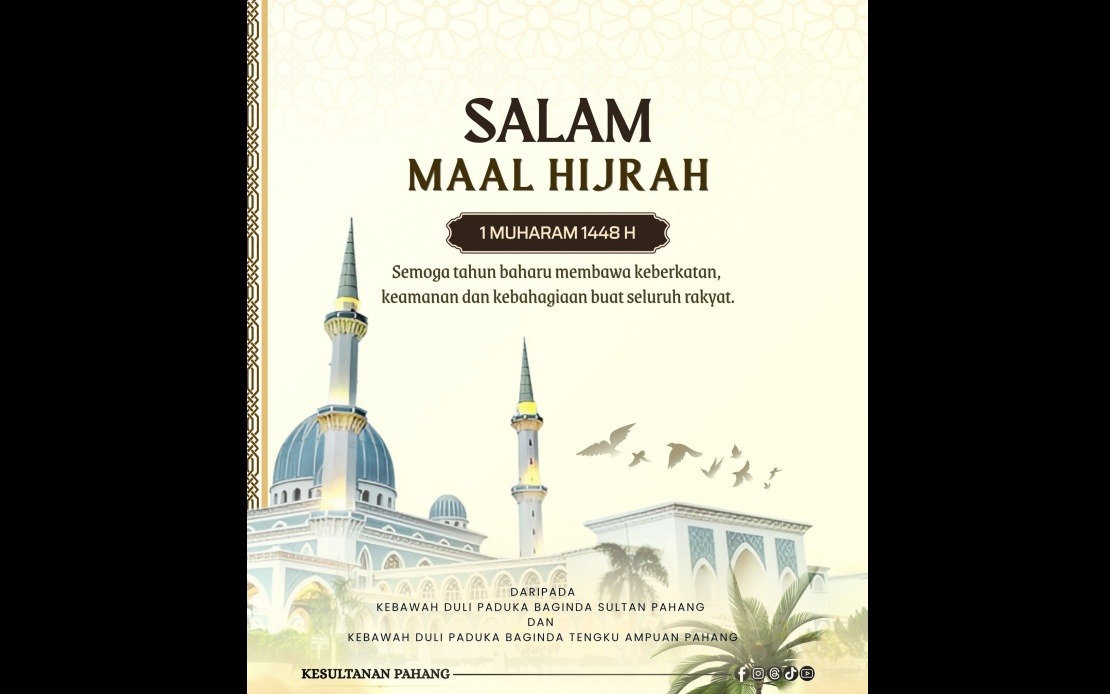
The Sultan of Pahang, Al-Sultan Abdullah Ri'ayatuddin Al-Mustafa Billah Shah, and the Tengku Ampuan of Pahang, Tunku Azizah Aminah Maimunah Iskandariah, have issued their official greetings marking the Islamic New Year 1448 Hijri, conveying hopes that the occasion will usher in a period of prosperity, tranquility and contentment for residents throughout the state. The message, distributed through the official Kesultanan Pahang social media channels, reflects the traditional role of the monarchy in reinforcing spiritual and social values during significant religious observances within Malaysia's Islamic calendar.
The couple's greeting carries particular weight in the context of contemporary Malaysian society, where leadership messaging during religious festivals serves to unite diverse communities and underscore shared values. By publicly acknowledging Maal Hijrah, the rulers affirm the importance of the Islamic calendar in the state's collective life while addressing their subjects with messages of hope and inclusive prosperity. The timing of such greetings demonstrates how constitutional monarchies in Malaysia integrate religious observance with governance, using these moments to communicate beyond ceremonial functions and articulate their vision for the state's development.
Maal Hijrah commemorates the migration of Prophet Muhammad and his followers from Mecca to Medina in 622 CE, representing a pivotal moment in Islamic history that symbolises renewal, resilience and moral transformation. In the Malaysian context, where Islam holds a constitutionally recognised position as the religion of the Federation, the occasion has evolved into a national moment of reflection and spiritual recommitment. The participation of Pahang's highest-ranking leaders in extending formal greetings elevates the significance of the observance and encourages citizens to engage with the deeper spiritual dimensions of the Islamic calendar rather than treating it as merely a day off work.
Parallel to the rulers' message, Pahang Menteri Besar Datuk Seri Wan Rosdy Wan Ismail contributed his own statement, framing the new Islamic year as an opportunity for personal and collective introspection among Muslims. His commentary emphasised the concept of hijrah not merely as a historical event but as a metaphorical framework for positive change and self-improvement. By connecting the religious occasion to practical matters of state governance and social development, the Menteri Besar demonstrated how religious observance intersects with administrative responsibility in Malaysia's federal system.
The Menteri Besar's statement particularly emphasised using the new Islamic year as a springboard for renewed commitment to faith-based values including integrity, communal unity and charitable endeavour. Such messaging is strategically important in Pahang, a state with a significant Muslim population where religious messaging carries considerable political and social weight. The emphasis on strengthening unity and enhancing integrity speaks to broader concerns about social cohesion and ethical governance that resonate across Malaysia's diverse demographic landscape.
Central to the Menteri Besar's address was the concept of emulating Prophet Muhammad's own hijrah as a model for personal transformation and community betterment. This religious-civic framework encourages Muslims to view the new year not as a passive marker on the calendar but as an active call to improve their conduct, deepen their spiritual practice and contribute more meaningfully to their families and communities. The integration of this message with a commitment to state development reflects how Islamic values are positioned as drivers of practical, measurable progress rather than merely abstract spiritual ideals.
The invocation of divine mercy and protection in the Menteri Besar's statement—phrases such as requesting Allah's ongoing blessings and strength for continued steadfastness—represents standard language in Malaysian official religious discourse. Such terminology reinforces the explicitly Islamic framework within which Malaysia's leadership operates and addresses its Muslim citizens. For non-Muslim Malaysians, such communications underscore the constitutional place of Islam in the nation's governance while demonstrating that state leadership actively engages with the religious calendar and concerns of the Muslim majority.
In the broader Southeast Asian context, Malaysia's approach to integrating religious observance with state functions offers a distinctive model. Unlike purely secular governance frameworks, Malaysian leadership at all levels explicitly acknowledges and validates religious occasions, creating space for spiritual observance within the administrative structure. This approach reflects Malaysia's unique constitutional settlement and demonstrates how multi-ethnic, multi-religious societies can incorporate Islamic values into public leadership without marginalising non-Muslim communities or departing from democratic principles.
The participation of both the Sultan and Menteri Besar in extending Maal Hijrah greetings illustrates the hierarchical and complementary nature of Malaysia's constitutional monarchy and parliamentary system. The Sultan's message carries the added weight of constitutional authority and traditional prestige, while the Menteri Besar's statement grounds religious sentiment in concrete governance objectives. Together, they create a comprehensive leadership narrative that validates personal spiritual renewal while simultaneously directing such renewal toward public-minded goals including state development and community welfare.
For Malaysian Muslims, particularly in Pahang, these official greetings provide what might be understood as institutional validation of their religious practice and values. The fact that the state's highest-ranking officials take time during their administrative responsibilities to publicly acknowledge and reflect upon religious occasions signals that Islamic faith constitutes an integral rather than peripheral element of Malaysian governance and citizenship. This stands in contrast to secular frameworks where religious observance might be treated as purely private matter absent from public institutional life.
The greetings also carry implications for inter-community relations within Pahang and Malaysia more broadly. By emphasising universal values such as peace, happiness, integrity and unity rather than denominational or exclusionary messaging, the rulers' statements frame Islamic observance as compatible with multi-community coexistence. This inclusive rhetoric helps establish space for religious observance within civic life without generating communal tension, contributing to the delicate balance that Malaysia's plural society requires.
Moving forward, such leadership messages during religious occasions will continue to shape how Malaysian society understands the relationship between faith, governance and national identity. The Maal Hijrah greetings extended by Pahang's rulers represent more than ceremonial courtesy; they constitute deliberate articulations of values and priorities that influence public discourse and social expectations. As Malaysia navigates contemporary challenges including economic transformation and social change, the continued integration of Islamic values into leadership messaging underscores the enduring relevance of religious identity to Malaysia's political and social structures.