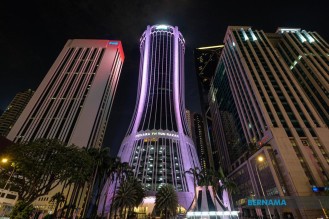
The entire approval process for Lembaga Tabung Haji's landmark investment in Putrajaya Perdana Bhd proceeded during a period when the construction company remained under the alleged control of fugitive financier Low Taek Jho through his vehicle Utama Banking Group Bhd, according to sworn testimony disclosed in Parliament. Finance Minister II Datuk Seri Amir Hamzah Azizan presented this revelation to lawmakers during the Dewan Rakyat's special sitting on the Royal Commission of Inquiry report into Tabung Haji's management, highlighting a critical timeline that placed every major decision within the window when Jho Low's influence was purportedly dominant.
The chronology of approval decisions paints a compressed and troubling picture for the state-owned pilgrim savings institution. Tabung Haji's Investment Panel green-lit the proposal on July 24, 2014, followed by board approval on August 25 and ministerial sign-off on August 27 of the same year, with the sale and purchase agreement formalised on December 3. Throughout this entire period, testimony from Putrajaya Perdana director Datuk Rosman Abdullah indicated that Jho Low retained control through Utama Banking Group, a situation that only concluded when the company's sale was completed on April 13, 2015—months after Tabung Haji had already committed to the investment. This sequential vulnerability suggests the institution proceeded without securing clarity on the vendor's true ownership structure.
The financial mechanics underlying the transaction reveal how substantially Tabung Haji overpaid for its stake. According to Amir Hamzah's parliamentary disclosures, the research division initially valued the 30 per cent equity holding at between RM124 million and RM155 million, representing a careful assessment of market value. Yet the eventual purchase price of RM193.5 million exceeded even the most generous internal estimate, climbing to nearly three times what the original seller had paid for the entire company—just RM260 million in 2012 for 100 per cent ownership. This means the seller's 30 per cent stake, acquired for RM78 million two years earlier, generated a windfall profit of over RM115 million within a single transaction, a dramatic escalation that should have triggered institutional alarm.
Critically, Tabung Haji's due diligence processes operated in reverse, a concerning departure from established investment protocols that raised red flags in both the Royal Commission findings and the 2023 fact-finding assessment. Due diligence investigations were only conducted after all approvals had been obtained and after the agreement was already signed, meaning decision-makers—the Investment Panel and board of directors—proceeded without the foundational investigation that should precede major commitments. The Research Division's recommendation to seek identification of the ultimate shareholder, requested on July 24, generated no documented response from management, yet the transaction advanced regardless. This procedural failure enabled the investment to proceed despite the Investment Panel's own awareness that critical information about ownership remained unknown.
The seller's identity and acquisition history added another layer of opacity that should have necessitated heightened scrutiny. Cendana Destini Sdn Bhd, the vehicle through which the sale occurred, was owned by Datuk Rosman Abdullah, who had himself purchased the majority stake in Putrajaya Perdana from a business group linked to Jho Low in 2012. This chain of transactions—from Jho Low's sphere to Rosman Abdullah to Tabung Haji—should have prompted comprehensive beneficial ownership verification. The fact that investigators found no documentation of the seller's ultimate shareholder being identified suggests Tabung Haji's governance structures either failed to enforce their own policies or were overridden by pressures to complete the transaction expeditiously.
The dual promises that justified the investment valuation were never fulfilled, compounding the reputational and financial damage to Tabung Haji. Approval was predicated on commitments that Putrajaya Perdana would be relisted on the Malaysian stock exchange within twelve months and would achieve RM86 million in profit during 2015. Neither materialised, stripping away the institutional rationale for the acquisition and leaving Tabung Haji holding an equity stake in a private company with no identified pathway to liquidity. More remarkably, the RCI documented that Tabung Haji's chairman at the time simultaneously held the chairmanship of Putrajaya Perdana itself, creating an apparent conflict of interest that positioned the pension fund administrator in a position of dual governance over a transaction in which it was the principal buyer.
The Risk Management Department's concerns appear to have been systematically sidelined, a pattern that extended beyond the Putrajaya Perdana investment. The 2023 fact-finding assessment identified a troubling organisational pattern whereby four separate investments failed to undergo required due diligence processes, while recommendations from risk oversight functions were not appropriately addressed across multiple transactions. This systemic weakness suggests the problems encountered with Putrajaya Perdana were symptomatic of broader governance deficiencies within Tabung Haji's investment committees, potentially indicating that institutional controls had been compromised or made subordinate to transaction completion objectives.
When the promised commercial returns failed to materialise, Tabung Haji invoked contractual remedies available to investors. In March 2018, the institution exercised a put option requiring the seller to repurchase the equity stake at RM210.7 million, a figure representing the transaction price plus accrued losses. However, despite obtaining a Mareva injunction to freeze assets and initiating legal proceedings, Tabung Haji has not received payment. By the conclusion of the 2024 financial year, the entire RM193.5 million investment was written off as a total loss, representing a permanent erosion of depositor funds entrusted to the institution's stewardship. The case currently languishes in the court system, with trial scheduled for June 23, 2027, meaning full judicial resolution remains years away.
The parliamentary revelations carry significant implications for Malaysian institutional governance and public fund stewardship. For Tabung Haji's millions of depositors—primarily Malaysian Muslims saving for hajj pilgrimage—the investment represents a direct loss of resources that should have been preserved and grown. The nexus between Putrajaya Perdana and the 1Malaysia Development Berhad scandal ecosystem, represented by Jho Low's alleged involvement, underscores how shell companies and obscured ownership structures can penetrate ostensibly independent state institutions. The fact that lawmakers from multiple constituencies, including Syed Saddiq Syed Abdul Rahman from MUDA-Muar, raised concerns about Jho Low's role suggests the issue extends beyond individual transaction failures to broader questions about institutional independence and susceptibility to external pressure.
The governance failures illuminated by this case offer lessons extending beyond Tabung Haji's specific circumstances. The compression of approval timelines, the subordination of research divisions' recommendations, the absence of documented due diligence before commitments, and the simultaneous chairmanship of both buyer and seller represent procedural vulnerabilities that could recur in other Malaysian public institutions managing significant assets. That a 2023 assessment could identify similar patterns across multiple investments suggests systemic rather than isolated failures. For Southeast Asian regulators monitoring institutional integrity and public fund management across the region, the Putrajaya Perdana transaction serves as a cautionary template of how governance structures, when inadequately supervised or overridden, can facilitate value destruction and investor loss in transactions involving complex ownership chains and vague beneficial ownership disclosure.

