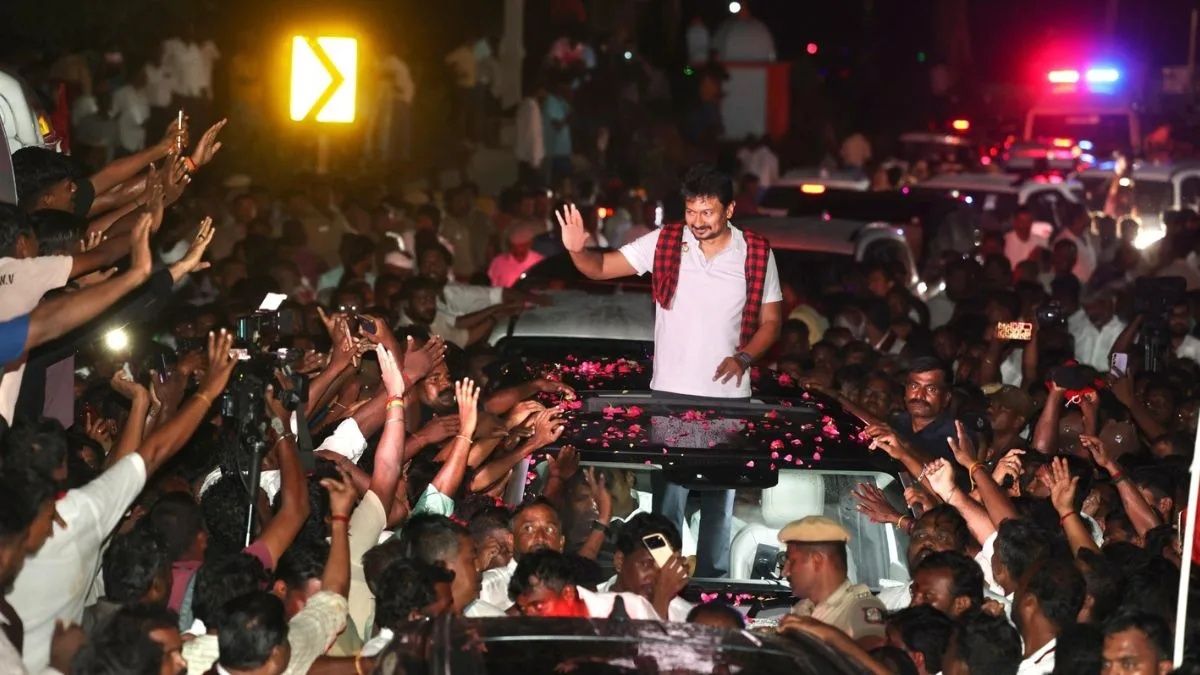
Tamil Nadu's Leader of Opposition Udhayanidhi Stalin walked free from police custody late Tuesday evening after several hours of interrogation connected to controversial remarks he made during a public gathering. The former deputy chief minister was granted station bail in connection with comments perceived as derogatory towards actress Trisha Krishnan, whose name was invoked during a recent protest rally in Thanjavur district focusing on agricultural and water-sharing disputes.
Thousands of DMK party supporters assembled outside Sengipatti police station to welcome Stalin upon his release, transforming the police facility into an impromptu political rally. The crowd chanted anti-government slogans directed at Tamil Nadu Chief Minister Vijay and his newly formed TVK political party, demonstrating the deep polarization within the state's political landscape following the controversial arrest.
At a media briefing shortly after his release, Stalin categorically rejected accusations that his language carried derogatory implications towards women. He framed his arrest as a deliberate attempt by the ruling administration to distract public attention from substantive governance issues, particularly his criticism of the state government's handling of the Cauvery water crisis and Karnataka's proposed Mekedatu dam project.
StStalin's defence emphasised his intentions were purely political in nature, stating he did not employ disrespectful language towards any woman and that his words carried only innocent, straightforward meaning. He dismissed suggestions of hidden meanings or double entendres as unfounded allegations designed to undermine his political credibility. The opposition leader characterised the current state government not as a legitimate administrative body but as a theatrical performance more concerned with persecuting political opponents than addressing pressing public concerns.
The controversy originated during a DMK-organised demonstration in Thanjavur where Stalin was addressing supporters regarding agricultural grievances and interstate water distribution. During his speech criticising the chief minister's position on the Cauvery dispute, a supporter in the crowd called out actress Trisha Krishnan's name. Stalin momentarily paused, acknowledged the interjection with a smile, and then delivered a statement about water availability, remarking that water should flow to wherever it is needed.
To observers present and those who subsequently reviewed recordings of the incident, Stalin's response appeared to contain innuendo related to the actress. The remark quickly circulated through media channels and social networks, prompting strong condemnation from the ruling TVK party, which characterised the statement as verbal harassment and an attempt to objectify a woman in public discourse. The party escalated the matter by simultaneously filing complaints with both the National Commission for Women and state police authorities.
The arrest was executed at Stalin's residence in Chennai on Wednesday morning, following the formal police complaint. His detention sparked immediate mobilisation from DMK cadres and allies, who viewed the action as politically motivated persecution of the opposition. The party portrayed the arrest as part of a broader pattern of using law enforcement machinery to silence dissenting voices and intimidate opposition politicians.
This incident exemplifies the intensifying friction between Tamil Nadu's opposition DMK and the recently elected TVK government led by Chief Minister Vijay. Since assuming office, the new administration has faced considerable pressure from the opposition, which continues to hold significant assembly representation and maintains substantial grassroots support in various districts. The handling of Stalin's arrest will likely influence broader public perceptions regarding the ruling government's commitment to democratic norms and impartial law enforcement.
The Cauvery water dispute remains one of Tamil Nadu's most contentious political issues, with successive governments claiming the state receives inadequate water allocation from the inter-state river sharing agreement. Karnataka's proposed Mekedatu project has become a flashpoint for Tamil Nadu politicians across party lines, though the DMK has positioned itself as a more vociferous defender of the state's water interests. Stalin's arrest during remarks ostensibly focused on this issue has added another dimension to the controversy, with political analysts viewing it as potentially counterproductive to the government's image.
For Malaysian observers, this episode illustrates how even relatively prosperous Indian states continue to grapple with political tensions that translate into aggressive law enforcement action against opposition figures. The use of statements perceived as morally or ethically questionable as grounds for arrest raises questions about the boundaries between legitimate law enforcement and political intimidation, a distinction that remains blurred in various democracies across South Asia.
The station bail arrangement allows Stalin to remain free pending further legal proceedings, though investigations into the matter continue. Legal experts have debated whether the remarks genuinely constitute criminal conduct or whether law enforcement authorities overstepped in responding to what appears primarily as a political controversy. The incident is likely to feature prominently in Tamil Nadu's ongoing political discourse as the state government consolidates its recent electoral mandate and the opposition attempts to rebuild its political strategy.

