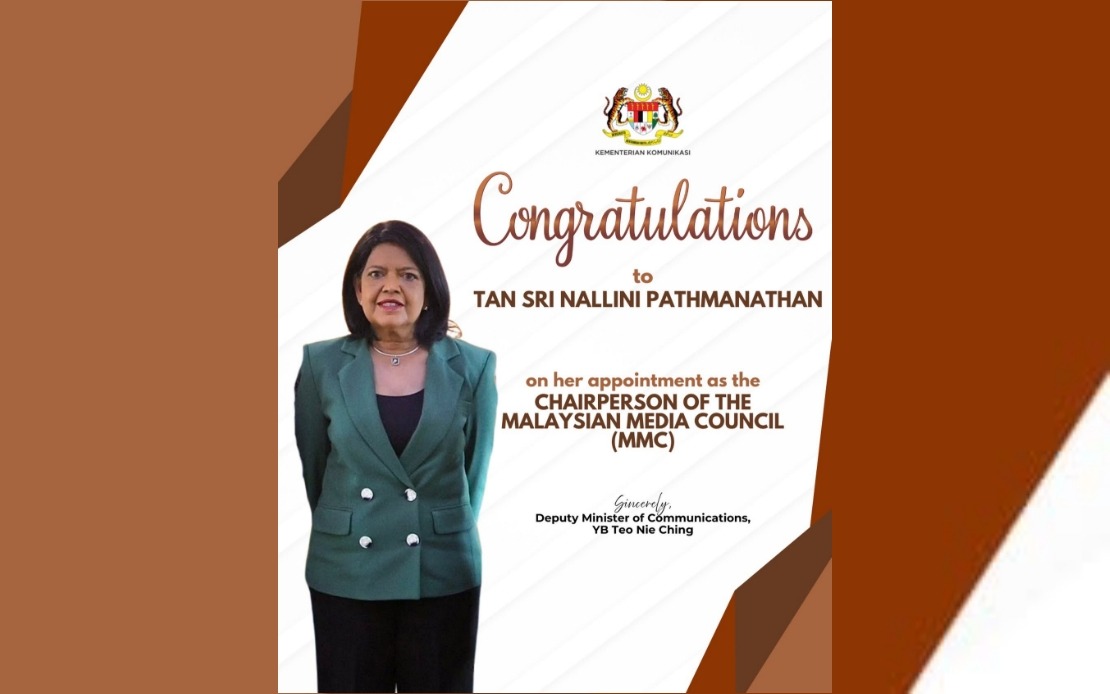
Deputy Communications Minister Teo Nie Ching has thrown her weight behind former Federal Court judge Tan Sri Nallini Pathmanathan's appointment as chairperson of the Malaysian Media Council (MMC), publicly expressing confidence that the judicial veteran will steer the fledgling self-regulatory body toward independence and integrity. Teo's endorsement, shared via social media on June 17, underscores the government's apparent commitment to positioning the MMC as an institution insulated from political influence at a time when media regulation remains a sensitive subject across Southeast Asia.
Nallini's appointment to lead the MMC represents a milestone for Malaysia's media ecosystem. The council was formally established under the Malaysian Media Council Act 2025, marking the culmination of more than fifty years of sustained advocacy, public petitions, and policy deliberation aimed at creating a robust self-regulatory framework for journalism. This lengthy gestation period reflects deep-seated concerns within Malaysia's media sector about the need for industry-led oversight that can balance professional standards with editorial independence. The MMC Board unanimously endorsed Nallini's leadership at a meeting held on May 26, signalling broad consensus around her suitability for the role.
Teo's decision to publicly champion Nallini's credentials reveals deliberate messaging about the calibre expected of the MMC's leadership. Rather than emphasizing administrative experience or corporate credentials, Teo focused attention on the former judge's philosophical approach to constitutional interpretation, particularly her willingness to challenge narrower legal readings in favour of principles she viewed as more aligned with human dignity and democratic values. This framing suggests that the government regards the MMC's success as contingent not merely on operational competence but on principled stewardship grounded in constitutional consciousness.
Central to Teo's argument is Nallini's dissenting judgment in a case concerning Malaysian citizenship law. In a closely divided four-three decision, Nallini stood apart from the majority, advocating for what she termed a purposive and compassionate interpretation of constitutional provisions governing citizenship for children born outside marriage to Malaysian fathers and foreign mothers. Her willingness to dissent on such a fraught issue—touching as it does on nationality, legitimacy, and constitutional boundaries—illustrates a judicial temperament oriented toward expanding rather than restricting rights. For those concerned about media regulation in Malaysia, such a record suggests a leader unlikely to defer uncritically to state pressure.
Equally significant is Nallini's stance in a landmark case involving an online news portal and user-generated comments. In her judgment, Nallini ruled that the portal could not be held liable for comments posted by its subscribers, a position that carries immediate relevance to contemporary debates about platform responsibility, editorial discretion, and the boundaries of liability in the digital age. Her reasoning implicitly recognized the distinction between editorial content and third-party speech, a distinction that underpins much of modern media law globally and protects publishers from the paralyzing prospect of policing every user contribution. This precedent matters considerably for Malaysia's media ecosystem, where clarity on such questions remains contested.
Teo's broader case for self-regulation over state intervention reflects tensions that have animated media policy debates across Southeast Asia for decades. She articulated the fundamental tension succinctly: journalists occupy a unique constitutional role as what she termed the "4th Estate of democracy," tasked with scrutinizing power and informing public deliberation. Any direct state involvement in regulating journalism, Teo argued, risks being perceived as suppression rather than stewardship, thereby corroding the public trust essential to journalism's legitimacy. This reasoning acknowledges that media regulation's legitimacy depends not merely on what rules are enforced but on who enforces them and how.
The establishment of the MMC itself represents an attempt to resolve this tension through structural innovation. By vesting regulatory authority in an industry body rather than a government agency, Malaysia's policymakers sought to create distance between journalism and state apparatus. However, the success of such arrangements ultimately depends on the independence and credibility of the individuals entrusted with leadership. Nallini's appointment signals an effort to fill that leadership role with someone whose judicial background and intellectual commitments suggest genuine commitment to press freedom principles rather than merely nominal independence.
For Malaysian readers and observers across Southeast Asia, Nallini's appointment carries significance beyond institutional mechanics. The region has witnessed recurring cycles in which media regulation frameworks, ostensibly created to protect journalistic integrity, become vehicles for state control of public discourse. Thailand, for instance, has experienced multiple media crackdowns despite nominally independent regulatory structures. Vietnam and Cambodia maintain tight state control over journalism despite various regulatory facades. Against this backdrop, Malaysia's creation of a self-regulatory council led by someone with Nallini's track record represents a meaningful departure, though ultimate success remains contingent on sustained political will to respect the body's independence.
Teo's public advocacy for Nallini also suggests internal government confidence that the MMC can serve legitimate regulatory purposes without becoming a tool for suppressing inconvenient reporting. Self-regulatory bodies can address genuine industry concerns—accuracy standards, conflicts of interest, fair newsgathering practices—that warrant attention. If the MMC operates effectively within such parameters, it might strengthen public confidence in journalism while providing journalists with a backstop against frivolous litigation. Conversely, if the council devolves into punishing critical reporting, its self-regulatory legitimacy will evaporate rapidly.
The five-decade timeline to MMC establishment also merits reflection. That Malaysian journalists and media organizations required fifty years of advocacy to secure a self-regulatory framework speaks to deep-seated reluctance within government circles toward empowering independent media institutions. This history context matters when assessing the significance of the MMC's arrival. It represents not an inevitable evolution but a hard-won institutional innovation, making the choice of leadership particularly consequential.
Moving forward, Nallini's stewardship will be tested by specific decisions about complaint handling, disciplinary processes, and boundary-setting between legitimate regulation and editorial interference. Her judicial background provides intellectual grounding for wrestling with such questions, but implementation will determine whether the MMC becomes a meaningful force for professional standards or a peripheral body lacking industry buy-in and public credibility. Early transparency about the council's operations and principled reasoning in its decisions will be essential to building legitimacy.