Thai law enforcement has widened its investigation into a suspected transnational drug network, detaining a married couple in the northeastern province of Loei following the arrest of a Thai Airways flight attendant in Australia. The woman, identified in Thai media reports as Mina, was apprehended at Melbourne Airport with approximately one kilogram of heroin allegedly hidden in her baggage, prompting Thai authorities to trace the source and supply chain of the illicit shipment. This development signals growing collaboration between regional law-enforcement bodies in tackling increasingly sophisticated cross-border narcotics operations.
The investigation moved rapidly after Australian police contacted their Thai counterparts with details of the airport seizure. Thai authorities subsequently launched a coordinated effort to identify individuals involved in preparing and dispatching the parcel destined for the Melbourne-bound flight. Working backwards from the flight attendant's arrest, investigators from multiple agencies began tracing communication records, financial transactions, and logistical arrangements associated with the alleged smuggling operation. This methodical approach reflects how modern drug networks often compartmentalise operations across multiple jurisdictions to obscure their connections.
On Thursday, July 2, police from Chiang Khan Police Station conducted operations in That subdistrict within Loei's Chiang Khan district after establishing that two individuals, Athit aged 43 and Thatsaphon aged 42, were connected to an address in the Pak Tom subdistrict of the same district. When officers found the residence unoccupied, further investigation revealed the couple had been employed in rubber tapping work in Erawan district. This detail is significant as it demonstrates how smuggling networks often recruit workers in agricultural or seasonal employment, individuals who may feel economic pressure or obligation to participate in illegal activities.
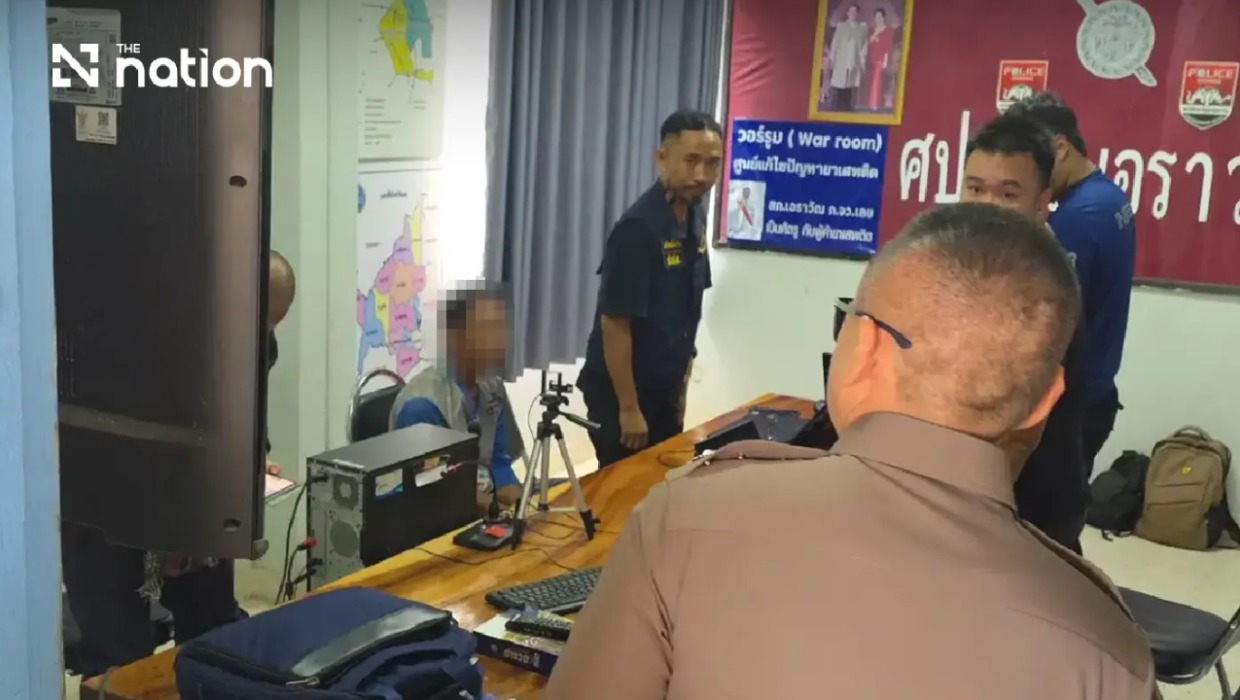
Authorities from the Office of the Narcotics Control Board (ONCB) and associated police units eventually located Athit working on temple renovation at Wat Tham Pha Mak Ho in Sri Songkhram subdistrict of Wang Saphung district. Upon questioning at Erawan Police Station, he provided crucial admissions to investigators. According to police records, Athit confessed to having been paid to dispatch parcels to Bangkok on six separate occasions. Three of these shipments were sent through a parcel service operating in Chiang Khan, with two originating from Ban That in That subdistrict and one from Erawan district itself.
Financial incentives appear to have been modest but consistent. Athit allegedly received 8,000 baht—equivalent to approximately US$240—for each parcel delivery, with payments originating from a national of Laos. The most recent shipment in this sequence was dispatched on June 28, 2026, suggesting the operation had been running for some time before unravelling through the Melbourne airport seizure. These relatively small per-delivery payments indicate how drug syndicates exploit economic disparities between nations, offering sums that represent meaningful income to individuals in lower-income regions while constituting minimal losses if individual shipments are intercepted.
Thatsaphon, aged 42 and a Lao national married to Athit, was subsequently detained after police discovered a black Mitsubishi Triton pickup truck bearing Loei registration plates parked in a rubber plantation in the Pha Nang-Pha Koeng area of Pha In Plaeng subdistrict in Erawan district. The vehicle's strategic placement in a remote rural location suggested possible use in moving materials or personnel associated with the operation. When brought in for questioning at Erawan Police Station, Thatsaphon denied any involvement or knowledge of the smuggling network during preliminary interrogation, though investigators continued pursuing leads to establish her precise role.
Both detainees have now entered the formal questioning process overseen by the ONCB, with investigators seeking to expand the investigation to identify higher-level operatives. Law-enforcement authorities are particularly interested in locating individuals who ordered the shipments, provided financial support, or facilitated the logistics of moving narcotics through commercial parcel services. This hierarchical approach to investigation reflects modern understanding that dismantling drug networks requires targeting not just couriers and handlers but also the organisers and financiers directing operations from insulated positions.
According to statements from the ONCB secretary-general, this case exemplifies the operational methodology now employed by transnational drug networks seeking to evade detection. These organisations deliberately fragment their operations across multiple countries and recruit participants from different socioeconomic backgrounds and nationalities, creating compartmentalised structures where individual actors possess limited knowledge of the broader enterprise. The ONCB's analysis suggests that cross-border cooperation between law-enforcement agencies proved instrumental in connecting seemingly discrete incidents into a coherent investigation pattern.
The successful identification of these connections underscores the importance of intelligence sharing between nations in Southeast Asia and beyond. When the Thai Airways flight attendant was detained in Melbourne, Australian authorities rapidly communicated details to Thai counterparts, enabling investigators to begin tracing the supply chain backwards. This cooperative approach contrasts with the isolation that criminal networks depend upon for survival, demonstrating how coordinated international action can effectively disrupt operations that span multiple jurisdictions.
Moving forward, the ONCB has committed to intensifying its investigation while simultaneously taking legal action against all individuals identified as involved at any level of the operation. The agency has also pledged to strengthen bilateral and multilateral cooperation with foreign law-enforcement counterparts to intercept transnational drug networks at critical points, disrupt established smuggling routes, and target the financial mechanisms enabling these organisations to function. These measures align with Thailand's broader government strategy prioritising drug suppression across the region.
For Malaysian readers and broader Southeast Asian observers, this case illustrates several critical patterns in modern narcotics trafficking. The use of legitimate commercial services to conceal illicit shipments, the recruitment of economically vulnerable individuals across borders, and the involvement of aviation workers represent evolving threats requiring adaptive law-enforcement responses. The network's apparent attempt to exploit international travel and postal systems underscores why regional cooperation mechanisms remain essential for protecting communities from transnational organised crime.

