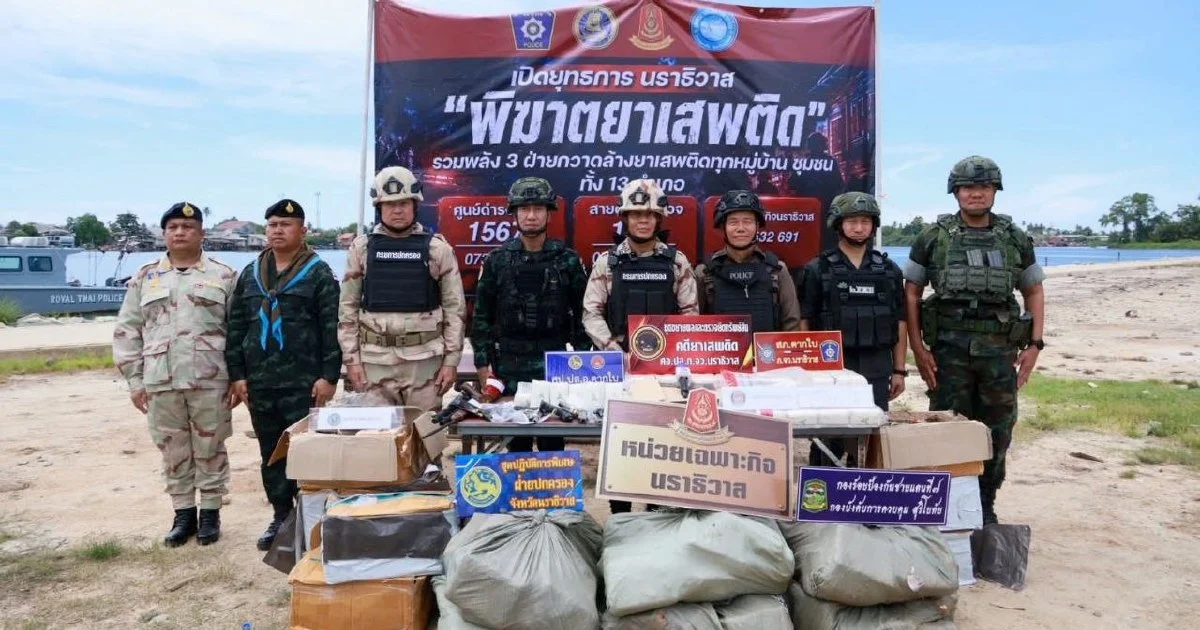
Thai law enforcement agencies have scored a significant victory against organised narcotics crime, culminating in the arrest of 233 individuals suspected of involvement in drug trafficking operations centred on Narathiwat province. The intensive anti-drug campaign, spanning the course of a month, has exposed the sprawling nature of a transnational smuggling network that appears to extend across the Malaysian border, raising fresh concerns about the persistent flow of illicit substances through the region's porous frontiers.
The scale of the operation reflects the sophisticated nature of modern drug trafficking enterprises in Southeast Asia, where criminal syndicates operate across international boundaries with relative impunity. Among those apprehended, security officials have identified several individuals believed to maintain direct contact with Malaysian traffickers, suggesting a coordinated supply chain that feeds narcotics southward into peninsular Malaysia. This development underscores the vulnerability of both nations to organised crime and the challenge authorities face in disrupting deeply entrenched distribution networks that have evolved over years of commerce.
The seizure of contraband valued at RM1.2mil during the crackdown represents a substantial haul of illicit drugs that would otherwise have reached Malaysian streets and caused considerable social harm. Such quantities typically include methamphetamine tablets, heroin, cocaine, and other controlled substances that fuel addiction and associated crimes across the region. The monetary value attached to these seizures reflects both the street-level retail worth of the drugs and their significance as evidence of the scale at which these operations function.
Narathiwat province, located in Thailand's deep south near the Malaysian border, has long been identified as a critical transit point for narcotics flowing between production zones in the broader Golden Triangle region and consumer markets in Malaysia, Singapore, and beyond. The province's mountainous terrain, limited border infrastructure, and historical prevalence of cross-border smuggling routes have made it an attractive corridor for trafficking organisations. Thai authorities' focus on this area acknowledges the region's persistent role as a conduit for contraband and the necessity of sustained enforcement operations to intercept shipments before they reach Malaysian territory.
The presence of Malaysian-linked suspects within the arrested cohort points to the integrated nature of cross-border criminal networks, where Thai producers or traffickers coordinate directly with Malaysian distributors to ensure efficient supply. Such connections facilitate the movement of bulk quantities across the frontier and suggest a degree of operational trust and established protocols between criminal actors on both sides of the border. This transnational coordination complicates law enforcement responses, as authorities must navigate jurisdictional constraints and coordinate investigations across sovereign territories.
From a Malaysian perspective, the Thai operation carries significant implications for domestic drug control efforts. Disruptions at the source—whether through Thai police actions or broader regional cooperation—reduce the volume of narcotics entering Malaysian supply chains and can temporarily elevate street prices, thereby reducing consumption among price-sensitive users. However, the arrest of Malaysian-connected suspects indicates that domestic criminal elements remain actively engaged in sourcing narcotics from foreign suppliers, suggesting that demand within Malaysia continues to sustain these transnational trade relationships.
The month-long campaign reflects an intensive approach to anti-drug enforcement that requires sustained commitment and coordination among multiple Thai police units and possibly military-affiliated forces, as narcotics suppression in Thailand often involves armed services personnel. Such sustained operations are resource-intensive and typically focus on high-impact targets—major suppliers, distribution hubs, and key traffickers—rather than street-level dealers. The arrest total of 233 individuals suggests a comprehensive sweep that may have extended beyond primary targets to include facilitators, couriers, and lower-level operatives within the network.
Cross-border narcotics enforcement remains among the most complex challenges facing law enforcement in Southeast Asia, complicated by limited intelligence sharing, differing legal frameworks, and the enormous profits that motivate trafficking organisations to innovate around interdiction efforts. Success in any single operation, while noteworthy, typically represents a temporary disruption rather than a long-term solution unless coupled with sustained pressure on criminal infrastructure and recruitment pipelines. The Thai crackdown thus serves as one component of a broader regional struggle to contain drug production and trafficking.
Regional cooperation mechanisms, including the Association of Southeast Asian Nations framework and bilateral agreements between Thailand and Malaysia, theoretically enable coordinated responses to transnational drug crime. However, practical intelligence exchange and joint operations remain limited in scope, often constrained by bureaucratic procedures and competing national priorities. The Thai operation's exposure of Malaysian-linked trafficking networks represents an opportunity for Malaysian authorities to pursue leads generated by the enforcement action and to strengthen coordination with Thai counterparts in targeting shared criminal targets.
The RM1.2mil seizure, whilst significant, likely represents only a fraction of the total volume moving through established trafficking routes during any given period. Criminal networks typically operate with redundancy, maintaining multiple routes and suppliers to ensure that disruption of one pathway does not collapse the entire operation. This resilience explains why sustained enforcement pressure across multiple jurisdictions remains essential to achieving meaningful reductions in narcotics availability.
Looking forward, the Thai crackdown underscores the necessity of enhanced data sharing regarding trafficking methodologies, route patterns, and suspect networks between Thailand and Malaysia. Intelligence regarding the specific Malaysian connections within the arrested cohort could inform domestic investigations and contribute to dismantling the distribution apparatus on the Malaysian end of the supply chain. Such intelligence-led approaches, informed by cross-border cooperation, represent the most efficient means of disrupting trafficking operations that exploit gaps between national enforcement systems.

