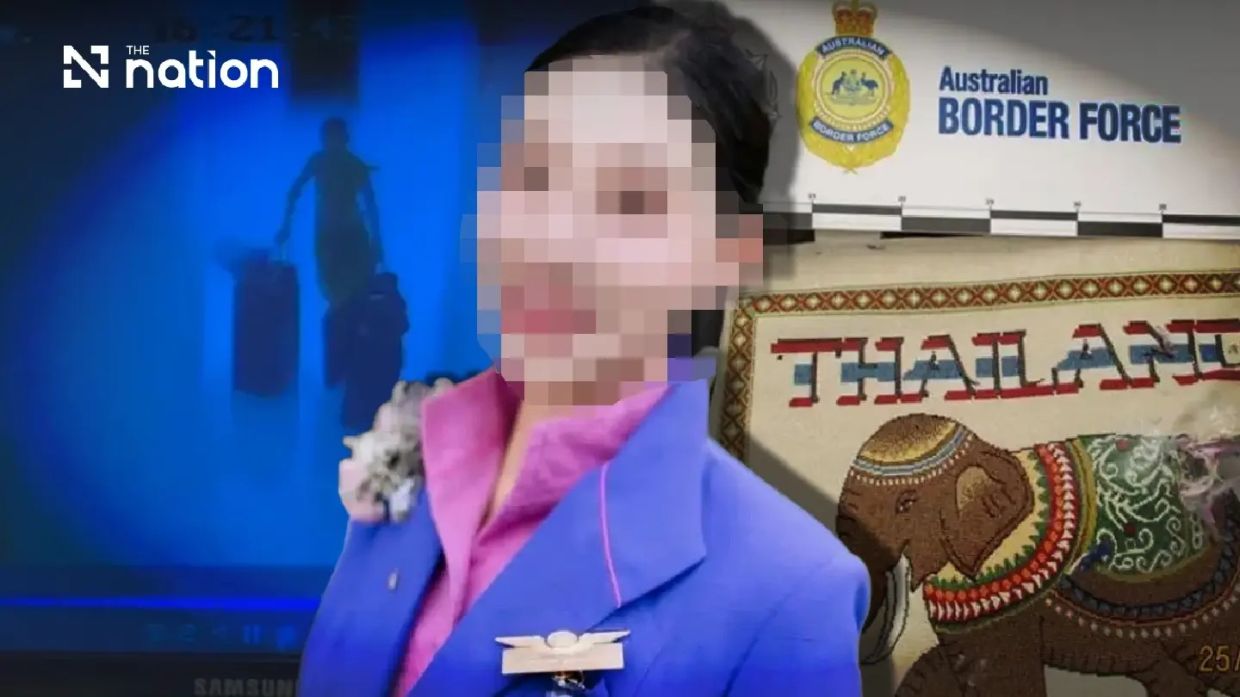
A Thai flight attendant apprehended at Melbourne Airport with 900 grammes of heroin may have been exploited by an elaborate transnational criminal enterprise that recruits frequent international travellers as unsuspecting couriers, according to investigations by Thailand's Office of the Narcotics Control Board. The woman's legal status remains that of a detainee rather than a formally accused person, a distinction that carries significant weight as Thai authorities coordinate with Australian police and consular officials to support her potential defence. The case has prompted a multi-agency expansion of enquiries that now encompasses not only this incident but a broader network suspected of orchestrating large-scale narcotics trafficking from sources in the Golden Triangle.
The investigation framework has been restructured to reflect the apparent scope of the criminal organisation involved. The Department of Special Investigation has taken the lead on several connected arrests made in Bangkok, which yielded seizures of more than 26 kilogrammes of heroin. These parallel cases emerged after authorities identified a delivery rider who had received heroin from a foreign national, and subsequently uncovered the involvement of a Lao couple in the supply chain. The sophistication of the operation becomes evident when examining the dual distribution methodology: the network employed both postal services and direct hand-to-hand exchanges to move narcotics, suggesting experienced operatives managing multiple contingencies.
At the operational core of this scheme lies a deceptive recruitment mechanism that targets vulnerable workers in the aviation and travel sectors. According to Metropolitan Police investigations, scammers created fake social media profiles to send mass messages to flight attendants and others who frequently crossed international borders, offering what appeared to be lucrative compensation for transporting goods overseas. The offers were sufficiently attractive to overcome initial hesitation among workers concerned about legal consequences, indicating that financial desperation or career ambitions may have clouded judgement among some targets. This approach mirrors known trafficking methodologies employed by organised crime networks across Southeast Asia, where human vulnerability and economic incentive are weaponised as trafficking tools.
The recipient of the heroin shipment, identified by Thai authorities as a Thai national using the alias "Dear", has emerged as a critical figure in the Australian end of the operation. This individual has reportedly lived in Australia for approximately ten years, though Thai and Australian investigators remain uncertain about their legal residency status or citizenship standing. What distinguishes this case is evidence suggesting Dear has previously received multiple similar shipments through identical mechanisms, indicating a sustained operational pattern rather than isolated incidents. Thai authorities have compiled substantial evidence linking Dear to the smuggling network and have forwarded documentation to the Australian Federal Police for their investigation into the final recipients and broader network structure.
The mechanics of how the heroin entered the flight attendant's possession reveal methodical planning that exploited the trust typically extended to airline personnel. According to her boyfriend's account to investigators, the woman received a parcel box decorated with elephant-pattern bags delivered by a courier. She transported these items to her room, unpacked the bags, and inspected them thoroughly without discovering any contraband. Finding nothing suspicious, she placed all the bags into her luggage. The suitcase subsequently passed through Thai airport security's X-ray screening without triggering any alarms, allowing the shipment to proceed to Melbourne where Australian customs detected the heroin. This sequence suggests either remarkably sophisticated concealment methods or deliberate staging designed to create plausible deniability.
The question of whether the flight attendant possessed genuine knowledge of the shipment's contents remains contested and central to her defence prospects. Evidence offered by the male delivery rider, who stated this was his first delivery to this particular flight attendant despite having conducted three or four similar deliveries previously, could suggest her uninformed participation. However, investigators acknowledge gaps in their understanding of the full circumstances. The reported compensation of 8,800 baht, approximately US$264, appears modest for international drug trafficking assistance, yet Thai bank records fail to show corresponding transactions despite reports of two separate 1,700-baht transfers. These inconsistencies have prompted authorities to refrain from concluding whether the woman acted with knowledge or became an unwitting victim of elaborate deception.
The involvement of Lao nationals in the supply chain reflects shifting trafficking patterns across the Mekong subregion, a development that illuminates how enforcement pressure reshapes criminal logistics. Historically, narcotics from the Golden Triangle typically entered Thailand via northern routes, but intensified law enforcement interdiction in high-risk areas prompted traffickers to redirect operations toward the north-east region bordering Laos. Border regions including Nakhon Phanom, Bueng Kan, Loei, and Nong Khai have emerged as preferred transit points due to geographical characteristics: the Mekong River in these areas is relatively narrow, and the extended border length makes continuous surveillance prohibitively difficult. Narcotics are typically pre-packaged and transferred through multiple intermediary groups before final distribution within Thailand, fragmenting individual participants' understanding of the broader operation.
Thai-Lao cooperation on narcotics interdiction remains ongoing, though authorities acknowledge that enforcement effectiveness varies across the porous frontier. The trafficking method documented in this case—where drugs move from the Golden Triangle through northern routes, into the north-east via Lao territory, and then across the Mekong—represents an adaptation to intensified police operations rather than evidence of Lao institutional negligence. The two countries maintain information-sharing protocols and coordinate interdiction efforts, yet the structural challenges of monitoring extensive, sparsely populated borderlands mean some trafficking inevitably succeeds. This reflects a wider Southeast Asian reality where transnational crime networks possess advantages in mobility and coordination that often exceed what under-resourced law enforcement can practically interdict.
The Bangkok arrests connected to this case demonstrate that the criminal enterprise operates as an integrated supply chain rather than isolated actors. The recovery of 26 kilogrammes from these arrests suggests that multiple shipments were in transit simultaneously, and that the network maintained redundancy in case individual consignments faced interdiction. The revelation that a delivery rider had conducted similar operations multiple times before indicates the network had established reliable courier relationships and tested procedures. This institutional sophistication suggests organised crime figures with substantial experience and capital investment, distinguishing them from ad-hoc smuggling attempts.
Thailand's approach to supporting the flight attendant's legal defence abroad reflects diplomatic awareness that her treatment in Australian courts will influence bilateral relations and Thailand's international reputation regarding trafficking and exploitation. By designating her as a detainee rather than formally accusing her, Thai authorities preserve the possibility of arguing she was deceived or coerced, which could influence Australian judicial proceedings and sentencing considerations. Thai consular support, combined with evidence compilation for her legal team, signals recognition that the international trafficking ecosystem depends partly on exploitation of workers who lack sophisticated understanding of criminal networks' methodologies. This strategic positioning distinguishes her case from prosecutions of trafficking organisers or knowing participants.
The investigation's progression suggests Australian authorities will ultimately bear primary responsibility for identifying the network's upper hierarchy and final drug recipients, whilst Thai investigators focus on dismantling the recruitment and supply mechanisms. The collaboration between the ONCB, DSI, Metropolitan Police, Australian Federal Police, and Thai consular officials represents a regional response to transnational crime that requires coordination across multiple jurisdictions and agencies. However, fundamental questions remain unanswered: whether the flight attendant genuinely lacked knowledge of her cargo's nature, how many workers the network successfully recruited versus how many detected the deception and refused, and whether authorities can disrupt the recruitment mechanisms or merely interdict individual shipments. The case ultimately exposes vulnerabilities in border security, exploitation of workers' economic circumstances, and the resilience of Golden Triangle trafficking networks in adapting to enforcement pressure across Southeast Asia.

