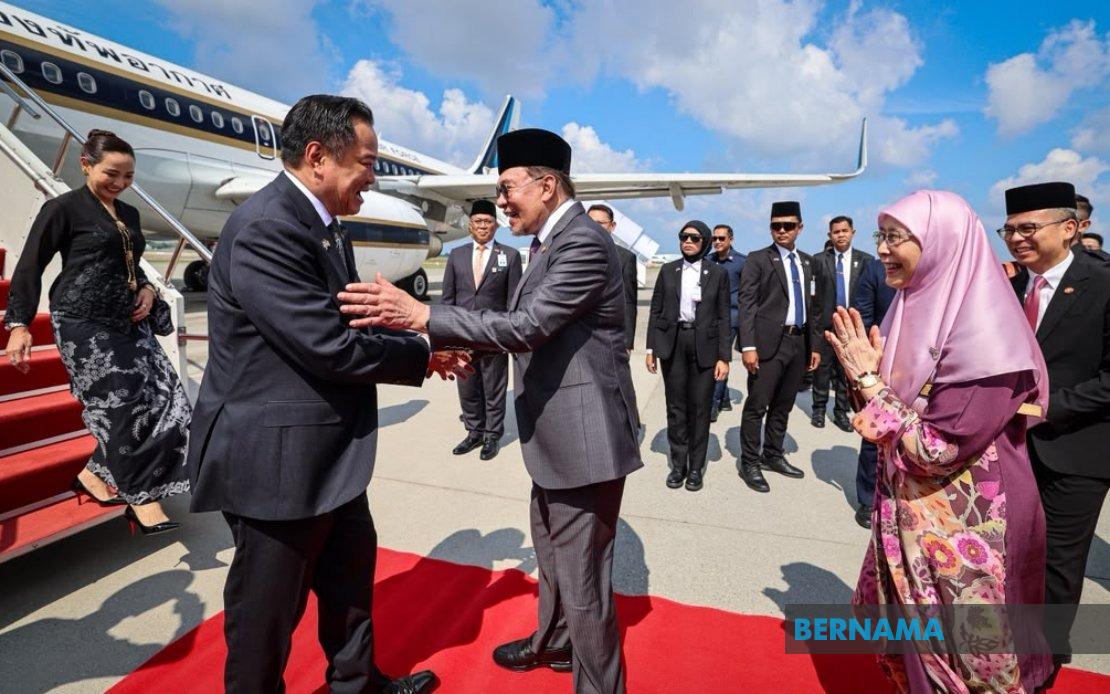
Thailand's Prime Minister Anutin Charnvirakul touched down in Kuala Lumpur on July 9 for a two-day official visit at the invitation of Malaysian Prime Minister Datuk Seri Anwar Ibrahim, marking his first trip to Malaysia since resuming the top post in March this year. The aircraft carrying Anutin and his spouse, Thananon Charnvirakul, arrived at the Bunga Raya Complex at Kuala Lumpur International Airport at 11.11 am, where Anwar personally received the Thai leader in a gesture of diplomatic warmth. The reception reflected the importance both nations place on their bilateral relationship and the need to maintain high-level engagement across the region.
The welcome ceremony adhered to formal state protocol, with a guard of honour comprising 34 officers and personnel from the First Battalion of the Royal Ranger Regiment, commanded by Major Muhammad Nur Addeen Mustaza. National anthems of both Malaysia and Thailand were performed during the proceedings, followed by introductions to Malaysian Cabinet ministers and senior government officials. This carefully orchestrated reception underscored Malaysia's commitment to honouring its neighbour and reinforced the significance of the state visit within diplomatic circles.
Anwar's wife, Datuk Seri Dr Wan Azizah Wan Ismail, and Communications Minister Datuk Fahmi Fadzil, who served as the receiving minister, were also present during the arrival ceremony. The involvement of senior government figures signalled that the visit commanded high-level attention across Malaysia's administration. Such protocols typically indicate anticipated discussions on matters of substantial mutual concern, suggesting that the bilateral agenda extends beyond ceremonial pleasantries.
During his stay, Anutin is scheduled to hold substantive bilateral meetings with Anwar at Perdana Putra, where officials expect the two leaders to assess progress made in Malaysia-Thailand bilateral relations over recent months. These discussions will likely encompass a broad spectrum of issues affecting both nations, from border security and trade to cultural and people-to-people exchanges. The bilateral framework between the two countries has evolved considerably over recent years, with regular high-level engagement becoming a defining feature of contemporary Malaysia-Thailand diplomacy.
A significant highlight of the visit involves the signing and exchange of a memorandum of understanding on agricultural cooperation, reflecting both nations' recognition that food security and agricultural development remain critical priorities in the region. Thailand's agricultural sector is globally significant, while Malaysia increasingly focuses on sustainable farming practices and food self-sufficiency. This MoU will formalize collaborative efforts that could benefit farmers in both nations and strengthen supply chain integration across borders.
The visit's second day promises equally substantive engagement. On July 10, Anutin and Anwar will jointly travel to Bukit Kayu Hitam in Kedah, where they will officially open the new road linking Malaysia's Immigration, Customs, Quarantine and Security Complex at Bukit Kayu Hitam with Thailand's corresponding Customs, Immigration and Quarantine Complex in Sadao. This infrastructure project exemplifies practical cross-border cooperation designed to expedite trade flows and improve logistics efficiency for goods and people moving between the two countries. Such investments in border connectivity directly impact businesses operating in border zones and reflect broader aspirations to deepen ASEAN integration.
Trade figures demonstrate the substantial economic interdependence between Malaysia and Thailand. In 2025, Thailand ranked as Malaysia's sixth-largest trading partner globally and second-largest within ASEAN, with bilateral trade valued at RM118.57 billion, equivalent to approximately US$27.73 billion. These numbers attest to the vitality of commercial relations and the incentive both governments have to maintain and expand trading opportunities. The trend has continued into 2026, with trade during the first quarter reaching RM31.33 billion compared with RM27.35 billion during the same period in 2025, representing year-on-year growth that reflects sustained economic momentum between the neighbouring economies.
This positive trade trajectory provides important context for understanding the visit's significance. Growing bilateral commerce creates constituencies in both nations—businesses, workers, farmers, and consumers—whose prosperity depends on stable, predictable relationships. When trade flows increase, governments face corresponding pressure to address regulatory harmonization, tariff consistency, and dispute resolution mechanisms. The MoU on agriculture and the infrastructure opening on July 10 address precisely these operational challenges that can either facilitate or impede commercial activity.
The broader regional context merits consideration as well. Malaysia and Thailand occupy strategic positions within ASEAN, and their bilateral relationship influences the association's internal dynamics. Both nations share interests in maritime security, counter-terrorism cooperation, and managing China's expanding influence in Southeast Asian affairs. Anutin's visit provides an opportunity to synchronize positions on these larger regional questions while attending to bilateral priorities. The timing also reflects Malaysia's interest in maintaining equilibrium in its diplomatic relationships, particularly important as the nation navigates complex geopolitical considerations affecting ASEAN as a collective body.
Anwar's hosting of a luncheon at the Seri Perdana Complex adds another layer of ceremonial engagement, allowing informal conversation alongside formal discussions. Such occasions often prove diplomatically valuable, enabling leaders to address sensitive matters in relaxed settings and to build personal rapport that eases negotiations on contentious issues. The inclusion of Anutin's spouse in the visit further emphasizes the personal and diplomatic dimensions of the engagement, extending relationship-building beyond ministerial levels.
The visit's strategic timing warrants examination. Anutin's political position in Thailand has been consolidated through his March 2026 reappointment, suggesting renewed stability in Bangkok's administration. This provides Malaysia with a predictable counterpart for medium-term planning and cooperation initiatives. Conversely, Malaysia's government maintains its own domestic agenda while managing regional relationships, making visits such as this essential for demonstrating active foreign policy engagement and securing tangible outcomes that benefit Malaysian constituencies.
Looking ahead, the outcomes of this visit—particularly the agricultural MoU and the border facility opening—will likely establish templates for future cooperation. Successful implementation of these agreements could create momentum for addressing other areas of mutual interest, from tourism promotion to educational exchanges and cultural partnerships. The effectiveness of cross-border infrastructure in facilitating legitimate commerce while maintaining security will also influence future investment decisions and confidence levels among businesses operating in border regions.
The visit ultimately reflects a mature bilateral relationship between two ASEAN neighbours with deep historical ties, significant economic interdependence, and shared regional interests. For Malaysian readers, the expansion of agricultural cooperation and improved border infrastructure promise practical benefits in food availability, trade efficiency, and employment opportunities. As Thailand and Malaysia deepen engagement, the outcomes of high-level visits such as this one directly influence the commercial and social landscape facing businesses and citizens throughout both nations.

