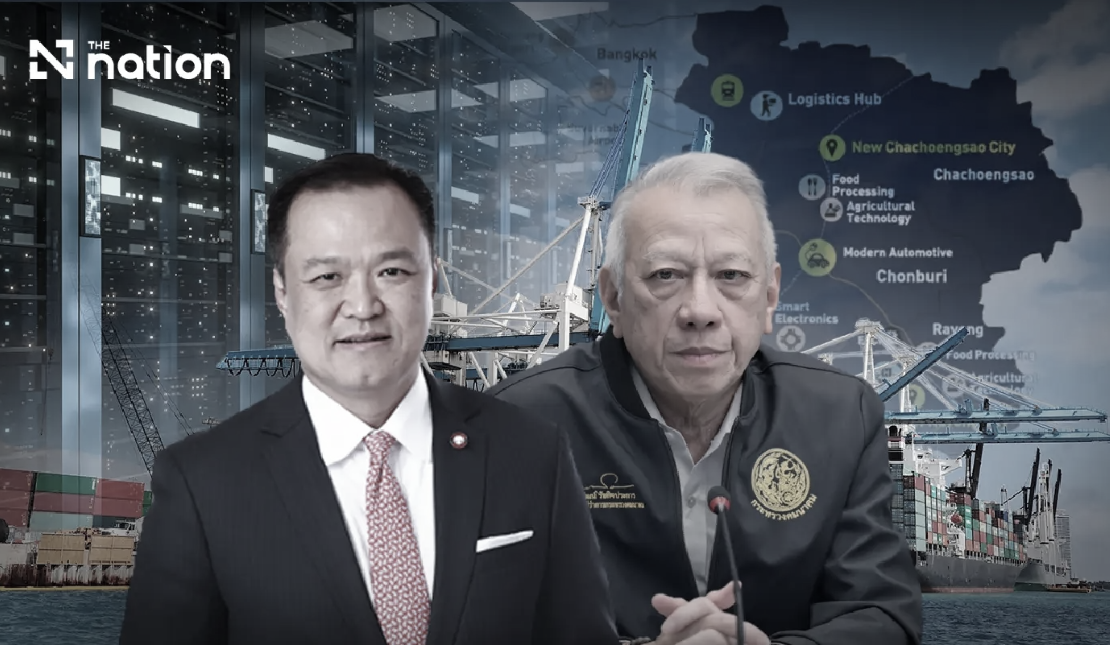
Thailand's Prime Minister Anutin Charnvirakul has consolidated control over the Eastern Economic Corridor, wresting supervisory authority from Deputy Prime Minister and Transport Minister Phiphat Ratchakitprakarn in a strategic recalibration aimed at reshaping the region's investment appeal. Cabinet orders signed on June 15 formally stripped Phiphat of his oversight responsibilities, effective immediately, positioning Anutin to steer the corridor towards emerging sectors and personally champion Thailand's investment proposition to international partners.
The power consolidation represents more than a simple administrative reshuffle. According to Government House sources, the restructuring reflects a fundamental reassessment of the Eastern Economic Corridor's competitive positioning in an increasingly crowded regional investment landscape. Traditional heavy industry, which once anchored the corridor's development strategy, faces mounting constraints from electricity shortages and water scarcity, both critical resources that carry substantial procurement expenses. This reality has forced Thai planners to reimagine the corridor's raison d'être and identify sectors where the eastern region possesses genuine comparative advantage.
Food security has emerged as the primary alternative pillar in this strategic pivot. The eastern region's established strengths in livestock production, commercial fisheries, agricultural operations, fruit cultivation, and horticultural exports position it to serve as a significant node in global food supply chains—a consideration gaining urgency as countries worldwide grapple with supply chain vulnerabilities exposed by recent geopolitical disruptions and climate pressures. By rebranding the corridor as a food security hub rather than a manufacturing centre, Bangkok aims to attract investment from agribusiness conglomerates and food processors seeking reliable, integrated production ecosystems closer to Asian markets.
Equally prominent in this recalibration is the pursuit of data centre investment, a sector representing the technological frontier of Thailand's economic diversification ambitions. Data centres present distinct infrastructure demands—enormous electrical consumption, substantial water requirements for cooling systems, and ancillary support facilities—that necessitate coordinated planning across multiple government agencies. The Energy Ministry is already preparing a new electricity tariff category, Type 9, specifically designed for data centre operators, who would pay premium rates reflecting their outsized power consumption but gaining priority access to reliable supply chains critical for continuous operations.
The centralization of EEC authority under Anutin's direct purview carries significant implications for Thailand's regional competitiveness. By positioning himself as the primary interface between the government and foreign investors, the Prime Minister can streamline decision-making, reduce bureaucratic friction, and project unified messaging about Thailand's investment climate to multinational corporations evaluating Southeast Asian alternatives. This personalized approach to economic diplomacy reflects a broader pattern among Thai leadership, where prime ministerial attention signals commitment and reduces the transaction costs investors face when navigating complex institutional frameworks.
Official explanations emphasize that the transfer occurred without acrimony between Anutin and Phiphat, attributing the decision to operational dysfunction rather than political conflict. Government sources suggest that persistent friction between the EEC Office and the Board of Investment had created an untenable working environment, prompting Phiphat to voluntarily propose that the Prime Minister assume direct control. However, Phiphat's public statements revealed he had received no advance notice of the Cabinet orders, suggesting the decision involved greater unilateralism than the harmonious narrative initially conveyed. Such discrepancies are not uncommon in Thai political culture, where coordinated announcements sometimes obscure underlying power calculations.
The reshuffle's timing intersects with broader policy disagreements within the government coalition. The three-airport high-speed rail project, nominally under Transport Ministry purview, has consumed considerable political capital as the government navigates disputes with the private concession holder, Asia Era One (linked to the influential CP Group), over contract modifications. Phiphat had taken a hardline stance against shifting the payment model from completion-based reimbursement to incremental progress-based payments, a shift the private partner sought to mitigate construction financing risks. Though Government House sources deny the EEC reshuffle relates to these rail disputes, the timing and Anutin's reported skepticism toward Phiphat's Disneyland proposal for the corridor suggest deeper underlying tensions about development priorities and decision-making authority.
For Malaysian and Southeast Asian observers, Thailand's EEC repositioning carries important implications. The strategic emphasis on food security reflects regional recognition that agricultural supply chains represent increasingly valuable competitive terrain as global food price volatility and supply disruptions persist. A reinvigorated Thai corridor focused on agricultural processing and distribution could reshape competitive dynamics for Malaysian agribusiness interests operating across borders, potentially creating opportunities for integration or, conversely, intensifying rivalry depending on sectoral overlap. Similarly, the data centre thrust positions Thailand to compete more directly with emerging regional hubs in Vietnam, Indonesia, and Singapore, particularly as Southeast Asia becomes an increasingly important node in Asia-Pacific digital infrastructure networks.
The concentration of EEC authority within Anutin's office may enhance decision-making efficiency in the short term, but institutional consolidation carries inherent risks. The corridor's historical challenges—sluggish implementation, infrastructure bottlenecks, bureaucratic delays—suggest that authority concentration alone cannot overcome structural impediments rooted in Thailand's fragmented administrative systems and competing agency interests. Success will ultimately depend on whether Anutin can deploy sufficient political capital to align the various ministries and state enterprises whose cooperation proves essential for executing integrated food security and data centre strategies.
Looking forward, the EEC's reinvention under new thematic frameworks represents Thailand's attempt to remain relevant in evolving regional investment competition. The selection of food security and data centres—sectors combining genuine regional advantages with global relevance—reflects sophisticated strategic thinking about Thailand's positioning within shifting patterns of international capital allocation. However, implementation will test whether administrative restructuring can overcome the institutional inertia and interagency rivalry that have historically constrained the corridor's development, ultimately determining whether the rebranded EEC becomes a genuine economic engine or remains a high-profile initiative frustrated by operational realities.