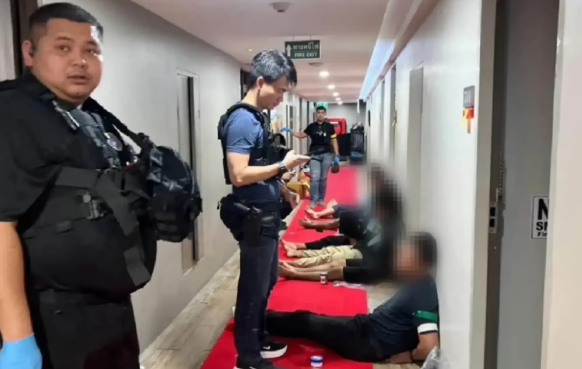
Thai law enforcement has executed a significant operation against what authorities describe as a sophisticated underground criminal network operating from within a upscale hotel in Nonthaburi province. The Central Investigation Bureau's Crime Suppression Division led the coordinated raid, dubbed Operation Dragon Nest, following public complaints about suspicious activity at a facility on Ngam Wong Wan Road in Bang Khen subdistrict. The investigation revealed that the entire hotel had been systematically converted into a clandestine operational hub serving exclusively Chinese nationals, with tight security protocols preventing access to regular tourists.
The scope of the alleged criminal enterprise became apparent once officers breached the facility with over 100 personnel and a Criminal Court warrant. Police discovered that the accommodation levels, spanning floors two through six, functioned as living quarters while the upper floors had been deliberately repurposed for illicit activities. The seventh and eighth floors contained dedicated spaces for drug consumption parties, high-stakes gambling operations, and arranged sexual services exclusively targeting wealthy Chinese visitors. This compartmentalized structure suggests a well-organized operation designed to maximize secrecy and operational efficiency.
Authorities arrested a 33-year-old Chinese national on serious narcotics charges, specifically for possessing and attempting to distribute ketamine, classified as a Category 2 psychotropic substance under Thai law. The suspect maintained during initial interrogation that he held only a subordinate position, claiming responsibility merely for courier duties rather than supply or organizational roles. Three Myanmar nationals were also taken into custody for immigration violations, having entered and remained in Thailand without proper authorization. These secondary arrests point to the operation's reliance on migrant workers for operational support roles.
The investigation generated an impressive collection of evidence documenting the operation's scope and sophistication. Police recovered more than 200 individual items including substantial quantities of ketamine and "happy water," a liquid substance commonly used recreationally in underground entertainment scenes. The seizure encompassed professional-grade drug preparation equipment, indicating substantial processing capabilities within the facility itself. Gambling materials recovered included casino chips, playing cards, dice, baccarat scoresheets, and hi-lo gaming equipment, demonstrating multiple betting mechanisms to maintain client engagement.
Beyond these physical items, authorities secured digital and financial evidence proving the operation's financial dimensions. Mobile phones, banking records and information, along with complete CCTV system data extracted from the hotel's surveillance infrastructure, provide investigators with communication trails and visual documentation of daily operations. This digital haul will likely reveal the organizational hierarchy, client networks, and money-movement patterns that sustained the enterprise. The scale of recovered cash and documented financial transactions suggests significant revenue generation.
The discovery highlights a growing trend of transnational criminal networks exploiting Thailand's infrastructure to serve wealthy foreign clientele. The operation's exclusive focus on Chinese nationals reflects the increasing economic power and mobility of Chinese capital seeking entertainment and pharmaceutical access beyond their domestic borders. These networks capitalize on Thailand's reputation as a destination for both tourism and underworld activity, leveraging the country's geographic position and service sector sophistication. The all-in-one facility model, providing accommodation, gambling, drugs, and sexual services under one roof, represents an evolution in organized crime operational security.
For Malaysian observers, this development carries particular significance given the region's shared vulnerabilities to similar transnational criminal networks. The sophisticated nature of this Nonthaburi operation, with its dedicated infrastructure and multi-layered service offerings, suggests that comparable facilities likely exist across Southeast Asia, potentially including Malaysian territories. The presence of Myanmar nationals in the operation also underscores how porous borders and migration patterns enable criminal groups to establish reliable supply chains and support networks.
The police investigation commenced following persistent public complaints about the hotel's suspicious operational patterns. Residents and observers noticed that ordinary tourists received no access while Chinese nationals moved through the premises continuously throughout both day and night cycles. This visibility, despite deliberate security measures, demonstrates the difficulty of maintaining complete operational secrecy even with significant resources invested in compartmentalization. The tip-off mechanism proved effective, suggesting that community vigilance remains valuable in identifying hidden criminal infrastructure.
Thailand's approach through Operation Dragon Nest reflects increasing governmental focus on eliminating what authorities term "grey dragon" networks—underground financial and criminal operations believed to represent significant money-laundering and financial crime threats. The terminology suggests recognition of these networks' structural sophistication and transnational dimensions. The deployment of over 100 officers and coordination through specialized investigative bureaus indicates resource commitment to dismantling organized networks rather than pursuing isolated offenders. This institutional focus may prove more effective against distributed criminal enterprises than traditional case-by-case prosecution approaches.
The implications extend beyond immediate law enforcement success. The operation demonstrates that luxury hospitality infrastructure, despite ostensible legitimacy and government oversight, remains vulnerable to wholesale conversion into criminal operational bases. Hotel owners and management companies operating in Thailand and throughout Southeast Asia will likely face increased scrutiny regarding tenant vetting and facility monitoring protocols. The incident raises questions about how an entire hotel escaped detection until public complaints prompted investigation, suggesting gaps in existing regulatory frameworks and routine monitoring systems.
These revelations occur within broader Southeast Asian concerns about transnational organized crime, drug trafficking networks, and underground gambling operations exploiting porous regional borders. The Nonthaburi case provides a detailed examination of how criminal entrepreneurs structure integrated service operations to serve specific wealthy client demographics while maintaining operational security. For Malaysian authorities and regional policymakers, the operational model unveiled in this investigation offers a troubling blueprint of organized crime evolution and adaptation within Southeast Asian urban centers.

