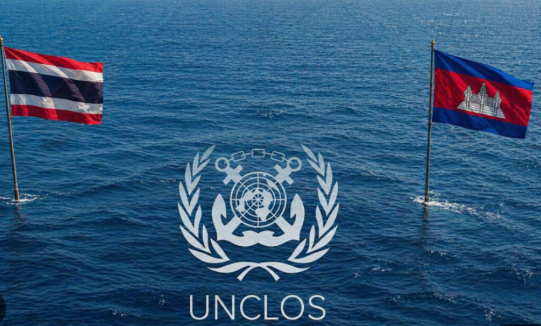
Thailand has taken a formal step forward in addressing a long-standing maritime boundary dispute with Cambodia by agreeing to enter into compulsory conciliation proceedings under the 1982 United Nations Convention on the Law of the Sea. However, Bangkok's acceptance comes with carefully stated conditions that underscore its determination to maintain control over the eventual outcome and preserve its negotiating position in what may prove to be a protracted process.
Thailand submitted its official response to Cambodia's conciliation request on June 19, following Cambodia's initial notification transmitted on June 2. In doing so, Thailand has signalled its willingness to engage with an internationally structured dispute resolution mechanism while simultaneously seeking to narrow the scope of discussions to maritime boundary delimitation alone. This strategic positioning reflects Thailand's assessment that a constrained process serves its interests better than one addressing broader dimensions of the dispute.
The composition of the Thai delegation reveals Bangkok's serious engagement with the proceedings despite its caveats about binding authority. Deputy Prime Minister and Foreign Minister Sihasak Phuangketkeow will serve as Thailand's Agent, a formal role in international conciliation that carries significant diplomatic weight. Songchai Chaipatiyut, Thailand's ambassador to Kuwait and a veteran of the Department of Treaties and Legal Affairs, has been appointed Deputy Agent, providing experienced legal and diplomatic guidance throughout the process.
Thailand has also appointed two conciliators to the panel: Judge Albert J Hoffmann of South Africa and Judge Rudiger Wolfrum of Germany, both described by Thailand's Foreign Ministry as internationally recognised experts in maritime law. These selections indicate that Bangkok is taking the technical and legal dimensions of the dispute seriously, despite its public emphasis on the non-binding nature of any eventual outcome. The appointment of respected international judges suggests Thailand recognises the need for credible, neutral expert involvement.
The conciliation commission will eventually comprise five members. The four conciliators already appointed by Thailand and Cambodia will have 30 days from Thailand's response to select a fifth conciliator who will chair the proceedings. This chair will play a critical role in shaping the commission's final report and recommendations. The full commission is expected to complete its work within approximately 12 months, though both countries retain the option to extend this timeline through mutual agreement.
Thailand's Foreign Ministry has repeatedly stressed that compulsory conciliation under Unclos differs fundamentally from litigation. The conciliators, officials emphasise, are not advocates for either side but rather neutral experts tasked with understanding the dispute's context, hearing both parties' positions, and identifying potential pathways toward mutual settlement. This framing is significant because it establishes expectations about the process's nature while potentially reducing domestic political pressure by presenting conciliation as consultative rather than adjudicatory.
The legal foundation for Thailand's position rests on Unclos Annex V, which explicitly states that a conciliation commission's report and recommendations carry no binding force on the parties involved. This provision gives Thailand considerable flexibility regarding the eventual outcome. Even if the commission's recommendations prove unfavourable to Bangkok's claims, Thailand faces no legal obligation to accept them. This structural feature of Unclos conciliation may explain why Thailand felt comfortable accepting Cambodia's request while simultaneously emphasising the non-binding character of results.
Thailand has made clear that it views conciliation as a stepping stone toward resumed bilateral negotiations rather than as a substitute for direct talks. Bangkok's stated preference is that the conciliation process should provide a framework within which both countries can work toward a mutually acceptable settlement, with negotiations continuing between national governments. This approach reflects Thailand's broader diplomatic strategy of maintaining sovereignty over final decisions affecting its maritime and resource interests.
A significant point of contention concerns the scope of the conciliation process itself. While Thailand insists the proceedings should focus exclusively on maritime boundary delimitation under Unclos, Cambodia's original notification appears to encompass not only boundary issues but also provisional arrangements for joint development of offshore resources and equitable sharing of hydrocarbons. This disagreement over the conciliation's scope could affect the commission's recommendations and the subsequent negotiating environment.
The underlying resource dimension cannot be overlooked. The disputed waters of the Gulf of Thailand are believed to contain substantial reserves of natural gas and other hydrocarbons, making the boundary dispute fundamentally intertwined with economic interests. Thailand's termination in May of the 2001 memorandum of understanding with Cambodia—the framework that had previously governed discussions on overlapping continental shelf claims—signals Bangkok's desire to reshape the negotiating structure. Prime Minister Anutin Charnvirakul attributed the termination to lack of progress over 25 years rather than any bilateral conflict, a diplomatic characterisation that preserves the possibility of future cooperation.
Thailand's cancellation of the 2001 MoU represented a significant move but one officially framed as structural adjustment rather than diplomatic rupture. The government stated it would continue maritime negotiations with Cambodia using Unclos as a common reference point, a formulation that acknowledges the convention's centrality to both nations' maritime policies while implying that the old bilateral agreement framework had become inadequate for contemporary circumstances.
Cambodia's decision to invoke compulsory conciliation can be interpreted as an attempt to internationalise what had become a stalled bilateral process. By appealing to Unclos mechanisms, Cambodia shifted the dispute from purely bilateral negotiation to a framework involving internationally appointed conciliators, potentially levelling what Cambodia may view as an asymmetry in negotiating power. Thailand's acceptance, however conditional, indicates recognition that participating in international legal processes carries diplomatic benefits even when outcomes remain non-binding.
For Malaysia and other Southeast Asian nations with their own maritime boundary disputes, this process offers instructive lessons about Unclos conciliation as a conflict management tool. The Thailand-Cambodia experience demonstrates both the utility and limitations of compulsory conciliation: it provides a structured mechanism for moving beyond diplomatic stalemate while leaving final authority firmly with national governments. The coming months will reveal whether the conciliation process genuinely facilitates movement toward settlement or merely formalises positions that bilateral negotiations have been unable to resolve.

