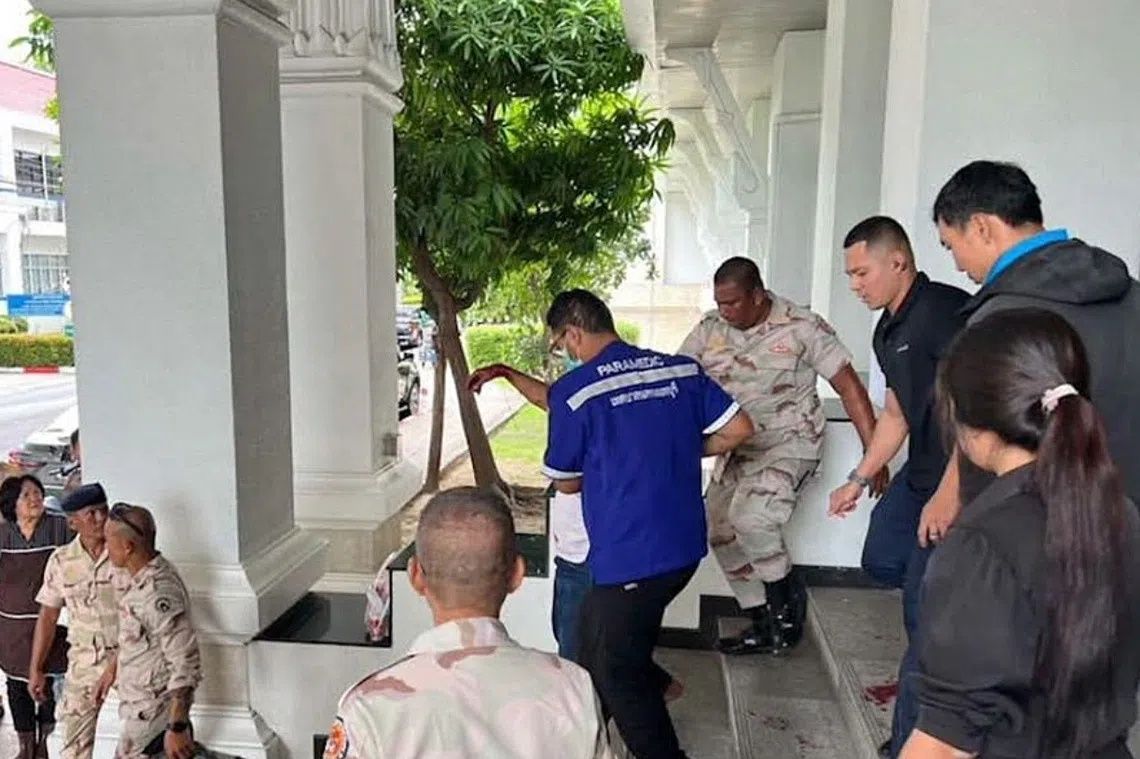
Thailand's fragile peace was shattered again on Monday when a gunman opened fire at a local government building on Bangkok's outskirts, injuring two officials in an incident that underscores the nation's escalating firearms crisis. The attack came barely three days after one of the country's worst mass shootings in recent memory, when a teenager murdered nine people at a school in the same province, prompting fresh calls for stringent regulation of civilian gun ownership across Southeast Asia's second-largest economy.
Authorities apprehended the suspected shooter at the provincial government office after he allegedly discharged multiple rounds at a senior provincial official and the official's driver, according to Major General Dejrapee Kongdee, the provincial police commander. The assailant, identified as a former lawmaker, was taken into custody at the scene. Both victims sustained injuries and were transported to a nearby hospital for medical care, though the severity of their conditions was not immediately disclosed by officials.
The shooting occurred against the backdrop of national trauma from Friday's rampage at Debsirin Nonthaburi School, where a 14-year-old boy allegedly murdered his grandparents before arriving at the school and opening fire indiscriminately on students and staff. That attack, which claimed nine lives with more than 20 others wounded, represents Thailand's deadliest mass shooting incident in nearly four years and has become a stark reminder of the dangers posed by unrestricted firearm access in civilian hands. The teenager subsequently turned the weapon on himself, ending the carnage but leaving the nation to grapple with profound questions about its gun policies and security protocols.
The back-to-back incidents have catalysed intense debate among Thai policymakers and the public about whether current regulations adequately protect citizens from armed violence. Prime Minister Anutin Charnvirakul has signalled his administration's commitment to implementing stronger gun control measures, though specifics of proposed legislation remain unclear. Such reforms would represent a significant policy shift for Thailand, where gun ownership has historically been relatively accessible compared to neighbouring countries, and where hunting and sport shooting maintain cultural significance in certain communities.
The school shooting's reverberations extended into the educational sphere as classes resumed across the province on Monday. Many institutions implemented enhanced security protocols, including metal detector screenings at entry points, reflecting heightened anxiety among parents and educators about student safety. The visible fortification of school environments serves as a physical manifestation of the collective fear gripping the nation and the urgent pressure on authorities to prevent future tragedies.
For Malaysia and other Southeast Asian nations, Thailand's security challenges offer cautionary lessons about the intersection of accessible weapons, mental health vulnerabilities, and inadequate institutional safeguards. The region's relatively porous borders and varying regulatory standards across countries create complications for law enforcement efforts, as firearms can move between jurisdictions more easily than in more developed nations with harmonised regulations. Thailand's experience suggests that isolated incidents of gun violence can quickly cascade into broader patterns of armed aggression when systemic vulnerabilities remain unaddressed.
The involvement of a former lawmaker in the government office shooting adds a political dimension to what might otherwise be viewed as a purely criminal matter. Questions will inevitably arise about whether someone with prior legislative experience possessed particular grievances or access to weapons that facilitated the attack. Such involvement could complicate the political discourse around gun control, as opposing factions may use the incident to advance competing narratives about the causes of Thailand's violence and the appropriate remedies.
Thailand's recent surge in mass shooting incidents reflects broader regional tensions around urbanisation, economic dislocation, and access to firearms. Unlike neighbouring countries with stricter weapons regulations or smaller civilian firearm stocks, Thailand has struggled to keep pace with international best practices in gun control and mental health intervention. The concentrated nature of Friday's and Monday's incidents—occurring within days and in the same geographical area—suggests systemic vulnerabilities that transcend individual criminality and point toward structural challenges in how Thai society addresses conflicts and mental health crises.
The psychological impact of repeated mass shootings on Thai society extends beyond immediate victims and their families. Educators, parents, and students are experiencing heightened anxiety that may reshape the national conversation about public safety and government accountability. Schools implementing metal detectors and security screenings represent normalisation of fortress-like environments, raising questions about whether such measures genuinely enhance safety or merely create an illusion of protection while potentially traumatising young people accustomed to more open campuses.
Prime Minister Anutin's stated intention to strengthen gun controls will face practical implementation challenges, including resistance from gun owners and hunting advocates, questions about enforcement mechanisms, and the broader reality that Thailand has millions of firearms already in civilian circulation. Any meaningful reform will require sustained political commitment beyond the immediate aftermath of tragedy, as governments frequently struggle to maintain momentum for controversial security measures once initial shock fades from public consciousness. The window for decisive action remains open, but the historical pattern of legislative backtracking in response to security crises suggests that substantive change will require sustained public pressure and political will extending well beyond current headlines.

