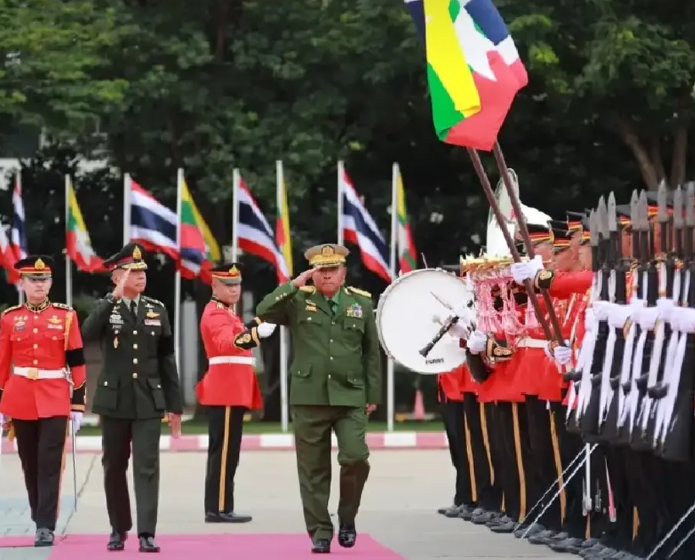
Thailand's military leadership extended a formal welcome to Myanmar's newly installed military chief Ye Win Oo on Thursday, receiving him at a Bangkok hotel for high-level discussions. The visit represents Ye Win Oo's inaugural overseas journey since assuming his position, underscoring Myanmar's intensifying efforts to rebuild international connections after half a decade in the diplomatic wilderness. The encounter between Thai military chief Ukris Boontanondha and his Myanmar counterpart signals a significant shift in regional attitudes toward Naypyidaw's armed forces, which orchestrated a coup d'état in 2021 that toppled an elected government and imprisoned its leader Aung San Suu Kyi.
Myanmar's military establishment has endured years of isolation following their seizure of power, which triggered a devastating civil conflict that has claimed an estimated 100,000 lives and spawned accusations of widespread human rights violations. The junta navigated this pariah status by orchestrating tightly controlled elections at the beginning of 2026, which they have presented internationally as evidence of a return to constitutional governance. Under this arrangement, Min Aung Hlaing, the retired general who orchestrated the original coup, transitioned into a civilian presidency while delegating military leadership to Ye Win Oo, a former intelligence operative with close ties to the regime. Despite these structural rearrangements, Myanmar's fundamental political system remains under military control, with democratic institutions and opposition parties effectively sidelined.
The bilateral talks in Bangkok are anticipated to concentrate on managing the extensive 2,400-kilometre border shared by both nations, an area destabilized by Myanmar's ongoing internal conflict. This border region has emerged as a critical diplomatic issue, with cross-border armed activities and refugee flows affecting Thai security interests. For Thailand, the visit represents a pragmatic calculation that dialogue with Myanmar's military leadership is preferable to maintaining cold relations with a powerful neighbour, regardless of international condemnation of the junta's governance practices. The previous month saw Prime Minister Anutin Charnvirakul extend an elaborate reception to Min Aung Hlaing in the Thai capital, a decision that generated international controversy and domestic debate about Thailand's positioning.
Ye Win Oo carries substantial international baggage, having served as a senior spymaster in Myanmar's previous military junta and subsequently played a central role in the 2021 coup. Multiple Western nations, including the United States, have imposed sanctions against him in response to his involvement in the power seizure. His appointment to Myanmar's top military position underscores the continuity of military power rather than any genuine transition toward democratic governance. The UN's Independent Investigative Mechanism for Myanmar documented in its latest annual assessment that the military organization now under his command continues to escalate aerial bombardments targeting civilian populations, whilst also engaging in systematic arbitrary detention, torture, and sexual violence.
Thailand's decision to host both Myanmar's previous and current military leaders has divided international observers and prompted sharp criticism from civil society organizations. Thai Foreign Minister Sihasak Phuangketkeow defended the diplomatic overture by emphasizing pragmatism over principle, remarking to media representatives that "it's not about legitimacy, it's about reality." This formulation captures the dilemma facing neighbouring states: maintaining international human rights standards whilst managing tangible border security concerns and economic interdependencies with Myanmar. The calculation reflects a broader Southeast Asian reluctance to isolate Myanmar completely, despite documented atrocities, based on the logic that engagement preserves channels for potential influence.
Human rights advocates and democracy monitoring organizations have responded with uncompromising condemnation of Thailand's approach. The Special Advisory Council for Myanmar issued a statement this week characterizing Thailand's reception of Min Aung Hlaing as effectively destroying its credibility on democracy and human rights issues, with the subsequent Ye Win Oo visit described as "adding to its ignominy." These organizations argue that the 2026 elections represented a carefully orchestrated performance designed to legitimize continued military rule rather than a genuine democratic opening, particularly given the exclusion of Suu Kyi's National League for Democracy from political competition and the imprisonment of political opponents.
The international community remains fractured in its approach to Myanmar's post-coup trajectory. Western nations and global human rights institutions have largely rejected the 2026 elections as credible, maintaining principled opposition to the military's grip on power. Conversely, neighbouring states particularly Thailand, Laos, and Cambodia have utilized the elections as a justification for normalizing relations and reengaging with Myanmar's leadership. This divergence reflects the tension between values-based foreign policy and regional stability priorities, with Southeast Asian governments prioritizing pragmatic management of border issues and economic relations over external pressure for democratic restoration.
Myanmars's military government has dismissed international criticism regarding documented human rights violations, characterizing UN investigative findings as "one-sided allegations based on unverifiable and inaccurate information." This defensive posture is consistent with the junta's broader strategy of rejecting external accountability mechanisms whilst claiming that elections and administrative restructuring demonstrate a commitment to normality. The military's framing positions international scrutiny as an infringement on sovereignty, appealing to nationalist sentiment within Myanmar whilst attempting to reset regional relationships on terms more favourable to continued military dominance. For Thailand and other regional counterparts, engaging with Myanmar despite these concerns reflects a calculation that dialogue offers better prospects for managing transborder instability than continued isolation.

