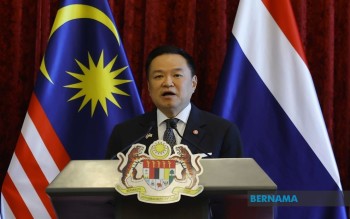
Thailand's Prime Minister Anutin Charnvirakul has signalled strong confidence in pushing bilateral trade with Malaysia to the US$30 billion mark by 2027, a goal that reflects the deepening economic integration between Southeast Asia's two most significant trading partners in the region. Speaking at a joint press conference alongside Malaysian Prime Minister Datuk Seri Anwar Ibrahim following a memorandum of understanding exchange ceremony at Perdana Putra Complex in Putrajaya, Anutin indicated that the ambitious target is within reach given the current trajectory and cooperative framework both nations have established.
The current state of Malaysia-Thailand trade demonstrates a relationship already functioning at substantial scale. With bilateral commerce presently hovering around US$28 billion, the two countries are separated by just US$2 billion from their stated objective, a gap that underscores the feasibility of the target rather than representing an aspirational fantasy. Thailand's recognition of Malaysia as its largest trading partner within ASEAN reflects the fundamental importance of cross-border economic relations to Bangkok's regional strategy and broader economic growth objectives.
Both prime ministers committed to establishing fresh mechanisms for deepening trade ties and expanding commercial opportunities. The joint trade committee will convene specifically to calibrate new, more ambitious targets beyond the 2027 benchmark, suggesting that policymakers in both capitals view the US$30 billion figure as a milestone rather than a ceiling for bilateral commerce. This iterative approach to trade goal-setting reflects confidence that the structural foundations supporting current trade flows will continue strengthening as supply chains deepen and market access expands.
Thailand has articulated a clear strategic vision for leveraging its relationship with Malaysia to enhance regional value chains and supply chains. Rather than pursuing narrowly bilateral gains, Bangkok is framing the partnership as an opportunity to build upon the complementary strengths each economy brings to the table. Thailand's agricultural and manufacturing prowess combines with Malaysia's advanced services sector, technology capabilities, and strategic geographic positioning to create natural synergies that can benefit both nations simultaneously.
Three priority sectors have emerged as focal points for intensified cooperation. Food security has assumed particular importance across Southeast Asia as regional demographics expand and climate pressures mount on agricultural systems, making collaborative approaches to farming innovation and supply chain resilience increasingly critical. Energy security represents another natural area of convergence, particularly as both nations navigate the transition toward renewable and cleaner energy sources while managing demand from growing populations and industrial bases. The digital economy and high-tech industries constitute the third pillar, reflecting recognition that sustainable competitive advantage in the modern global economy depends upon technological sophistication and innovation capacity.
Malaysia's commitment to the trade expansion agenda carries institutional weight. Anwar emphasised that his government will dedicate resources from both the Ministry of Foreign Affairs and the Ministry of Investment, Trade and Industry to achieving the target, indicating that the goal receives high-level political priority rather than functioning as mere diplomatic rhetoric. This governmental commitment suggests that Malaysia will actively remove regulatory barriers, facilitate business partnerships, and invest in infrastructure supporting increased bilateral commerce.
Anwar further contextualised the trade ambition within a broader framework of bilateral friendship and comprehensive collaboration. His assertion that fundamental economic and trade issues must serve as the foundation for deeper regional partnership reflects a sophisticated understanding of how commerce builds the confidence and institutional relationships necessary for cooperation across other domains. Tourism emerged as an additional area requiring coordinated attention, capitalising on mutual attractiveness as travel destinations and the growing middle-class populations in both countries driving cross-border leisure spending.
Anutin's visit marks his first official trip to Malaysia since returning to the prime ministerial role in March 2026, carrying symbolic significance beyond its immediate diplomatic function. The timing of this visit and the substantive bilateral meetings signal that Thailand regards its Malaysian relationship as sufficiently important to warrant early engagement following leadership transitions. The formal bilateral meeting at Perdana Putra Complex enabled comprehensive review of existing cooperation frameworks and exploration of new initiatives across multiple sectors.
The visit itself, scheduled for two days and beginning with Anutin's arrival at Kuala Lumpur International Airport at 11.11 am on the announced date, followed conventional diplomatic protocols while underscoring the institutional nature of Thailand-Malaysia relations. Senior leadership engagement at this frequency and intensity demonstrates that both governments view their bilateral relationship as a strategic priority deserving regular high-level attention and renewal of commitments.
For Malaysian observers, Thailand's confidence in achieving heightened trade targets carries implications extending beyond bilateral commerce. Stronger Thailand-Malaysia economic integration contributes to broader ASEAN cohesion and demonstrates that the region's largest economies can deepen ties without destabilising competition or zero-sum positioning. The emphasis on complementary strengths and collaborative supply chains suggests a model of regional integration that creates genuine mutual benefit, potentially influencing broader ASEAN trade architecture and regional value chain development.
The articulation of specific priority sectors—food security, energy security, and digital economy—also signals where both governments expect dynamic growth and believe competitive advantage can be built. These sectors carry implications for Malaysian businesses and investors seeking to identify opportunities aligned with official policy direction. Companies positioned at intersections of these three domains, particularly those facilitating technology transfer or supply chain innovation, may find expanding opportunities as government support mechanisms activate.
The mechanism of the joint trade committee, designated to develop more ambitious future targets following the 2027 benchmark, establishes an institutionalised process for regular review and escalation of bilateral economic cooperation. This structural approach to trade expansion differs from ad-hoc negotiations and suggests that both nations are committed to sustained, systematic deepening of economic ties rather than episodic engagement dependent upon leadership personalities or political circumstances.

