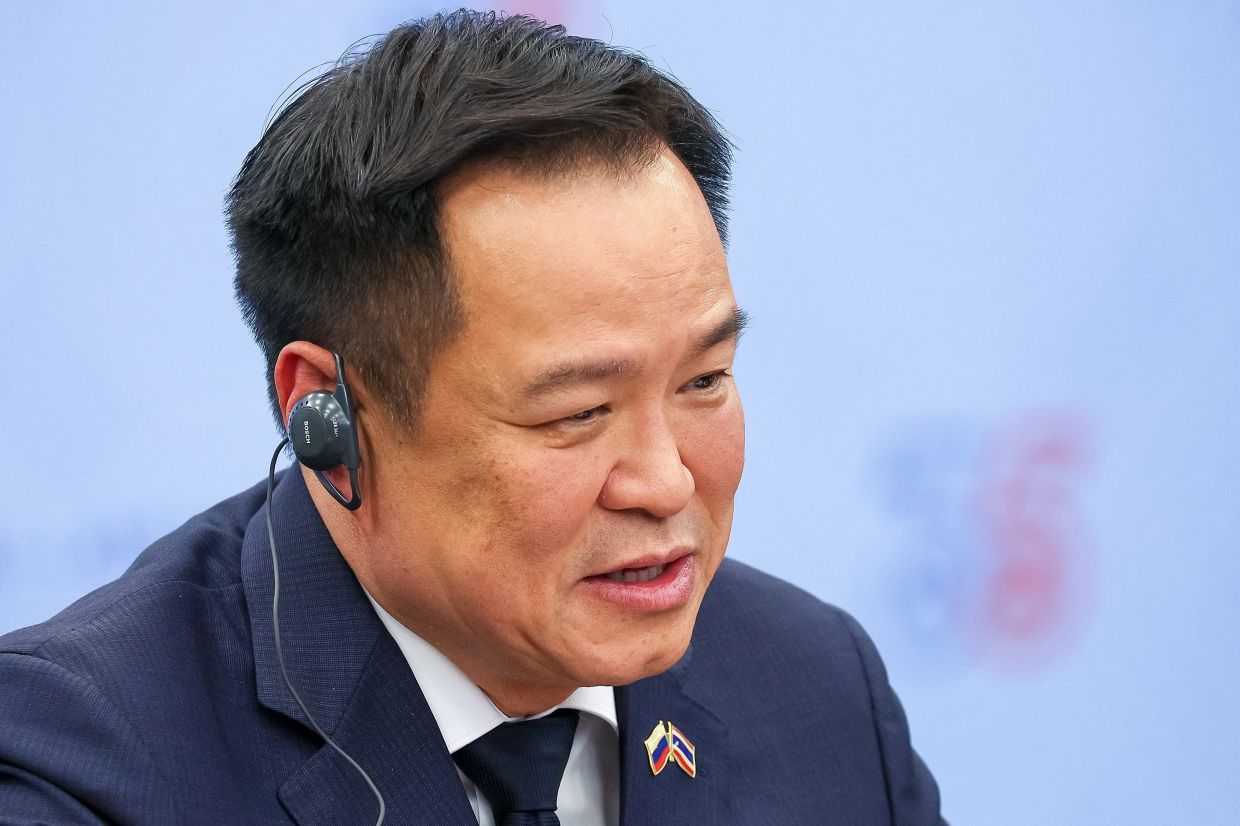
Thailand's Prime Minister Anutin Charnvirakul reached the hundred-day milestone of his tenure on June 27, marking a quarter-year into his second stint leading Southeast Asia's second-largest economy. The 59-year-old leader, who initially assumed office in September 2025 before being returned to power through the February 2026 general election, has so far demonstrated competence in managing immediate crises. Yet beneath this façade of stability, structural weaknesses that could undermine Thailand's long-term prosperity remain fundamentally unaddressed, raising questions about whether his administration's strategy of crisis management can sustain public confidence as deeper economic malaise persists.
Anutin inherited the prime minister's office at an inauspicious moment. Barely a month after his election victory, the February 28 United States-Israeli military operations against Iran rippled across global energy markets, disrupting crude oil exports and triggering immediate consequences in Thailand. Petrol stations struggled to keep up with panic buying as citizens feared fuel shortages, while crude prices surged above US$100 per barrel as shipping through the Strait of Hormuz faced repeated disruptions. For a Southeast Asian nation heavily dependent on imported energy and vulnerable to supply chain shocks beyond its control, the crisis threatened to cascade into broader economic turbulence precisely when the new government was still establishing itself.
The government's response demonstrated pragmatic crisis management rather than visionary policymaking. Officials deployed Thailand's Oil Fuel Fund to subsidise retail fuel prices, preventing the kind of public anger that uncontrolled energy costs might have provoked. Simultaneously, authorities ordered coal-fired power plants to operate at maximum capacity and pursued diversified sourcing from the United States, Malaysia, and Brunei. These interventions, while expensive, succeeded in averting the mass protests and deeper instability that plagued previous Thai administrations. Mathis Lohatepanont, a political science researcher at the University of Michigan, acknowledged that the government "managed to avoid further instability" despite the disruptive circumstances, suggesting Anutin's first hundred days met a baseline threshold of competent governance.
Beyond energy management, Anutin consolidated political support by delivering on nationalist commitments that resonated with voters. His Bhumjaithai Party had won the most seats in February's election by championing a hardline stance on Cambodia's territorial disputes, and as prime minister, Anutin followed through decisively. He maintained military primacy in border operations and unilaterally terminated a 2001 bilateral maritime boundary agreement with Phnom Penh, escalating the dispute to United Nations arbitration. These moves satisfied his party's base and projected strength to a Thai electorate that values nationalist rhetoric, creating a reservoir of political goodwill that cushioned his government against criticism on other fronts.
Another early political victory came through the "Thais Help Thais Plus" subsidy programme launched on June 1. The initiative permits eligible citizens aged 18 and above to purchase selected goods from participating merchants at forty per cent of normal retail price, with government bearing the remainder. Allocated 176 billion baht (US$5.27 billion) and targeting approximately 30 million Thais excluded from previous welfare programmes, the scheme delivered tangible relief to households squeezed by inflation and sluggish wage growth. It functioned precisely as election-year populism should: generating visible short-term benefits while creating an impression of governmental action and responsiveness.
Yet beneath these surface successes lies a troubling absence of strategic economic vision. Analysts including Puangthong Pawakapan from Chulalongkorn University's political science faculty acknowledged that the subsidy programme, while popular, addresses only symptoms rather than root causes. It provides temporary relief from cost-of-living pressures but "absolutely nothing to solve the underlying economic crisis." Thailand's fundamental challenges—sluggish growth averaging below three per cent annually over the past five years, an ageing population requiring increased healthcare and pension expenditures, and household debt levels that constrain discretionary spending—demand structural solutions that stimulus cheques cannot provide. The International Monetary Fund projects just 1.5 per cent growth for Thailand this year, the slowest pace across Southeast Asia and dramatically trailing Vietnam's projected 7.1 per cent expansion.
Most concerning to observers is the government's apparent disinterest in pursuing meaningful reform. Despite nearly 60 per cent of voters—approximately 20 million citizens—supporting constitutional change in a February referendum, the Anutin administration has made minimal progress on this critical issue. Thailand's 2017 Constitution, drafted under former coup leader Prayut Chan-o-cha, remains widely viewed as undemocratic and constraining long-term institutional development. Stithorn Thananithichot of Chulalongkorn University's political science faculty pointedly observed that "a government that intended to reform would have signalled at least one substantive structural commitment at the outset; this one did not, and that absence is by design rather than a matter of time." The absence of constitutional progress signals a governance philosophy focused on maintaining existing arrangements rather than implementing transformative change.
Anutin has publicly outlined ambitions to develop new economic engines in digital technology, artificial intelligence, and clean energy sectors. These aspirations align with regional trends and acknowledge Thailand's need to move beyond tourism and manufacturing dependence. However, no coherent roadmap translating these aspirations into concrete policy mechanisms has emerged. The government's energies, as Stithorn notes, have been absorbed by "routine administration and day-to-day management rather than into any initiative aimed at meaningful economic or political change." For a nation that has suffered through multiple military coups and short-lived governments over two decades, this lack of long-term strategic direction perpetuates a cycle in which structural problems fester while successive administrations focus on immediate stability.
Thailand's economic vulnerability to external shocks, demonstrated acutely by the Middle East energy crisis, demands domestic structural reforms that would strengthen productivity, diversify income sources, and enhance resilience. Instead, Anutin's approach prioritises political consolidation and crisis containment. While this strategy prevents immediate destabilisation, it postpones essential adjustments that become more expensive to implement the longer they are delayed. Regional competitors including Vietnam, with its rapid industrialisation and foreign investment attraction, continue widening competitive advantages that Thai policymakers seem unable or unwilling to challenge directly.
For Malaysian observers, Thailand's experience offers instructive lessons about the limits of technocratic crisis management divorced from structural reform. Both nations face similar demographic challenges, regional competitive pressures, and institutional legacies constraining rapid policy change. Yet Thailand's apparent choice to prioritise political survival over economic transformation suggests a government betting that short-term stability will suffice indefinitely. The viability of this wager will become apparent within Anutin's tenure, particularly if external shocks recur or domestic growth fails to accelerate. Until then, his hundred-day record reads as competent crisis navigation masking an absence of strategic vision—a pattern that has characterised Thai governance for too long.

