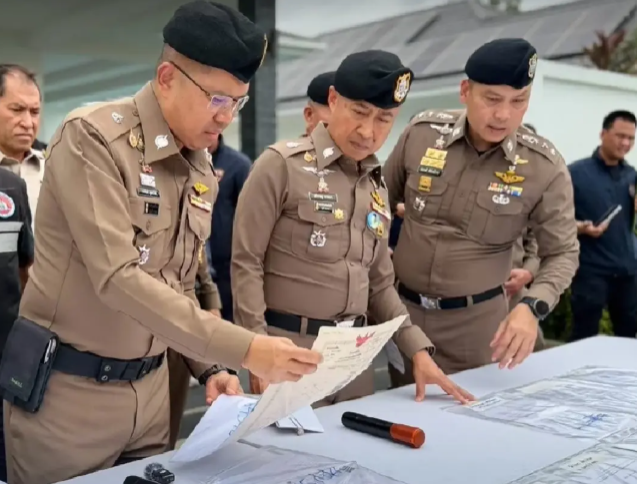
Thailand's authorities intensified their crackdown on foreign property ownership schemes by arresting 13 foreign nationals during coordinated raids across Hua Hin in Prachuap Khiri Khan province on Monday, marking the sixth phase of a nationwide operation targeting suspected misuse of Thai nominee structures to circumvent foreign investment restrictions. The operation, involving more than 200 police officers and government officials, represents a significant escalation in enforcement against what officials contend are deliberate attempts to mask foreign control of high-value residential properties through deceptive corporate arrangements.
The detained individuals included three British nationals, four Chinese nationals, and one person each from Italy, France, the Netherlands, Austria, the Philippines and the United States. While arrest warrants were issued for 45 foreign nationals in total, authorities also summoned 39 Thai nationals for questioning as investigators traced the networks surrounding the alleged schemes. The suspects arrested remain under investigation pending potential criminal charges, with the specific offences still being determined by prosecutors.
The raids targeted a residential development featuring detached houses and luxury pool villas in Thap Tai subdistrict, where individual properties commanded prices between 10 million and 20 million baht. Initial searches identified six companies allegedly using Thai citizens as front shareholders at this single location, with two firms connected to earlier phases of development. The broader investigation encompasses 33 companies suspected of holding land nominally in Thai names while being beneficially owned or controlled by foreign nationals, with the combined property portfolio valued at approximately 300 million baht. This scale demonstrates the systematic nature of the arrangements authorities believe are occurring across Thailand's premium property markets.
According to police testimony, foreign nationals implicated in the investigation claimed they had sought legal advice from law and accounting firms regarding property acquisition in Thailand. These professionals allegedly recommended establishing Thai companies as the vehicle for ownership, with the foreign buyers apparently understanding they were complying with Thai legal frameworks governing foreign land ownership. However, police investigations revealed that the companies involved appeared to conduct no legitimate business operations whatsoever, existing solely as property-holding entities. The law and accounting firms referenced in these statements remain unidentified, though their involvement suggests organised facilitation of these structures rather than isolated individual transactions.
Thailand's property laws restrict foreign individuals from owning land directly, though condominium units meeting specific Thai ownership percentage requirements remain available. This legal framework has created a market for alternative ownership structures, some legitimate and others clearly problematic. The nominee arrangement typically involved Thai nationals serving as registered shareholders who claimed to have no financial interest in the companies, received no dividends, participated in no management decisions, and had never seen financial documentation or investment evidence. This passivity contradicts fundamental shareholder responsibilities, suggesting the arrangements were purely nominal. Police suspect these corporate shells were designed specifically to conceal foreign beneficial ownership while creating a veneer of Thai control and compliance.
The investigation's expanding scope reflects growing official concern about the scale and sophistication of these schemes. The first five phases of the operation examined 233 land plots and buildings spanning more than 25.6 hectares with a combined estimated value of 2.539 billion baht. Across those earlier operations, which began on Koh Phangan in Surat Thani before expanding to Phuket, Phang Nga, Krabi, Chonburi and Chiang Mai, courts approved 133 arrest warrants while authorities successfully prosecuted 20 cases. The progression demonstrates authorities' methodical approach to dismantling these networks across multiple provinces, suggesting the phenomenon extends far beyond isolated incidents in tourist-heavy areas.
The coordinated nature of these investigations indicates involvement of multiple government agencies recognising the problem's severity. Deputy national police chief Pol Gen Samran Nuanma ordered the Hua Hin operation, with Pol Lt Gen Nopasil Poolsawat from the Office of the National Police Chief and Pol Lt Gen Phisit Tanprasert representing Provincial Police Region 7. The Prachuap Khiri Khan governor participated alongside officials from the Department of Business Development and Department of Lands, reflecting institutional coordination typically reserved for priority enforcement matters.
Investigators seized extensive documentation and digital materials during the raids, including company registration paperwork, accounting records, computers, mobile phones and electronic data. Authorities indicated they would examine these materials to trace financial flows, identify additional suspects, uncover beneficiary networks both domestically and internationally, and investigate any government corruption potentially facilitating these arrangements. This forensic approach acknowledges that individual property purchases likely connect to broader criminal enterprises coordinating multiple transactions across different locations and jurisdictions.
Thailand's authorities have emphasised that their campaign targets unlawful nominee structures rather than legitimate foreign investors operating within legal parameters. This distinction matters for Southeast Asia's broader investment climate, as Thailand remains attractive for foreign real estate acquisitions in condominiums and other lawful formats. However, the authorities' determination to prosecute systematic schemes suggests patience with unlawful workarounds is exhausted. The crackdown's expansion indicates that discovering and addressing these networks has become a law enforcement priority comparable to other transnational commercial crimes.
The implications for Malaysian readers warrant consideration, given similar property market dynamics in Malaysia where foreign ownership restrictions also exist. While Malaysian regulations differ substantively from Thailand's framework, the underlying vulnerability—foreign buyers seeking creative corporate arrangements to circumvent restrictions—remains relevant. The Thai authorities' success in identifying and prosecuting these networks, demonstrated through 20 convictions from earlier phases, provides a practical case study in enforcement challenges and prosecution methodologies that regional regulators might observe.
Public reporting mechanisms remain available for Malaysian observers or anyone suspecting similar schemes in Thailand. The Royal Thai Police accepts reports of suspected illegal foreign business activity through local police stations or the nationwide hotline 1599, operational around the clock. The police committed to expanding investigations into suspected nominee networks and foreign-funded unlawful operations throughout Thailand's tourist destinations, suggesting this initiative reflects strategic national priorities rather than temporary enforcement activity.
The Hua Hin operation's significance lies not merely in the 13 arrests but in what the investigation methodology reveals about Thailand's institutional capacity to detect, investigate and prosecute complex corporate structures designed to conceal foreign ownership. As regional authorities grapple with similar challenges across Southeast Asia, the Thai police's systematic, multi-phase approach offers insights into how coordinated governance agencies can effectively target organised schemes that exploit legal ambiguities and procedural gaps in property regulations.

