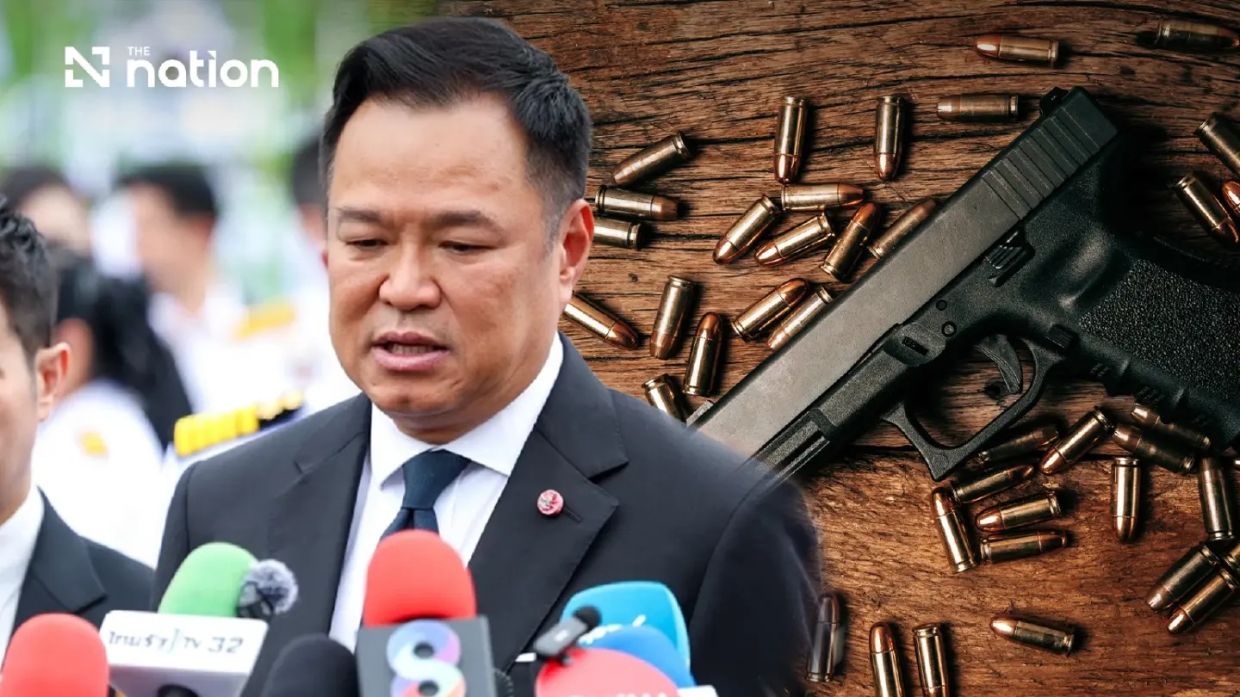
Prime Minister Anutin Charnvirakul has signalled his administration's commitment to tightening Thailand's firearm regulations in the wake of a devastating mass shooting at Debsirin Nonthaburi School. Following a direct visit to the school premises and subsequent discussions with national police chief Pol Gen Kittharath Punpetch at Government House, the premier outlined a comprehensive legislative and enforcement agenda designed to curtail unauthorised gun ownership and prevent future incidents of armed violence in public spaces.
The immediate focus of Anutin's proposed measures centres on establishing robust checkpoint systems and intensified weapons inspections across Thailand. Under the proposed framework, any individual discovered carrying a firearm in a public location, within a vehicle, or in areas outside their residence without legitimate official authority would face serious criminal charges. This zero-tolerance approach represents a deliberate hardening of Thailand's stance on unauthorised firearms, moving beyond current enforcement patterns toward a more aggressive prosecutorial strategy that would apply substantial legal consequences to violations.
During his policy discussions with Deputy Prime Minister Pakorn Nilprapunt, Anutin made clear his opposition to a proposal circulating among some security advocates to arm teachers as a defensive measure. The premier's position reflects a principled stance that educators lack the training, legal standing, and operational mandate to serve as armed security personnel. By explicitly rejecting this notion, Anutin has staked out a position emphasising that responsibility for public safety rests exclusively with designated law enforcement and authorised security agencies rather than civilian institutions.
Among the broader reform initiatives under consideration is the possible reinstatement of a previous amnesty programme that would permit individuals to surrender illegal or unlicensed firearms to state authorities without facing prosecution. However, Anutin's characterisation of this initiative suggests significant conditions attached to any such programme. He has insisted that all illegal weapons must ultimately be seized and that no illegal firearm can be legitimised through administrative processes. Rather than serving as a genuine amnesty, the initiative appears framed as a pathway for voluntary compliance before enforcement intensifies.
The prime minister emphasised that individuals possessing unauthorised weapons face genuine legal jeopardy under his administration's approach. He stressed that the risks associated with gun ownership without proper authorisation far outweigh any perceived benefits, particularly for those contemplating such violations. Anutin's message to the public carries an unmistakable warning that enforcement will be consistent and consequences substantial, whether weapons are discovered through checkpoint inspections or located during police searches connected to other criminal investigations.
Anutin's guidance on the surrender process specifies that illegal firearms should be transferred to either the Department of Provincial Administration, relevant district offices, or police stations to ensure proper official documentation. This procedural requirement addresses a practical concern about preventing individuals from destroying evidence or concealing weapons. The creation of an official record serves multiple purposes: establishing clear chains of custody, preventing re-entry of surrendered weapons into circulation, and creating documentation that protects surrendering individuals should any ambiguity arise regarding their compliance status.
Concerning the broader question of bullying as a potential factor in the school shooting, Anutin adopted a cautious stance emphasising the necessity of allowing police investigators to complete their work before drawing conclusions. He expressed concern that premature speculation about bullying or other triggering factors could generate unfounded anxiety among the public and potentially hinder the investigative process. This measured approach reflects tensions between the government's desire to address root causes of violence and the importance of preventing sensationalised public discourse that might inspire copycat incidents.
The premier's long-term strategic vision extends beyond the scope of any single incident to encompass a comprehensive national effort to suppress unlawful firearms activity. Beyond the Department of Provincial Administration, police forces and other authorised enforcement agencies have received explicit policy directives and operational orders mandating thorough and systematic weapons inspections. This multi-agency approach recognises that effectively reducing gun violence requires sustained institutional commitment across multiple government departments rather than relying on isolated enforcement actions.
Home-based firearm storage has emerged as another critical component of Anutin's regulatory framework. Licensed gun owners must now ensure weapons kept within residences are properly registered, secured in locked storage inaccessible to children, and maintained in conditions preventing unauthorised access. The government's position assigns joint responsibility to both registered owners and individuals who actually employ weapons in criminal acts, creating multiple enforcement pathways and ensuring that negligent firearm stewardship becomes legally actionable. This approach acknowledges that even lawfully owned weapons can pose serious risks when improperly stored or supervised, particularly in households containing minors or other vulnerable populations.

