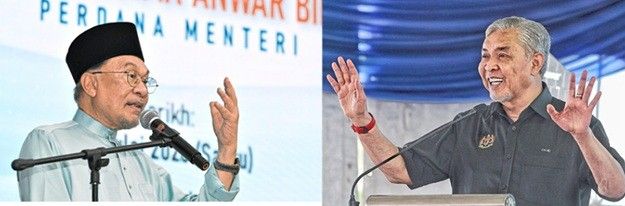
Malaysia's political theatre has taken an unexpectedly lyrical turn as senior coalition leaders exchange salvos couched in traditional pantun verses, a practice that reveals how deeply cultural symbolism runs through the nation's power struggles. The exchange between the PKR president and Umno president during the Negri Sembilan campaign illustrates a sophisticated political language that allows rival factions within the unity government to simultaneously compete at state level while signalling commitment to federal stability. This coded communication through poetry demonstrates how Malaysian political culture continues to value indirectness and cultural resonance over blunt confrontation, even when fundamental electoral interests collide.
The initial volley came from the PKR leadership, who posted a four-line verse on social media alongside photographs from a Cabinet meeting. The pantun's message carried dual meaning: on one level, it acknowledged that Pakatan and Barisan would inevitably contest the Negri Sembilan seats, yet on another it underscored the commitment to maintaining working relationships at the federal level where both parties govern together. This balancing act—competing fiercely while cooperating civilly—has become the defining characteristic of Malaysia's unity government arrangement, yet it creates constant tension that requires careful management through channels both formal and cultural. The very next day, the Umno president responded with his own pantun, employing imagery of mountains and storms to suggest that while the partnership roof could withstand electoral turbulence, the relationship itself faced mounting pressure. Such poetic rejoinders carry weight precisely because they signal intent without crossing lines that would trigger formal political crises.
In Malaysian political tradition, the pantun functions as far more than decorative verse. It serves as an instrument of strategic indirectness known locally as kiasan, allowing leaders to communicate sensitive messages through layers of metaphor and cultural allusion. The form's power lies in its simultaneous clarity and deniability: a well-crafted four-line stanza can deliver pointed political criticism, test coalition boundaries, or signal temporary truces without breaching the surface-level decorum that keeps rival factions from open warfare. This cultural mechanism has proven invaluable in Southeast Asia's most complex coalition arrangements, where formal partnerships between ideologically different parties require constant negotiation and occasional rebuke. The pantun transforms campaign trail friction into memorable cultural moments that resonate with Malay-language audiences while converting complicated coalition mathematics into accessible political messaging.
Datuk Seri Dr Ahmad Maslan of Umno has emerged as the undisputed master of political pantun composition, earning the informal title of Raja Pantun among observers and supporters. The Pontian MP and Deputy Minister of Works has weaponised the four-line form with remarkable consistency, deploying pantun verses during major campaign periods to both attack opponents and reinforce coalition messaging. During the March 2022 Johor state elections, Ahmad recycled and adapted a verse he had originally created during the November 2019 Tanjung Piai parliamentary by-election, demonstrating how successful pantun messaging can be refined and redeployed across electoral cycles. The original 2019 version explicitly named Pakatan Harapan as the target, but when Ahmad deployed the verse again in 2022, he strategically substituted the specific party name with the deliberately vague phrase parti itu, or "that party." This substitution allowed him to maintain plausible deniability while ensuring every supporter understood the intended target, a technique that became necessary as coalition alignments shifted following Pakatan's exit from federal government.
The Negri Sembilan state election presents a particularly complex coalition puzzle that pantun messaging has been employed to decode and navigate. The state's electoral mathematics involve four distinct political forces: Pakatan Harapan, which governs the state with strong support from DAP; Barisan Nasional, which competes at both state and federal level; Perikatan Nasional, which includes PAS and other components; and Bersatu, a party whose position defies easy categorisation. Bersatu's peculiar status—nominally part of Perikatan at the federal level while competing against Perikatan components in certain Negri Sembilan seats—creates what some analysts have dubbed an "opposition to the opposition" dynamic. In 24 of the state's contested seats, Bersatu is effectively campaigning against Barisan/Perikatan and Pakatan simultaneously, a positioning that could inadvertently advantage Pakatan by splitting the opposition vote in critical constituencies. This paradox has prompted speculation about whether sustained electoral pressure might eventually force Bersatu into strategic realignment with Pakatan, particularly given their historical partnership and shared interest in limiting Barisan's comeback.
Within Pakatan's coalition structure in Negri Sembilan, DAP commands dominant electoral position, a reality that carries both considerable advantages and significant strategic complications. The party secured eleven of Pakatan's seventeen seats in the 2023 state elections, with PKR winning five and Amanah capturing one, making DAP's organisational strength and voter mobilisation capacity essential to any Pakatan victory. However, DAP's commanding presence and aggressive rhetorical posture toward Umno and PAS risk unintended consequences: when the party's campaign messaging turns sharp and confrontational toward Malay-focused rivals, it can trigger backlash among fence-sitting Malay voters who may perceive DAP's stance as culturally insensitive or threatening to Malay-Muslim interests. This dynamic has prompted senior Pakatan figures to deploy pantun verses warning about the electoral costs of overly aggressive DAP campaigning, essentially using cultural poetry to signal to coalition partners that campaign intensity requires careful calibration.
The broader context for this coalition jostling involves fundamental questions about the sustainability and trajectory of Malaysia's unity government arrangement. The federal partnership between Pakatan and Barisan, brokered in 2023 to prevent political instability, remains fragile and contingent on both sides demonstrating restraint in competitive electoral situations. State elections like Negri Sembilan's provide opportunities for parties to test coalition boundaries, campaign aggressively, and signal to their respective bases that they remain serious electoral competitors despite federal cooperation. Yet such competitive activity constantly risks escalating into federal-level friction that could destabilise the unity government itself. Pantun messaging provides a cultural pressure valve, allowing leaders to communicate warnings, signal limits, and negotiate boundaries through symbolically rich language that feels culturally appropriate rather than politically confrontational.
The use of traditional verse forms in contemporary political communication also reflects deeper truths about Malaysian political culture and the continuing resonance of Malay-language literary traditions in shaping elite political behaviour. In a country where Malay remains the language of official state business and cultural identity, command of traditional poetic forms carries particular political weight and cultural authority. A leader who can compose effective pantun demonstrates cultural fluency and connection to Malay linguistic traditions, qualities that enhance political legitimacy particularly among Malay-dominant constituencies. This cultural dimension explains why senior politicians continue investing time in pantun composition despite the apparent availability of more direct communication channels: the exercise itself serves political purposes beyond mere message transmission, signalling cultural rootedness and respect for tradition.
Looking forward to the Negri Sembilan election results, the competitive dynamics between these four political forces remain genuinely uncertain, with pantun verses offering clues but not predictions about eventual outcomes. The poetry exchanges between senior figures suggest that federal unity government stability will likely survive whatever electoral outcome emerges, provided neither side interprets results as justification for fundamental partnership renegotiation. However, the intensity of coalition friction evident in recent pantun exchanges suggests that maintaining the unity government will require increasingly sophisticated political management, continued cultural communication through indirect channels, and willingness from all parties to accept electoral losses without escalating to federal-level confrontation. The pantun tradition, with its emphasis on subtlety and cultural resonance, appears well-suited to this demanding balancing act.

