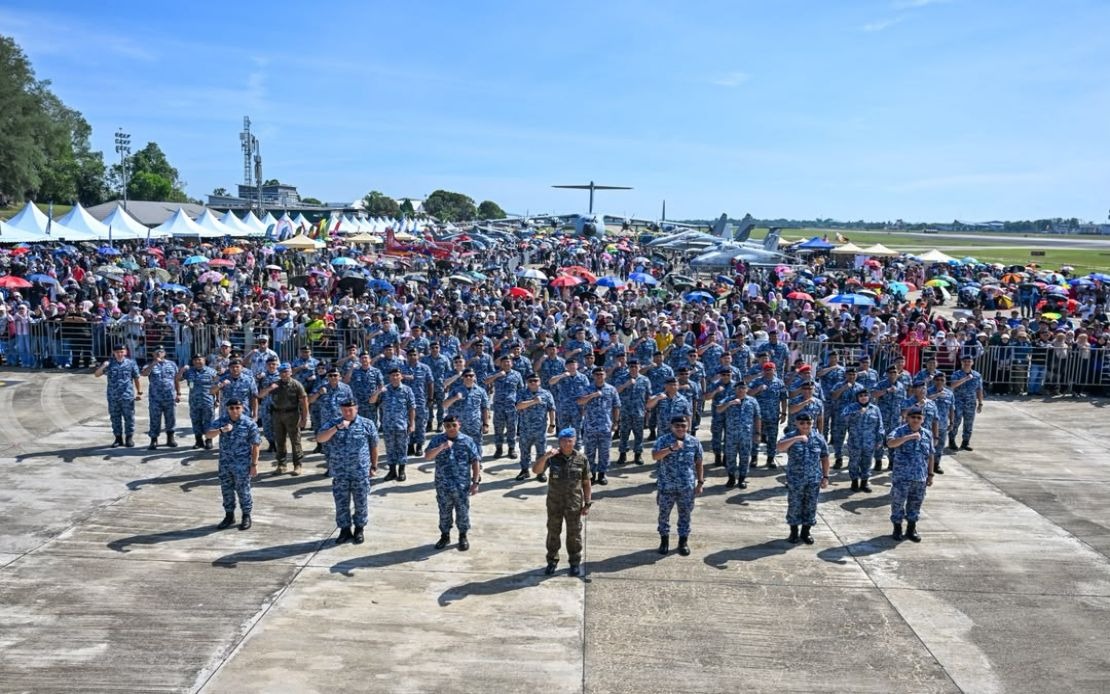
Despite intense heat, thousands converged on the Kuantan Air Base over the weekend to participate in the Royal Malaysian Air Force's 68th Anniversary Open Day 2026, a two-day public engagement initiative that offered unprecedented access to the nation's aerial defence capabilities. The gathering demonstrated sustained public interest in Malaysia's military operations and defence infrastructure, with visitors spanning multiple age groups and regions drawn by the promise of witnessing combat aircraft in flight and examining advanced weapons systems firsthand.
The RMAF mounted the celebration as a cost-conscious effort in line with broader government fiscal discipline, yet the scaled-back approach did not compromise the programme's appeal or scope. RMAF Chief General Tan Sri Muhamad Norazlan Aris acknowledged the budgetary constraints while emphasising that the event retained sufficient substance to showcase critical operational assets and facilitate meaningful dialogue between the armed forces and the public. This balancing act—maintaining public interest while controlling expenditure—reflects pressures faced by defence organisations across Southeast Asia as they seek to sustain recruitment pipelines and public support amid competing budgetary demands.
A central motivation for the open day extended beyond spectacle. Senior RMAF leadership sought to address informational gaps they perceive in public understanding of the service's role and capabilities. Muhamad Norazlan articulated frustration with social media as a conduit for defence information, contending that digital platforms fail to provide adequate depth or nuance. By enabling face-to-face interaction between RMAF personnel and civilians, the force aimed to foster more sophisticated public comprehension of operational doctrine, acquisition strategies, and the technological direction of Malaysia's air defence posture. This approach recognises that public confidence in defence institutions rests partly on informed constituencies capable of distinguishing genuine capability from speculation or misinformation.
The aerial demonstrations anchored the event's appeal. Visitors witnessed dynamic displays involving the Sukhoi Su-30MKM multirole fighter, the agile F/A-18D Hornet, strategic airlift platforms including the A400M and C-130H transport aircraft, and modern rotorcraft such as the EC725AP/H225M and AW139 helicopters. Beyond conventional flying displays, the programme featured helicopter insertion and extraction exercises alongside parachute demonstrations by the elite RMAF Special Forces (PASKAU), providing viewers with visceral insight into tactical operations that define contemporary military aviation. These practised manoeuvres underscored both the technical proficiency of RMAF personnel and the sophistication of equipment now integral to Malaysia's defence matrix.
On static display, attendees examined a comprehensive cross-section of RMAF assets including the agile Hawk trainer, the CN235 tactical transport, and ground-based air defence systems alongside logistics vehicles. The presence of fire engines and ground support equipment illuminated the multidimensional nature of air operations, conveying to civilian observers that military aviation extends far beyond pilots and combat jets. This holistic presentation served educational purposes while subtly reinforcing public understanding of the human and material commitments required to sustain air operations.
A particularly novel element—the RMAF Runway Run 2026—capitalised on public fascination with restricted military spaces. The event permitted approximately 3,000 registered participants, with organizers welcoming additional walk-up attendees, to traverse the Kuantan Air Base runway on foot. This unprecedented access transformed a functional military facility into a publicly accessible venue, a calculated move that deepens emotional engagement while generating social media content that amplifies the event's reach beyond physical attendees. The runway experience represented a rare inversion of normal security protocols, permitting civilians momentary entry into spaces ordinarily restricted to authorised personnel and aircraft operations.
Visitor testimonies reflected the event's resonance across demographic divides. A 24-year-old from Arau, Perlis, attending for the first time, described the experience as transformative, particularly meaningful because he accompanied his 67-year-old mother, who navigates with a wheelchair. His account highlights how public military events function as family occasions rather than exclusively educational forums, their value extending into social and bonding dimensions that strengthen community connection to defence institutions. The deliberate inclusion of visitors with mobility challenges suggests organisational attention to accessibility, though broader questions persist regarding how military institutions ensure equitable engagement across Malaysia's diverse population.
The programme incorporated cultural and entertainment elements designed to sustain visitor engagement throughout both days. The RMAF Central Band, drumline performances, and the Air Force Arts Group provided musical interludes, while weapons exhibitions and aircraft simulators offered interactive learning opportunities. Career exhibitions served recruitment purposes, targeting younger visitors and their parents with information about air force service options. This diversified programming reflected understanding that public engagement requires more than technical specification recitations; successful military outreach integrates spectacle, education, and entertainment into cohesive experiences.
From a regional perspective, Malaysia's approach to public military engagement warrants comparison with practices in allied nations. While most Southeast Asian militaries conduct occasional open house events, the RMAF's integration of special forces demonstrations, runway access, and direct personnel interaction suggests evolving sophistication in strategic communication. As regional military capabilities advance and defence budgets consume increasing government resources, public understanding and tacit support become critical political assets. Nations that effectively communicate defence posture to civilian populations build constituencies better equipped to support necessary expenditure and policy decisions.
The Kuantan event also reflects Malaysia's positioning within broader regional security architectures. By showcasing advanced platforms including the Su-30MKM—sourced from Russia—and American F/A-18 Hornets alongside European transport aircraft, the RMAF implicitly communicates its non-aligned acquisition philosophy and operational interoperability across multiple security partnerships. This technological pluralism characterises Malaysian defence modernisation and distinguishes it from more singular strategic alignments observable in some regional competitors. Public familiarity with this diversified approach inoculates against narrower geopolitical narratives that might oversimplify Malaysia's defence posture.
Looking forward, the success of the Kuantan open day will likely encourage similar initiatives at other military installations across Malaysia. As defence organisations contend with tightened budgets, personnel recruitment challenges, and public scepticism regarding military expenditure, direct engagement opportunities offer cost-effective mechanisms for building institutional legitimacy and fostering informed constituencies. However, organisers must remain attentive to balancing transparency with operational security, ensuring that public access does not compromise intelligence or operational capability assessments by foreign observers who may attend such events.
The event ultimately underscores how modern militaries operate within democratic societies where civilian support underpins institutional viability. By creating structured opportunities for public interaction with defence assets and personnel, the RMAF acknowledges that legitimacy derives not exclusively from capability but from public confidence grounded in transparency and accessible information. As Malaysia navigates increasingly complex regional security dynamics, such investments in civil-military communication may prove as strategically significant as the platforms displayed on the Kuantan runway.

