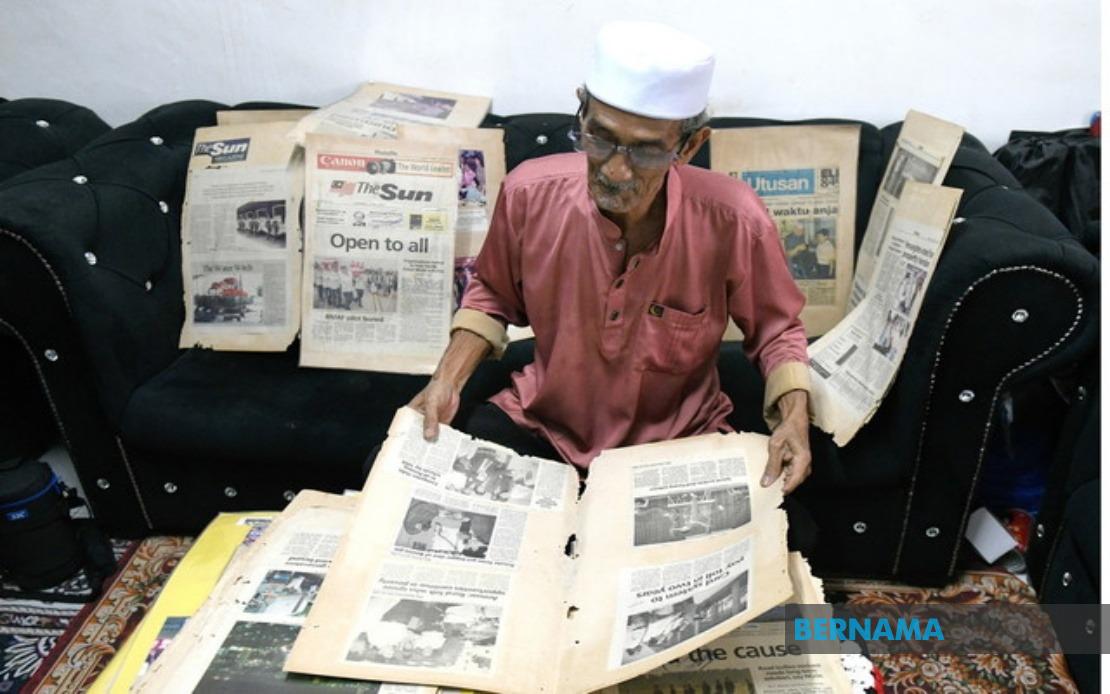
Azmi Sapiei's three-decade career in Malaysian journalism bears the unmistakable marks of a profession that demands more than technical skill. The 64-year-old veteran photographer and cameraman carries vivid memories of being physically assaulted while covering a court case around 2001, including being kicked and spat upon by a suspect. These moments, painful as they were, underscore a reality often overlooked in discussions about Malaysian media: the men and women behind cameras regularly place themselves in harm's way to document stories of public interest, facing not just professional challenges but genuine personal danger.
Azmi's journey through Malaysia's evolving media landscape began in earnest when he joined Bernama in 1993 after working independently in photography and magazine journalism. His nearly three years at the national news agency proved formative, establishing the discipline and standards that would define his approach to visual journalism. During this period, he gained access to significant historical moments, most notably securing exclusive photographs of Shamsiah Fakeh's return from China in July 1994. The former Malayan Communist Party member's arrival at her nephew's residence in Gombak represented a newsworthy moment with deep historical resonance, and Azmi's early arrival before police cordoned off the area allowed him and his journalist colleague to capture images that would run across major Malaysian newspapers the following day.
The anecdote Azmi recounts about that Shamsiah Fakeh assignment reveals much about the temperament required in journalism and the sometimes-harsh feedback mechanisms of newsrooms. When he returned to the office with three rolls of film from his shoot, his editor's dismissive response—questioning why only three rolls were used—proved initially demoralizing. The rolls were discarded into a bin, leaving Azmi feeling embarrassed and frustrated. Yet when the developed photographs were processed and distributed, major publications ran his images prominently. The experience encapsulated a valuable lesson: volume of effort does not guarantee quality output, and editorial judgment, while occasionally appearing arbitrary, ultimately shapes what the public sees.
After leaving Bernama at the end of 1996, Azmi returned to Penang and continued his career at The Sun newspaper, where the assault incident occurred. He subsequently worked with Bernama TV and took on part-time duties as a cameraman for RTM Penang beginning in 2003, eventually retiring in mid-2020. This progression through multiple organizations reflects the reality of Malaysian media careers: few practitioners remain with a single employer throughout their working lives, instead moving between government agencies, private publications, and broadcast outlets as opportunities arise.
The technological evolution from analogue to digital journalism fundamentally altered the profession Azmi practiced. During the film camera era of his early career, photographers faced severe constraints unknown to their modern counterparts. Every frame consumed expensive film stock, and images remained invisible until processing and development, creating a disconnect between shooting and verification that demanded intuitive judgment. Captions had to be handwritten or typed and reviewed by editors before distribution to Bernama customers, introducing additional layers of delay and human intervention. This mechanical process, while cumbersome by contemporary standards, cultivated what Azmi describes as a mature professionalism born from resource scarcity and permanent consequences.
The transition from still photography to television camera work introduced new physical demands that went beyond technical skill. When Azmi began working with Betacam equipment for Bernama TV, he encountered machines that staff members colloquially termed "junk iron"—devices weighing approximately 12 kilogrammes that operators had to shoulder during assignments. Sustaining such loads across hours of coverage in Malaysian heat and humidity, navigating crowded or hazardous locations while maintaining visual stability and technical precision, represented a form of endurance labor largely invisible to viewers. The profession required not only artistic and technical competence but genuine physical conditioning.
Azmi's recognition with the 2006 Penang State Media Award in the visual electronic media category acknowledges contributions that extended beyond individual assignments. Throughout his career, he absorbed and modeled the professional standards instilled by Bernama, the agency he credits as a "school" that produced quality photographers while instilling discipline focused on accuracy and news value. His understanding of journalism transcended mere image capture; it encompassed understanding how photographs functioned as storytelling devices within broader narratives, how visual angles conveyed meaning, and how the act of being present at significant moments carried civic weight.
The continuation of Azmi's professional legacy through his second son, Muhammad Syafiq, 30, now working with Media Prima Television Network, reflects patterns of occupational transmission common in skilled professions. Syafiq's interest in cameras emerged organically from childhood observation of his father bringing equipment home and subsequently accompanying him to assignment locations. After completing his Sijil Pelajaran Malaysia in 2016, Syafiq began operating cameras a year later, gradually developing the competencies his father had accumulated over decades. This apprenticeship model, occurring within family structures, allowed for transmission of not merely technical skills but professional values and work discipline.
Syafiq's characterization of his father as simultaneously mentor and teacher acknowledges the deeper educational role that experienced practitioners play within media organizations and family units. The knowledge transfer extended beyond camera operation to encompass filming techniques, selection of visual angles, and the psychological resilience required to maintain professional standards under challenging field conditions. These dimensions of professional competence—aesthetic judgment, physical discipline, and emotional composure—prove difficult to teach through formal instruction alone and rely instead on apprenticeship relationships where novices observe and gradually assume responsibilities alongside experienced practitioners.
The broader implications of Azmi's career arc deserve consideration within Malaysia's media ecosystem. His trajectory spans a period of significant transformation in how news organizations operate, how technology reshapes professional practice, and how individual journalists navigate institutional and occupational pressures. The assault he experienced while covering court proceedings illustrates a persistent vulnerability in Malaysian journalism, where access to newsworthy events occasionally places reporters and photographers in proximity to individuals experiencing high emotional distress or legal jeopardy. That such incidents remain largely undiscussed in public discourse suggests a profession that has internalized danger as occupational cost rather than systemic problem requiring policy attention.
The evolution from analogue to digital workflows that characterized Azmi's career continues accelerating, reshaping skill requirements and career trajectories for practitioners entering the field today. While digital technology has democratized access to cameras and editing tools, it has simultaneously intensified competitive pressures and accelerated news cycles. The contemplative professionalism that Azmi describes—where photographers considered composition, anticipated significant moments, and understood their images within editorial narratives—coexists with contemporary demands for immediate content production and social media distribution. The challenge facing Malaysian media institutions involves preserving the standards and disciplined judgment that Azmi exemplifies while adapting to technological and market realities that earlier generations never faced.
Azmi's decision to retire in mid-2020, as the COVID-19 pandemic began reshaping global media operations, marked the conclusion of a career spanning dramatic transformations in technology, organizational structures, and news consumption patterns. His legacy extends beyond individual photographs or broadcast footage to encompass a model of professional journalism grounded in accuracy, discipline, and commitment to capturing moments of public significance despite personal risk and professional uncertainty. That his son continues in the field suggests an ongoing transmission of values and skills, even as the specific conditions of contemporary journalism differ substantially from those that shaped Azmi's formative years at Bernama and beyond.

