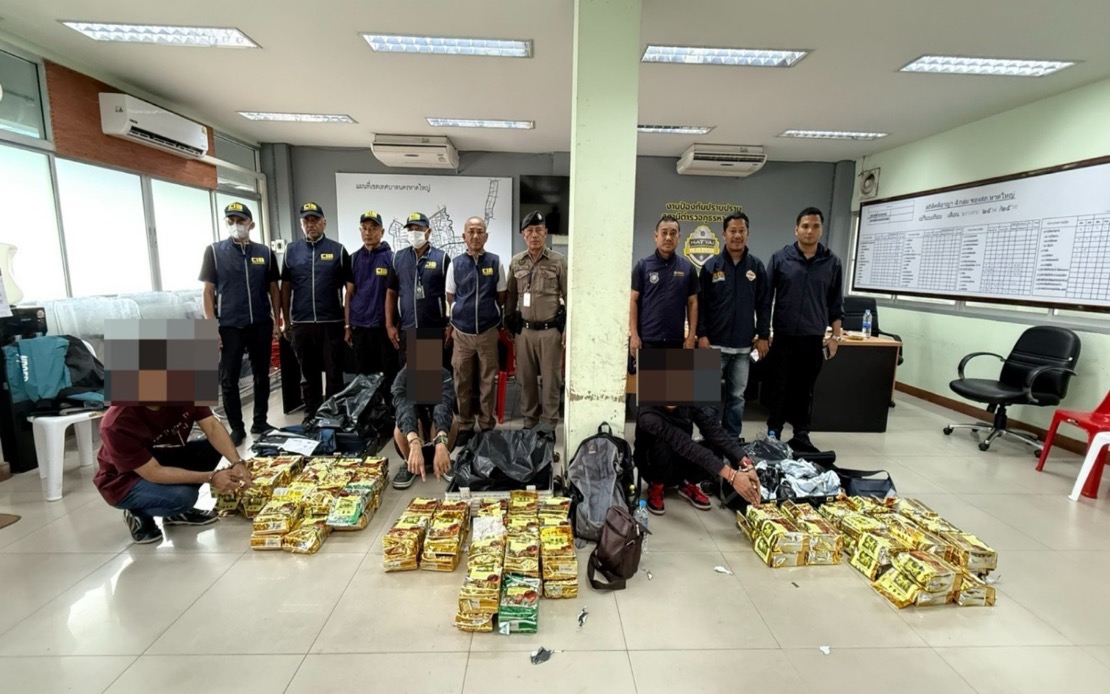
Three Malaysian men face serious drug trafficking charges after being intercepted at Hat Yai Railway Station in Thailand's Songkhla province on July 31 while attempting to smuggle 87 kilograms of crystal methamphetamine into Malaysia. The arrest represents a significant strike against organised drug networks operating along one of Southeast Asia's busiest smuggling corridors, where cross-border trafficking between Thailand and Malaysia remains a persistent law enforcement challenge.
The narcotics were discovered concealed within three wheeled suitcases and three backpacks when the suspects arrived at the station aboard a Bangkok-bound train. The interception was the result of coordinated intelligence and enforcement, with the Tawan Hat Yai unit working alongside multiple Thai agencies including railway police, the Crime Suppression Division, the Anti-Trafficking in Persons Division, tourist police, and the Narcotics Suppression Bureau, as well as Region 9 of the Narcotics Control Board.
According to Ratchapon Palakul, director of the ONCB Region 9 Office, preliminary questioning revealed the financial incentive behind the operation. One of the detainees confessed that a criminal syndicate had offered each member RM8,000 to transport the illicit cargo across the international border. This relatively modest individual payment—typical of how smuggling networks insulate themselves by using disposable couriers—underscores how vulnerable individuals are recruited into trafficking operations through economic inducement.
The three men have been formally charged with joint offences relating to possession and trafficking of Category 1 narcotics with intent to distribute. Under Thai law, these charges carry substantial penalties: imprisonment of up to 15 years combined with fines reaching approximately 1.5 million baht, equivalent to roughly RM183,000. The severity of potential sentences reflects Thailand's classification of crystal methamphetamine as a most-restricted controlled substance, recognition of the damage methamphetamine causes to communities across the region.
Crystal methamphetamine, locally known as syabu or "ice," has become increasingly prevalent in Malaysia and throughout Southeast Asia over the past decade. The 87-kilogram haul represents a substantial quantity by trafficking standards, suggesting this operation targeted significant supply chains rather than representing small-scale personal trafficking. The scale indicates the sophistication of organised networks that source precursor chemicals from pharmaceutical or industrial suppliers, manufacture finished product in clandestine laboratories primarily concentrated in Myanmar and Thailand's border regions, then distribute through established smuggling routes into Malaysia and beyond.
Thailand's Hat Yai district, located in Songkhla province near the Malaysian border, has become a critical chokepoint for transnational trafficking operations. The railway station serves as a major transport hub connecting Bangkok with southern Thailand and Malaysia, making it an obvious point where authorities concentrate surveillance efforts. Hat Yai's position as a gateway between the two nations makes it simultaneously attractive to smugglers—numerous passengers board and disembark daily—and to enforcement agencies attempting to intercept contraband before it reaches Malaysian markets.
The involvement of multiple Thai law enforcement bodies in this operation highlights the increasing cooperation between agencies in combating narcotics trafficking, though the scale and persistence of the problem suggests demand within Malaysia remains substantial. The drugs destined for Malaysian distribution networks would ultimately feed consumption patterns that have prompted escalating domestic enforcement efforts, including mandatory minimum sentences and enhanced penalties for trafficking offences implemented under Malaysia's own drug laws.
Investigations are ongoing to identify higher-level members of the trafficking syndicate and determine whether these three individuals were part of a larger operation. Thai and Malaysian authorities typically collaborate in such investigations through mutual legal assistance channels, seeking to understand distribution networks, financial flows, and the identity of organisers who recruited these couriers. The willingness of individuals to accept relatively modest financial compensation for extremely high-risk smuggling missions suggests either desperation or the effective coercion mechanisms deployed by organised crime groups.
The arrest underscores the continuing challenge posed by methamphetamine trafficking across Southeast Asia. Despite intensified efforts by law enforcement in multiple countries, production capacity in Myanmar and Thailand remains substantial, and demand from Malaysian consumers continues driving trafficking activity. The geographic proximity of Malaysia to major production areas, combined with extensive land borders and busy maritime trade routes, creates multiple vulnerabilities that criminal networks exploit systematically.
For Malaysian authorities, this case reinforces the necessity of maintaining close coordination with Thai counterparts and sustaining intelligence-sharing arrangements that enable early interception of major shipments. The RM183,000 fine equivalent and potential 15-year sentences handed down by Thai courts serve as significant deterrents, yet the continued recruitment of couriers suggests these penalties, while severe, have not yet sufficiently disrupted the economics of trafficking operations. Future interdiction efforts will likely require both enhanced border security and sustained pressure against the upstream production and distribution networks that supply these transnational smuggling operations.

