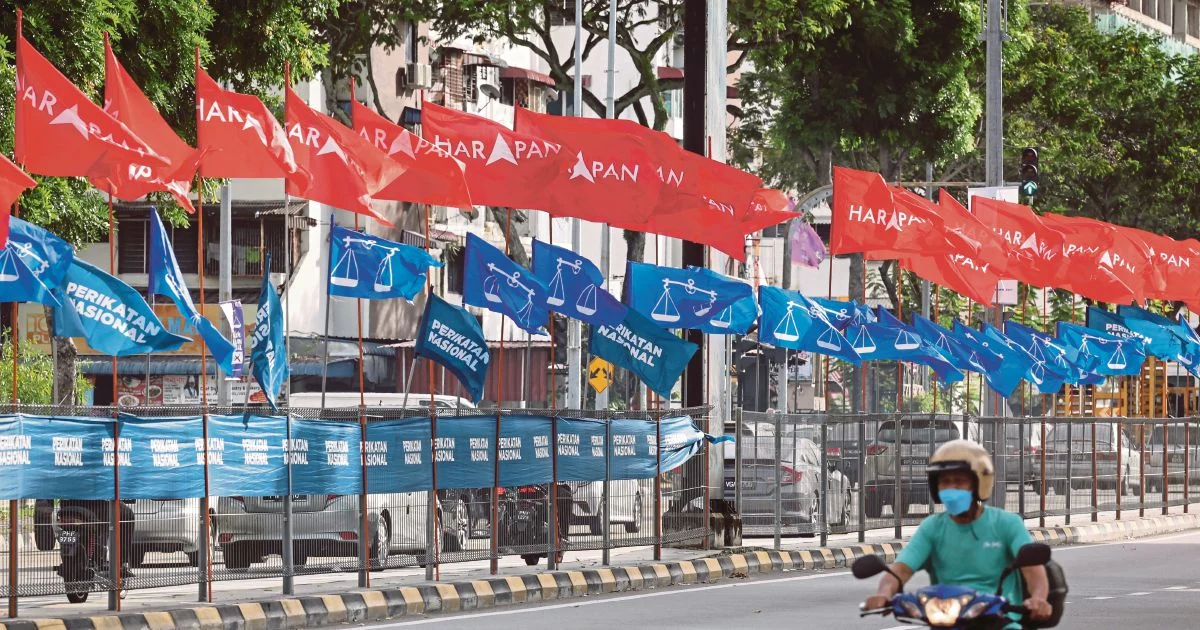
The Johor state election next month will feature unprecedented multi-cornered contests, with Barisan Nasional, Pakatan Harapan and Perikatan Nasional all fielding candidates in 33 of the 56 available state seats. This concentration of three-way battles across nearly 59 per cent of constituencies reveals a fundamentally altered electoral landscape in Malaysia's southern industrial heartland, where traditional two-party matchups have given way to a more fragmented political arena.
The prevalence of three-cornered contests reflects the broader realignment of Malaysian politics since 2020, when the collapse of the PH federal government opened space for PN to emerge as a significant force. In Johor specifically, the stakes are considerably higher than in previous elections, as control of the state assembly directly determines which coalition governs the oil-rich, manufacturing-dependent economy that accounts for a substantial portion of national export revenues. The state's political orientation has traditionally swung between BN and the opposition, but the injection of a competitive third force fundamentally changes the calculus for voters and strategists alike.
For Barisan Nasional, which has governed Johor continuously since independence except for a brief interregnum, the three-way dynamic presents both opportunity and peril. The coalition benefits from established administrative machinery, patronage networks dating back decades, and deep roots in rural constituencies across the state. However, the splitting of the anti-government vote between PH and PN in 33 seats could work against BN if voters consolidate behind a single opposition force. The proximity of contests, where the winning margin often depends on third-place finishes, means that victory probabilities shift dramatically with small shifts in voter preference or turnout patterns.
Pakatan Harapan's positioning in this election reflects its continuing struggle to regain momentum after the 2020 collapse. The coalition performed respectably in the 2022 federal election but has since faced internal tensions and defections that have weakened its organisational capacity. In Johor, where the party has maintained a foothold in urban and semi-urban areas, the three-way contests present a particular challenge. The coalition must simultaneously defend its existing vote share from both BN and PN while persuading swing voters that it remains a viable alternative government.
Perikatan Nasional's participation in 33 three-way contests signals its determination to establish itself as more than a temporary political experiment. The coalition's support base, which includes core Islamic voters and rural constituencies receptive to its messaging, could prove decisive in tightly contested seats. However, PN faces the persistent challenge of being perceived as a breakaway force with limited administrative experience at state level, a vulnerability that both BN and PH will likely exploit during the campaign.
The concentration of three-way battles in a single election creates unusual campaign dynamics. Candidates must appeal to voters while simultaneously managing the mathematics of vote-splitting, where a strong performance in one constituency might inadvertently help a rival coalition in another. This complexity rewards well-organised campaigns with sophisticated voter targeting and messaging that can reach specific demographic groups rather than relying on broad-brush appeals.
Geographically, the distribution of three-way contests across Johor's constituencies will largely determine which areas are genuinely competitive. Urban and suburban districts, where socioeconomic diversity creates volatile voting patterns, typically feature more closely contested races. Rural constituencies with established BN support and strongholds in certain regions may see clearer dominance, despite fielding candidates from all three coalitions. The state's industrial zones and port areas, home to large numbers of swing voters with pragmatic orientations towards governance, will prove particularly significant.
For Malaysian politics more broadly, the Johor election serves as a crucial test of whether the three-coalition configuration that has emerged since 2020 represents a stable new equilibrium or a temporary phase. A decisive outcome by any coalition would suggest consolidation, while fragmented results would indicate that Malaysian electoral politics remains in flux. The election's outcome will provide data points about voter preferences in one of Malaysia's most economically important states and could influence the timing and framing of future federal elections.
The three-way contest dynamic also reflects demographic and ideological shifts within the Malaysian electorate. Younger voters, particularly in urban areas, have shown willingness to consider multiple political alternatives rather than adhering to traditional BN-opposition binary. This generational shift, combined with persistent concerns about corruption, governance effectiveness and economic management, creates space for PN to operate as a credible third option, at least in the short term.
Campaign strategies will necessarily differ from previous Johor elections, with coalitions forced to allocate resources differently and craft messaging that differentiates their platforms not just from traditional opponents but from emerging competitors. The prevalence of three-way battles means that tactical voting becomes more salient—voters must weigh not only which coalition they prefer but also the likely outcome in their specific constituency and how their vote contributes to that outcome. This additional layer of complexity typically benefits better-organised campaigns with superior ground-level intelligence about local voter preferences and behaviour patterns.
The election will ultimately test whether the Malaysian electorate's appetite for political choice translates into sustained support for multiple competing coalitions or whether voters eventually gravitate back toward simpler, binary decision-making. The 33 three-way contests in Johor will provide the clearest picture yet of how Malaysian voters navigate this more complex political environment.

