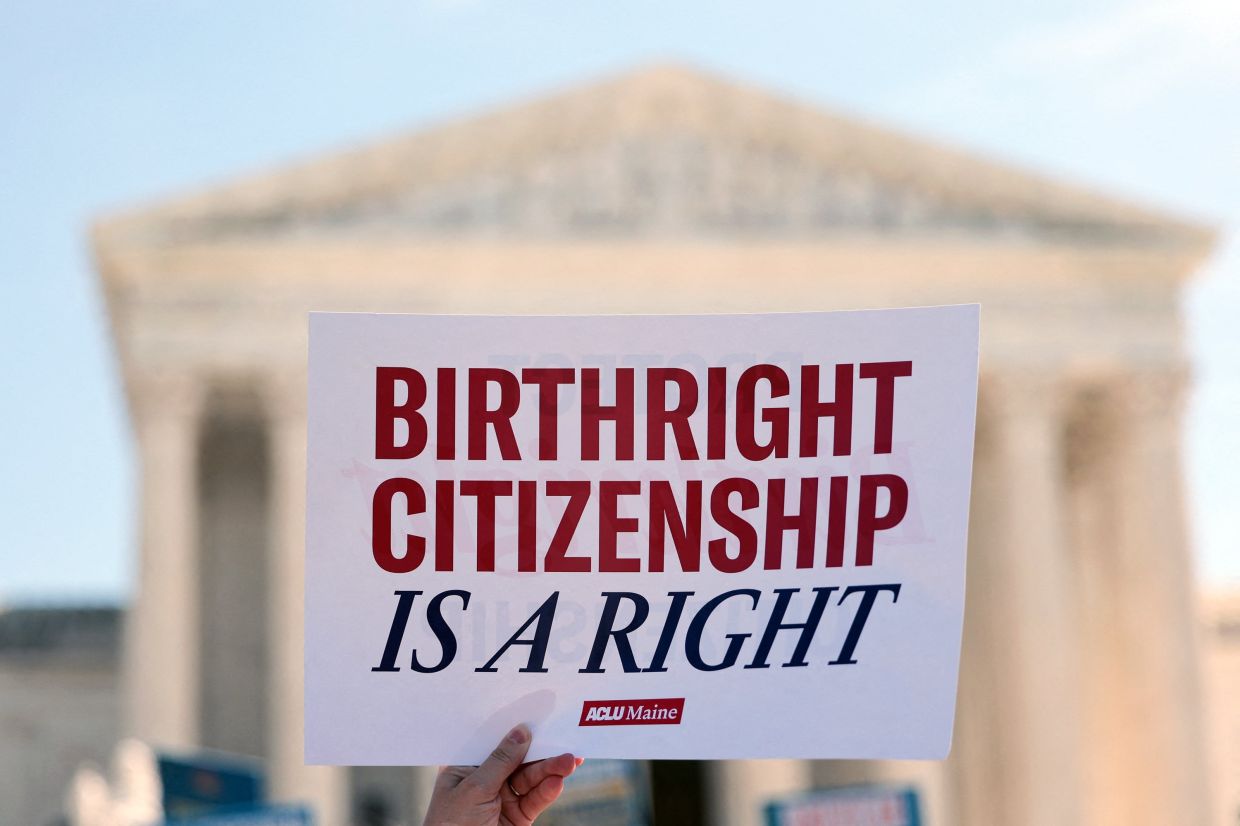
President Donald Trump has abandoned his constitutional challenge to birthright citizenship and pivoted sharply toward prosecuting so-called birth tourism schemes, with China positioned as the primary villain in a revamped policy narrative. The about-face came after the US Supreme Court blocked his executive order stripping citizenship from children born to undocumented parents or those on temporary visas. Within days of that setback, Trump celebrated the ruling's failure with a sarcastic post congratulating China on its birthright citizenship policies, signalling a strategic reorientation toward enforcement and legislation rather than constitutional reform.
The administration's new approach moved quickly from rhetoric to action. The Department of Justice issued directives to federal prosecutors to prioritise investigations into birth tourism networks, while House Speaker Mike Johnson announced that lawmakers were drafting legislation specifically targeting women who travel to the United States to give birth. These parallel moves in the executive and legislative branches suggest a coordinated effort to achieve through enforcement and new laws what the courts rejected on constitutional grounds. The strategy reflects a recognition that restricting birthright citizenship directly would require amending the Constitution, an unrealistic political goal.
China occupies an outsized role in this emerging policy framework, despite the scarcity of empirical evidence supporting the scale of the alleged problem. Trump has explicitly linked the citizenship issue to what he characterises as a Chinese scheme to exploit American law, claiming in March that birthright citizenship is being abused by wealthy foreigners, particularly Chinese nationals, who allegedly pay to have children born as US citizens. The framing positions China not merely as a source of problematic immigration behaviour but as a malicious actor deliberately weaponising America's legal system. This rhetorical escalation transforms what might be presented as a neutral immigration enforcement issue into part of the broader US-China strategic competition.
Congressional Republicans have amplified this framing with considerable intensity. Republican congressman Chip Roy characterised birth tourism by Chinese nationals as a national security threat, arguing that Chinese Communist Party efforts to gain influence through citizenship pathways jeopardise American sovereignty. This language deliberately conflates immigration enforcement with foreign adversarial behaviour, suggesting that pregnant women seeking medical care represent an existential risk to the nation. Such rhetoric has motivated calls for expanded enforcement and legislative action, even as the factual basis for such alarmism remains contested.
Yet the actual scale of birth tourism remains poorly documented and appears substantially smaller than administration claims suggest. The National Centre for Health Statistics recorded just 27,476 births to Chinese-born mothers in 2023, representing approximately 3.2 per cent of the 852,470 births to foreign-born mothers and less than one per cent of all US births. More significantly, only 113 of those births involved non-US resident mothers from China, suggesting that Chinese birth tourism cases constitute an infinitesimal fraction of total births. These figures have actually declined from 2018, when 267 births involved Chinese non-residents, indicating the phenomenon has become less prevalent over time rather than accelerating.
Specific claims about the magnitude of the problem have proven wildly exaggerated. Peter Schweizer, president of the Government Accountability Institute, claimed during a congressional hearing that approximately one million US citizens are being raised in China as products of birth tourism schemes. Legal scholars have dismissed this assertion as fundamentally implausible and disconnected from available evidence. Peter Spiro, a prominent legal scholar, characterised such figures as extraordinarily inflated, noting that while birth tourism may have increased modestly over recent decades, calling it a widespread phenomenon vastly overstates its documented prevalence.
The data challenges extend to claimed hotspots for birth tourism. The Northern Mariana Islands, frequently cited as a birth tourism epicentre, saw only two births involving foreign-resident mothers out of 581 total births in 2023. In 2018, the territory recorded 697 births to foreign residents out of 1,262 total births, a substantially higher number that suggests the phenomenon has contracted rather than expanded. These statistics do not capture mothers who may have misrepresented their residency status, an important limitation, yet even accounting for underreporting would leave the scale of the problem far below what administration rhetoric suggests.
Legally, birth tourism itself does not constitute a crime in the United States. Travelling while pregnant and delivering in American hospitals remains entirely lawful if the traveller possesses valid documentation and honestly discloses the purpose of their visit. Federal prosecutions styled as birth tourism cases have instead relied on charging visa fraud, conspiracy, money laundering, or similar offences, typically alleging that women concealed their pregnancy or true travel intentions from immigration authorities. The Justice Department characterises organised schemes involving facilitators and paid coordination as fraudulent exploitation of the immigration system, a framing that transforms what might be individual choices into orchestrated criminal enterprises.
The Justice Department's rationale centres on the claim that individuals and businesses involved in birth tourism schemes deliberately deceive immigration authorities and abuse visa programmes. Assistant Attorney General Colin McDonald has argued that thousands of foreigners enter the country under false pretences specifically to secure citizenship advantages for their children. A 2024 case and a 2020 prosecution involving fugitive Chao Chen, who allegedly operated a birth tourism business claiming over 500 clients, have been cited as evidence of systematic abuse. Chen's 37-month prison sentence signals serious federal commitment to prosecuting organised birth tourism schemes.
However, legitimate questions persist about distinguishing between prosecution of genuine fraud and harassment of pregnant travellers exercising lawful rights. Immigration lawyer Joseph Kwon has raised concerns about the assumptions underlying expanded enforcement, noting that pregnant women with valid visas should not face routine scrutiny premised on stereotypes about their intentions. When pregnant travellers must disprove presumptions of fraudulent intent as a matter of course, substantive harm occurs regardless of whether criminal charges are ultimately filed. This tension between enforcing immigration law and respecting the lawful rights of travellers remains unresolved.
While China dominates administration messaging, other nations have faced similar birth tourism accusations. Turkey, Russia, and Mexico have been associated with such schemes, yet receive far less rhetorical attention. The selective emphasis on China appears driven not primarily by empirical data about the relative prevalence of birth tourism by nationals of different countries but by the administration's broader China strategy. This reflects a pattern of using immigration issues as vehicles for advancing larger geopolitical narratives and policy priorities.
Trump has additionally claimed that the United States uniquely grants birthright citizenship, a factually incorrect statement that misrepresents international norms. Pew Research Centre analysis identifies 32 other countries with birthright citizenship laws substantially similar to American law, including Canada and Mexico. This widespread practice contradicts Trump's assertion that American policy represents an anomalous vulnerability, suggesting that the issue may be less about citizenship principles generally and more about which nationals the administration wishes to discourage.
The pivot away from constitutional challenge toward enforcement and legislation represents a pragmatic recognition of the political and legal obstacles to birthright citizenship restriction. However, the strategic deployment of China in this debate, combined with hyperbolic claims unsupported by evidence, suggests the primary purpose extends beyond addressing a narrowly defined immigration problem. Instead, birth tourism prosecutions may serve as a vehicle for advancing broader anti-China sentiment while demonstrating immigration enforcement credibility to a political base concerned about border security and national sovereignty.

