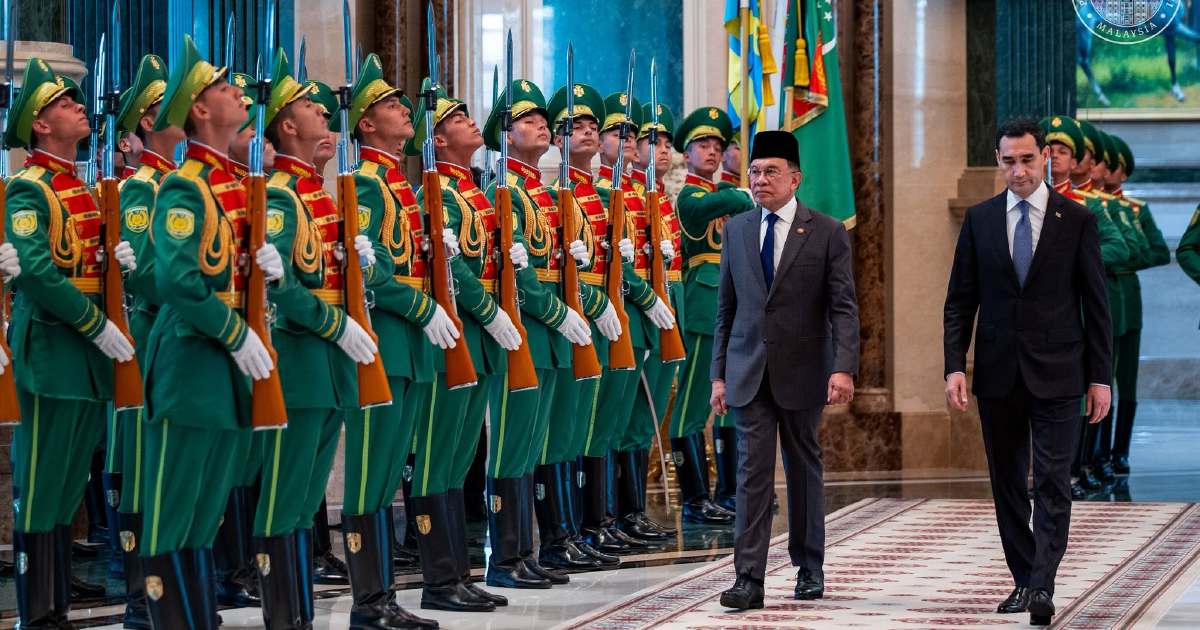
Prime Minister Datuk Seri Anwar Ibrahim has been granted a full official welcome ceremony at Turkmenistan's Presidential Palace in Ashgabat, underscoring the significance attached by the Central Asian nation to Malaysia's engagement with the region. The ceremonial reception marked the first state visit by the Malaysian leader since assuming the premiership, reflecting efforts to deepen diplomatic and economic relations between Kuala Lumpur and the oil-rich Turkmen state.
The timing of this maiden visit carries particular weight for Malaysia's regional diplomatic strategy. As an Islamic-majority nation with growing economic ambitions, Malaysia has increasingly sought to expand its footprint beyond Southeast Asia into Central Asia, where energy resources and emerging markets present substantial opportunities. Turkmenistan, which sits atop vast natural gas reserves and maintains a strategic position along ancient Silk Road corridors, has emerged as an attractive partner for diversifying Malaysia's international partnerships.
The Presidential Palace ceremony signals mutual interest in elevating bilateral relations from their current level. Official welcomes of this nature are carefully orchestrated diplomatic events that telegraph a government's commitment to strengthening ties and opening doors for substantive discussions on trade, investment, and cultural exchange. For Malaysia, engagement with Turkmenistan provides a pathway to better understand Central Asian dynamics and position itself as a bridge between Southeast Asia and the broader Eurasian economic sphere.
Malaysia's outreach to Central Asia has gained momentum in recent years as part of a broader recalibration of foreign policy priorities. Unlike some developed nations that have concentrated diplomatic efforts on established economic powers, Malaysia has recognised the potential of emerging regional hubs like Turkmenistan. The country's significant hydrocarbon wealth and its role as a transportation hub for regional trade make it a natural focus for Malaysian policymakers seeking to develop new economic corridors.
Turkmenistan's receptiveness to Anwar's visit reflects the nation's own interest in strengthening ties with Asia-Pacific nations. The Central Asian republic, which has maintained a policy of positive neutrality in international affairs, has gradually opened its doors to diplomatic engagement beyond its immediate neighbours. Malaysia, as a major Islamic economy with proven credentials in international diplomacy, represents an attractive partner for expanding Turkmenistan's Asian connections.
The visit provides an opportunity for substantive discussions on multiple fronts. Energy cooperation stands as a primary consideration, given Malaysia's persistent need for diversified fuel supplies and Turkmenistan's position as a significant global energy producer. Beyond commodities, there exists potential for collaboration in manufacturing, logistics, and financial services, sectors where Malaysian companies have demonstrated competitive advantage in international markets.
Cultural and people-to-people exchanges could also feature prominently in bilateral discussions. Both nations have Islamic heritage at their cores, though expressed through different historical and cultural contexts. Educational partnerships, tourism development, and academic collaboration represent areas where mutual benefits could be realised without significant friction or competition.
For Malaysian observers, this visit underscores the government's commitment to what has been termed a "look beyond" foreign policy orientation. Rather than remaining exclusively focused on regional dynamics, Malaysia's leadership has signalled willingness to engage with distant partners where strategic interests align. This approach acknowledges that contemporary economic and geopolitical realities demand flexibility and broader engagement horizons than previous eras required.
The formal ceremonial welcome also carries symbolic weight domestically within Malaysia. Demonstrating the nation's capacity to command respect and secure high-level diplomatic recognition abroad reinforces the government's international standing and contributes to narratives of renewed engagement with the global community. In an environment where Malaysia competes for investment, talent, and partnerships, such visible diplomatic successes serve important domestic political purposes.
Looking forward, this visit likely represents the beginning rather than the culmination of enhanced Malaysia-Turkmenistan relations. Official visits at the prime ministerial level typically precede more detailed technical discussions and potential agreements on trade, investment frameworks, or cooperation mechanisms. Subsequent visits by Turkmen officials to Malaysia would further institutionalise the relationship and establish regular channels for dialogue at senior levels.
The visit also carries subtle implications for how Malaysia positions itself within broader geopolitical narratives affecting Central Asia. By engaging with Turkmenistan, Malaysia demonstrates independence in foreign policy decision-making and refuses to be confined within regional blocs or spheres of influence that might limit its strategic autonomy. This approach has historically served Malaysian interests well, allowing the nation to maintain productive relationships across traditional geopolitical divides.
As Malaysia continues navigating complex regional and international environments, deepening engagement with Central Asian partners like Turkmenistan provides valuable diversification. The nation's economic resilience and diplomatic influence increasingly depend on the ability to build relationships across multiple regions and maintain presence in emerging growth areas. The Presidential Palace welcome ceremony, therefore, represents more than ceremonial courtesy—it signals Malaysia's serious intent to establish itself as a consequential player in Central Asian affairs and to explore economic opportunities that could benefit Malaysian enterprises and workers for years to come.

