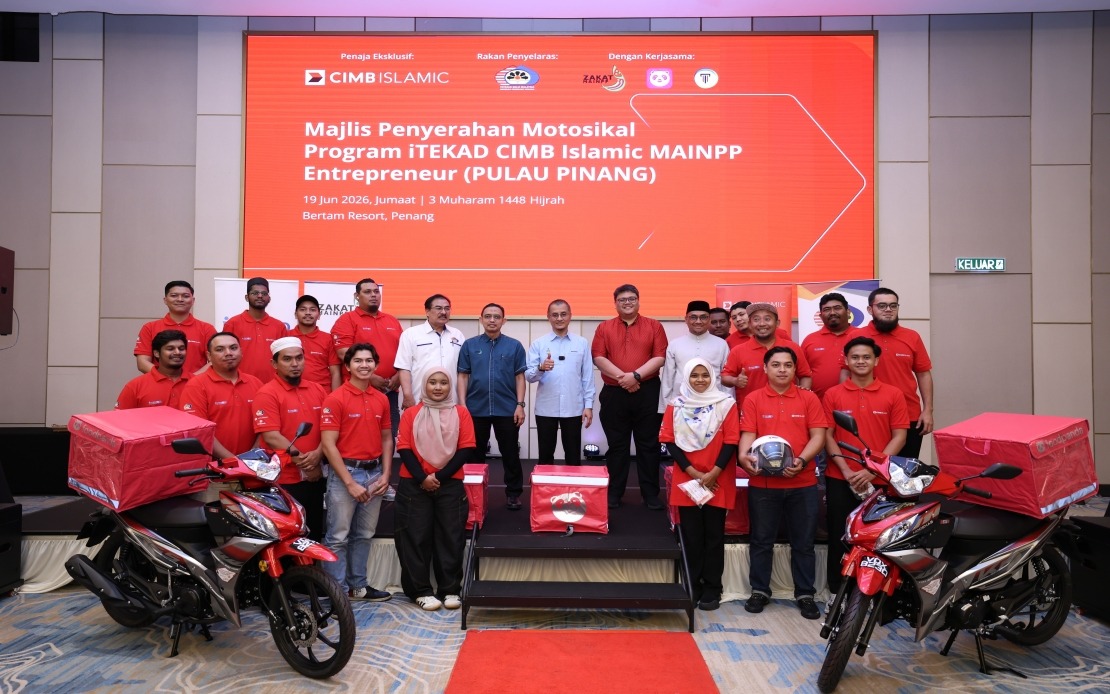
Twenty carefully selected entrepreneurs in Penang received motorcycles at a ceremony in Kepala Batas on Thursday, marking a significant milestone in efforts to uplift lower-income communities through structured economic opportunity. The motorcycles were distributed as part of the iTEKAD CIMB Islamic-MAINPP Entrepreneur programme, a joint initiative designed to provide productive assets alongside comprehensive business training to help participants establish sustainable income streams and escape poverty cycles.
The programme represents a coordinated effort among multiple institutional stakeholders, each bringing distinct capabilities to the table. CIMB Islamic Bank Berhad partnered with the Penang Islamic Religious Council, known locally as MAINPP, to operationalise the initiative through Zakat MAINPP, the council's charitable distribution arm. Additional implementation partners, including the Malaysian Youth Foundation, Taylor's Community, and food delivery platform foodpanda Malaysia, contribute specialised expertise in youth development, community engagement, and marketplace access respectively. This multi-party arrangement underscores a recognition that addressing asnaf welfare requires coordinated action across financial, religious, community, and private sector institutions rather than siloed interventions.
The initiative received financial backing through a RM400,000 seed fund structured as a matching grant mechanism. CIMB Islamic Bank contributed RM200,000 sourced from its Wakalah Zakat fund, while Bank Negara Malaysia, the country's central bank, allocated an additional RM200,000. This funding model demonstrates how zakat resources, when combined with monetary authority support, can be scaled into meaningful asset distribution programmes. The capital structure also reflects broader policy alignment within Malaysia's Islamic financial architecture and government commitment to poverty alleviation through religiously grounded economic development.
The selection process was notably rigorous, filtering a substantial applicant pool into a tightly curated final cohort. Zakat MAINPP received 151 applications from individuals seeking to participate, indicating strong community demand for such opportunities. Rather than employing simple selection criteria, administrators implemented a multi-stage evaluation framework that included structured interviews and a residential Entrepreneurship BootCamp conducted between May 31 and June 3. This four-day intensive programme, described as a camp component, allowed organisers to assess not merely application credentials but practical aptitude, resilience, and commitment to entrepreneurial pursuits. The rigorous filtering ensured that the twenty selected participants represented the strongest candidates likely to succeed.
Beyond the tangible asset of a motorcycle, the programme embeds comprehensive capacity building aimed at addressing underlying skills gaps within the asnaf demographic. Recipients obtained training in fundamental financial management, workplace discipline standards, and entrepreneurial mindset development. Rather than simply transferring assets and hoping for success, the programme architects recognised that sustainable income generation requires behavioural and cognitive shifts alongside material resources. The combination of delivery equipment provided through foodpanda Malaysia's involvement suggests that many participants intend to operate as delivery partners, leveraging the gig economy's accessibility while receiving structured onboarding support that typical gig workers might lack.
Penang Deputy Chief Minister I Datuk Dr Mohamad Abdul Hamid, who also serves as MAINPP president, positioned the programme as demonstrating the necessity of institutional synergy in asnaf development. His public remarks emphasised that meaningful uplift of lower-income communities cannot succeed when individual organisations operate in isolation, but instead demands coordinated commitment to shared objectives. This framing carries implications for how Malaysia's religious and state institutions conceptualise their developmental roles, particularly regarding whether traditional zakat distribution mechanisms should evolve toward more intensive, partnership-driven interventions rather than episodic cash transfers.
The timing and context of the programme connect to a broader state-level development framework. The initiative aligns with Penang's Islamic Religious Development Agenda 2030, often referred to as APAI2030, which articulates holistic ummah development spanning education, economic participation, family welfare, and youth engagement. By situating this entrepreneur programme within the APAI2030 framework, state leadership signals that asnaf economic empowerment represents a cornerstone of comprehensive Islamic social development rather than an isolated charitable gesture. This strategic positioning also suggests that future iterations of such programmes may expand beyond motorcycles toward other productive assets and sectors.
The programme's emphasis on breaking poverty cycles carries particular resonance for Malaysia's Islamic finance sector, which has increasingly positioned social impact alongside financial returns. For CIMB Islamic, programme participation offers an opportunity to demonstrate that Islamic banking principles encompassing community benefit extend into tangible livelihood creation. The bank's contribution through its Wakalah Zakat fund—an instrument structured around agency-based giving principles—reflects how contemporary Islamic financial products can mobilise resources for social welfare objectives while maintaining religious compliance.
From a broader Southeast Asian perspective, the Penang initiative exemplifies growing regional interest in structured microenterprise support combining asset provision with intensive business training. Similar models have gained traction across the region where traditional microfinance has been supplemented by programmes addressing the asset gaps that prevent informal workers from formalising income generation. The involvement of a logistics platform like foodpanda Malaysia also reflects how gig economy platforms increasingly partner with development programmes to create employment pathways, a trend observable across multiple Southeast Asian economies.
The motorcycle handover ceremony itself carried symbolic weight beyond the mere transfer of physical assets. By framing the moment as recognition of participants' latent potential and capacity for transformation, organisers sought to instil confidence and dignity alongside practical resources. This psychological dimension—treating recipients as capable entrepreneurs rather than charity cases—represents a subtle but significant shift in how development interventions position beneficiaries, one increasingly emphasised in contemporary poverty alleviation literature and practice.
Looking forward, the iTEKAD programme's outcomes will likely inform future expansion possibilities. With a relatively modest cohort of twenty, the initiative remains exploratory in scale. However, if participants demonstrate strong income generation and business sustainability, Penang authorities and financial partners may consider scaling the model, potentially extending it to other states or broadening asset categories beyond motorcycles. Success metrics will probably encompass not merely whether recipients generate income, but whether they maintain stable earnings streams, transition toward formal business registration, and potentially create employment for others within their communities.
The programme also raises broader questions about how Malaysia's zakat ecosystem should evolve. Historically, zakat distribution often emphasised direct cash transfers to qualifying recipients. Contemporary initiatives like iTEKAD suggest movement toward asset-based approaches that combine capital provision with capacity building and market linkages. This shift potentially improves poverty alleviation effectiveness by addressing multiple constraints simultaneously rather than income alone. However, it also demands greater institutional sophistication, partner coordination, and monitoring capacity than traditional distribution mechanisms.
Ultimately, the twenty entrepreneurs receiving motorcycles this week represent participants in an important experiment in collaborative development within Malaysia's Islamic social welfare framework. Their success or challenges will likely inform how institutions approach asnaf empowerment over the coming years, with implications extending across Penang and potentially beyond to other Malaysian states and the wider region.

